Ancient temples spanning millennia, a historic centre brimming with architectural treasures, culinary delights and enchanting beaches – Agrigento is a city not to be missed.
Home to some of ancient Greece’s finest temples in Italy and birthplace of Nobel Prize-winning author Luigi Pirandello, Agrigento is an unmissable stop on any Sicilian holiday.
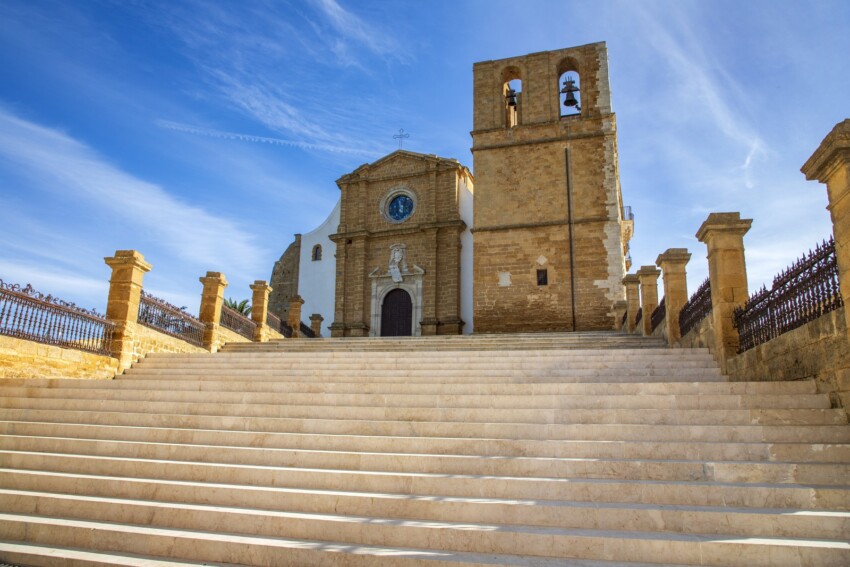
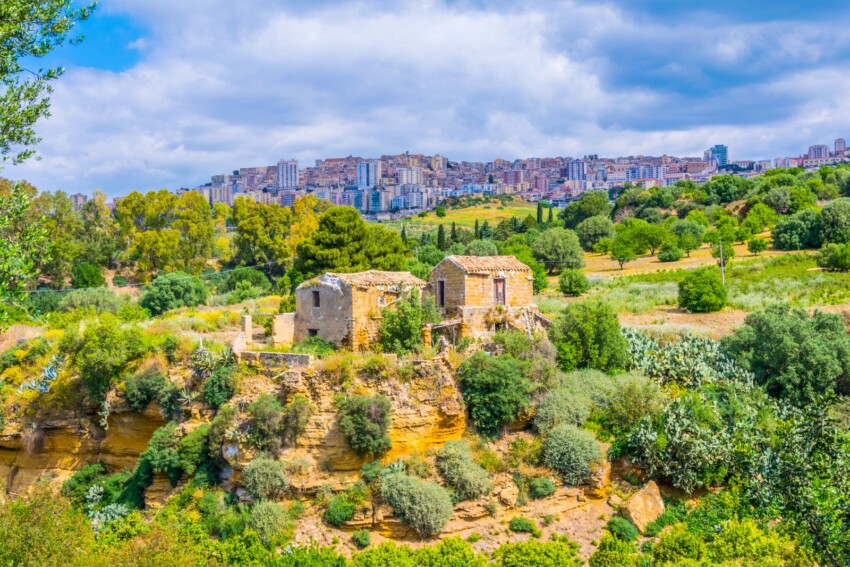
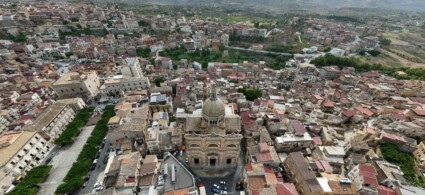
The historic centre is a maze of narrow alleys, courtyards, staircases and piazzas lined with grand palazzos, medieval churches, baroque cathedrals and other architectural treasures that bear witness to the blend of cultures that have shaped Sicily over the centuries.
A stroll through Agrigento’s historic centre is reason enough to visit. It’s not particularly large and easy to navigate on foot, despite the occasional steep staircase. You can rest your legs in a café and sample the exquisite pastries of traditional Sicilian confectionery, among the most indulgent in all of Italy.
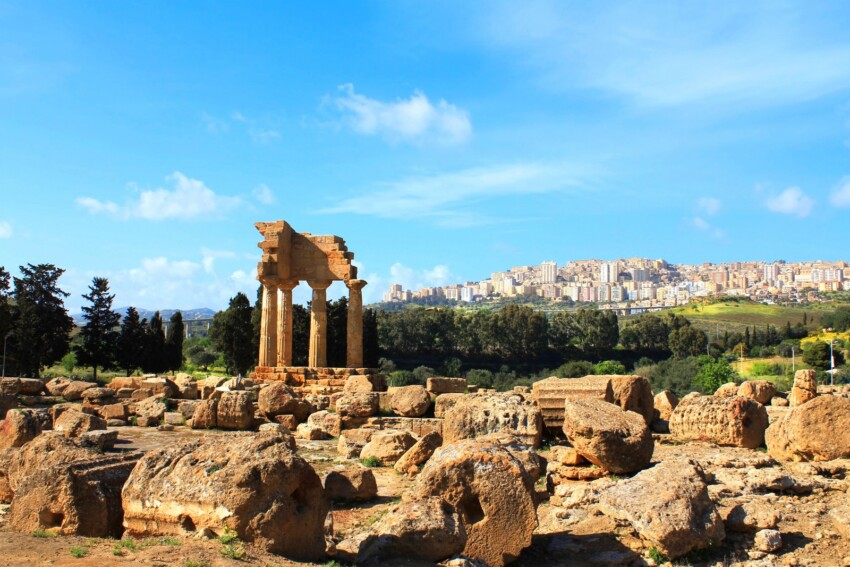
The top attraction in Agrigento, however, lies outside the town centre: the Valley of the Temples, a hillside crowned with monumental temples that have become the symbol of Sicily’s beauty and its fascinating thousand-year history. An extraordinary heritage site, a dreamlike vision.
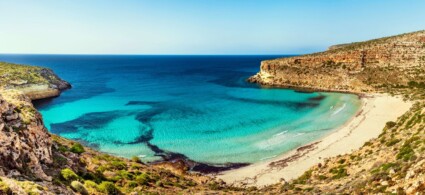
The sea is just a few kilometres away, waiting for you to spend lazy afternoons relaxing in the sunshine.
Things to do in Agrigento
Famous for its temples, Agrigento is a city with plenty of things to see.
If you’re passionate about history and architecture, Agrigento is an ideal destination, as almost every corner hides a church or building of historical or artistic importance, reflecting the successive historical events that have unfolded over the centuries, in a blend of Arab, Norman and Aragonese styles.
Among the numerous religious buildings, we recommend the Monastery of Santo Spirito, the medieval church of Santa Maria dei Greci, the San Gerlando Cathedral and the Bishop’s Palace, which houses numerous artworks in the adjoining Diocesan Museum. Among civic buildings worth noting are the Clock Tower Palace, the Town Hall and the Lucchesiana Library.
You can see them all by following a walking route through the historic centre that takes about an hour.
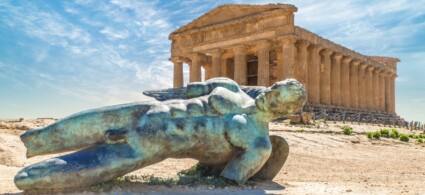
The Valley of the Temples, one of the world’s largest archaeological parks, is the reason everyone comes to Agrigento: there’s no visit to the city without exploring this extraordinary work created by man in perfect harmony with the surrounding landscape. Calling Agrigento’s temples majestic seems almost an understatement: perched on a rocky ridge, they have stood for thousands of years as silent and proud witnesses to the passage of time.
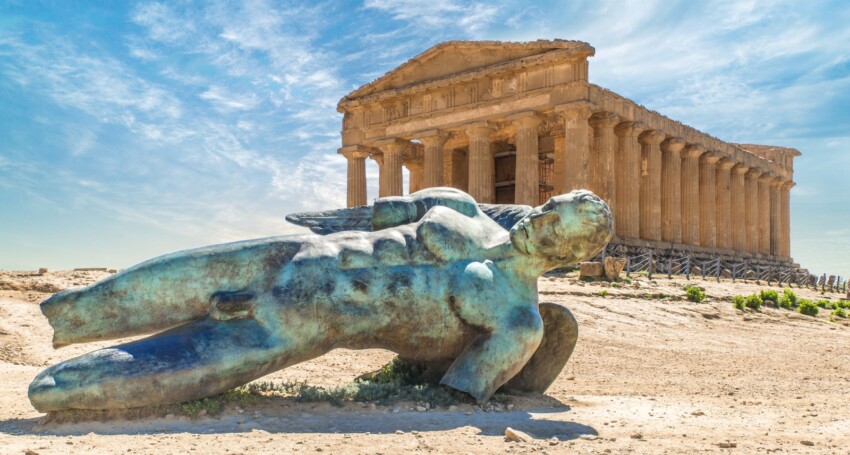
The most famous monument in the Valley of the Temples is the iconic Temple of Concordia, a magnificent temple that is almost entirely preserved and rivals the Parthenon in Athens for grandeur and splendour.
To find out more about this essential attraction, designated a UNESCO World Heritage site, visit our in-depth page on the Valley of the Temples.
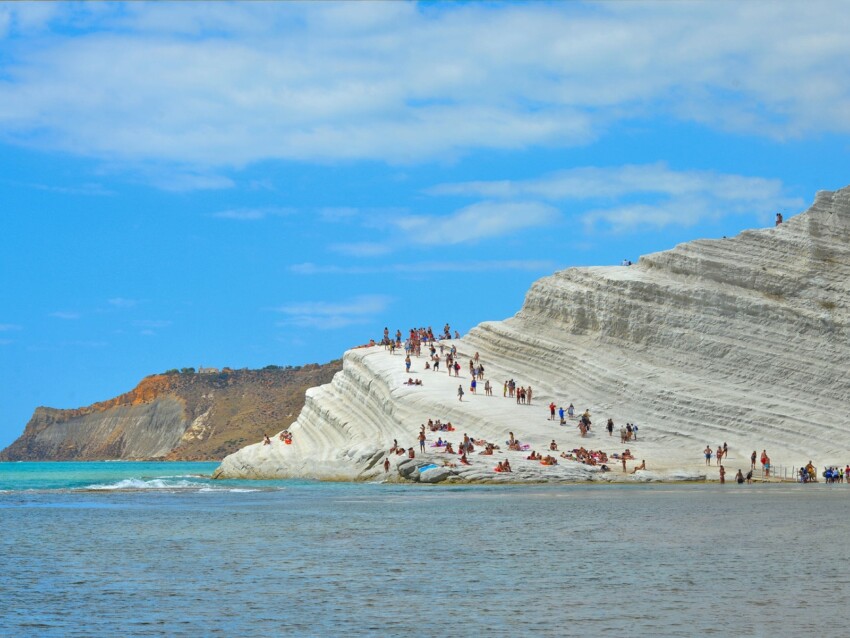
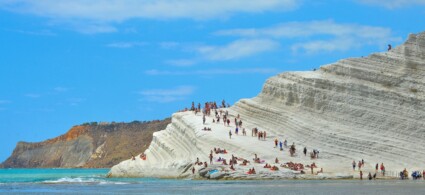
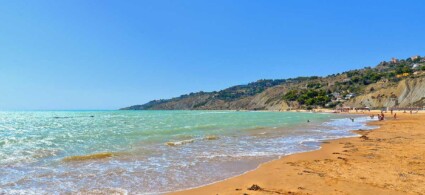
In the immediate vicinity of Agrigento, in the locality of Realmonte (about twenty minutes by car), stands the famous Scala dei Turchi, a must-see beach topped by a promontory of white rock carved into tiers. The contrast between the white rock and the deep blue sea is truly spectacular.
If you’re passionate about ancient history, after admiring the Valley of the Temples, add a visit to the fascinating Archaeological Museum to your itinerary. On display are artefacts found during excavations of the nearby temples, including a magnificent collection of Greek ceramics.
The museum’s showpiece is a faithful reconstruction of the telamon from the Temple of Jupiter, a colossal statue depicting a figure from Greek mythology.
Kolymbetra Garden
5Viale Caduti di Marzabotto, 92100 Agrigento AG, Italy
Just 500 metres from the Valley of the Temples lies another top attraction in Agrigento, ideal for immersing yourself in authentic Sicily: the Kolymbetra Garden. Managed by the FAI, it sits in a small valley where the ancient city of Akragas once stood and combines the wonders of a park and an archaeological site.
Access to the garden is only through the Valley of the Temples ticket offices, so you’ll need to buy tickets for both attractions. Given the beauty of the Valley of the Temples, no one has ever complained about this arrangement.
Via Atenea is the nerve centre of the old town: from here branch off the narrow alleys and lanes lined with elegant palazzos and historic churches that form Agrigento’s labyrinthine heart. The street is full of cafés, small restaurants and shops: perfect for a coffee break or some shopping.
During your visit to Agrigento, pay your respects to Luigi Pirandello, the brilliant Agrigento-born writer and Nobel Prize winner, author of seminal works in the history of European literature such as The Late Mattia Pascal and Six Characters in Search of an Author.
About 5 km from the historic centre stands Pirandello’s Birthplace, an elegant manor house converted into a museum. On display you’ll find photographs, newspaper articles reviewing the writer’s works, theatre posters and first editions of many important novels. In the garden of the house, at the foot of a pine tree, lies an urn containing the writer’s ashes.
Pirandello’s Birthplace is interesting to visit even if you’re not particularly interested in literature, as it offers a glimpse of aristocratic life in early twentieth-century Sicily.
From Via Atenea, climb a flight of steep stairs to visit one of Agrigento’s must-see attractions: the Monastery of Santo Spirito.
Founded by Cistercian nuns at the end of the thirteenth century, it is still an active monastery, famous for the goodness of the sweets prepared by its inhabitants. These are available for purchase: don’t miss the chance to sample delicious almond cakes, conchigliette and cuscusu prepared by hand.
As you enter the monastery, don’t forget to admire the magnificent gothic portal.
If you think Sicily is a region of ancient ruins and poor infrastructure, a visit to the Farm Cultural Park in Favara (just half an hour from the Valley of the Temples) will completely change your mind. Sicily is indeed a land of cultural ferment and creativity, as evidenced by this fascinating contemporary art centre.
It was once an abandoned village, but thanks to works by artists from around the world, it has been transformed into an open-air museum. Wandering through the seven courtyards of the village, white in Arab style, you can admire colourful murals and installations.
About 40 minutes’ drive from Agrigento lies the Punta Bianca Natural Park, a wonder still relatively unknown to tourists.
For those who love nature and peace, it’s an unmissable destination: a stretch of coastline of breathtaking beauty, characterised by spectacular cliffs, lunar atmospheres, blue sea inviting a dip and coves nestled between rocky promontories. Perfect for leisurely walks, hours of relaxation in the sun and refreshing swims, away from the crowds.
Map
In the following map you can see the location of the main places of interest mentioned in this article.
Beaches near Agrigento
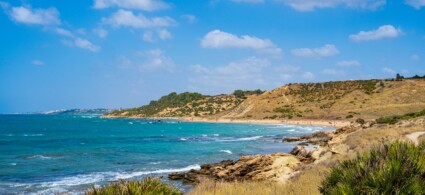
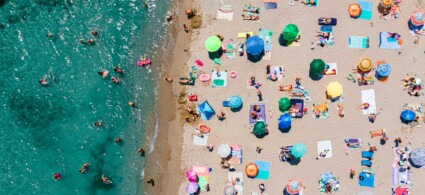
Agrigento is not on the coast, but the beaches are not far away and easily reached by car. The Agrigento coastline is a long succession of sandy beaches stretching for miles, alternating between well-equipped beaches, generally very crowded and suited to those wanting facilities and entertainment, and deserted beaches perfect for those seeking peace and quiet.
The most famous beach in Agrigento is San Leone, a fashionable spot where all of Agrigento’s locals flock in summer.
Of course, the aforementioned Scala dei Turchi is unmissable, though being very famous it’s also very crowded: if you prefer a quieter beach, head to Capo Rosso (also called Capo Rossello), also in Realmonte. It’s a sandy beach with some rock formations perfect as a backdrop for stunning photographs.
Where to stay in Agrigento
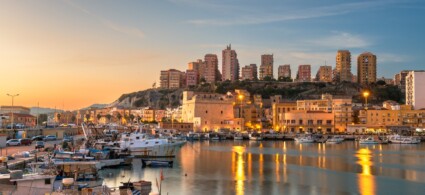
The modern part of Agrigento is unremarkable: it’s better to look for a hotel in the charming historic centre, an area full of character and restaurants and bars for spending your evenings.
A bed and breakfast is the most popular choice for those seeking accommodation in Agrigento as they tend to be more characterful. There’s everything from budget guesthouses with clean but basic rooms to charm-filled bed and breakfasts tastefully decorated by proud and warmly hospitable owners.
Even those who prefer to stay in a hotel will find options to suit all budgets. If you can spend a bit more, consider one of the luxury hotels just outside the centre, set in lush gardens; some have a swimming pool.
We offer best rates If you find it cheaper we refund the price difference.
Free cancellation Most properties allow cancellation without penalty.
We're available 24 hours a day For any problem call Booking.com.
The Agrigento area is not served by airports. The nearest ones are Trapani and Palermo, both about 170 km away and reachable by car in two to two and a half hours. They are served by low-cost flights, many of which are seasonal only.
With a car at your disposal, you can easily reach Agrigento from all major cities in Sicily. The SS189 and SS121 lead to Palermo, while for Enna, Catania or Caltanissetta you need to take the SS640. The coastal road SS115 connects Agrigento to Sciacca and Licata.
Trains to Palermo are frequent, whilst reaching other places by train can be difficult and in many cases impossible. An alternative is buses: there are direct services to Palermo (city and airport), Trapani (city and airport), Catania (city and airport), Caltanissetta, Gela, Licata.
Agrigento Weather
What's the weather at Agrigento? Below are the temperatures and the weather forecast at Agrigento for the next few days.
Sunday 13
24°
29°
Monday 14
20°
27°
Tuesday 15
19°
28°
Wednesday 16
20°
28°
Thursday 17
20°
28°
Friday 18
20°
27°
Where is located Agrigento
Agrigento is a city of around 60,000 inhabitants located on Sicily's southern coast.
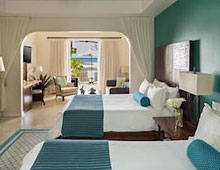 Hotel
Hotel 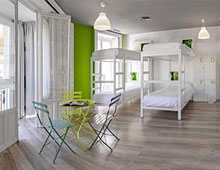 Budget accommodations
  Apartments
  Family Hotel
 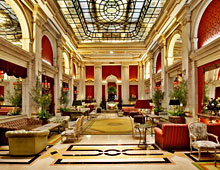 Luxury Hotel
 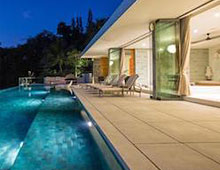 Resorts