Bestseller
Agrigento: Valley of the Temples Ticket & App Audioguide
From 21,50 €
Buy the ticket
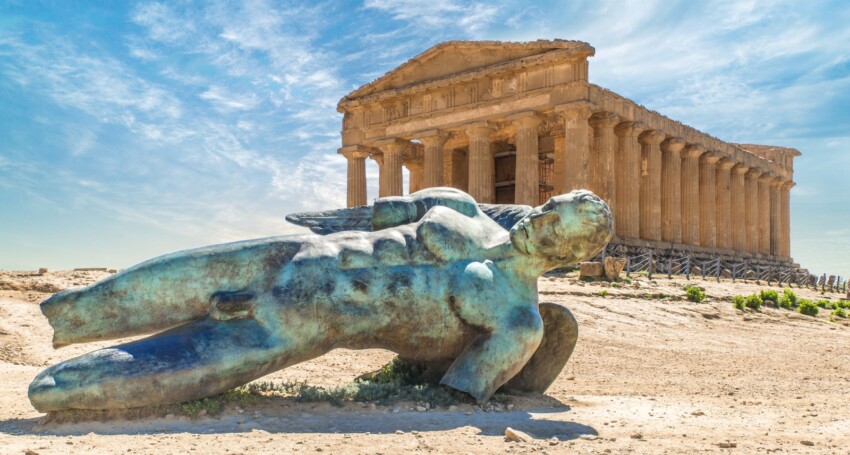
There is a place in Sicily where the splendour of Magna Graecia comes alive in a whirl of emotions stirred by its beauty: the Valley of the Temples in Agrigento, the emblem of ancient Sicily and one of the island’s most visited attractions.
It is a place of timeless fascination that rivals the Acropolis of Athens in fame and allure. Its monumental Doric temples, illuminated by the scorching Sicilian summer sun or bathed in the glow of floodlights at night, are an iconic image of the island’s beauty and its captivating history.
For over two thousand years they have stood majestic and proud on a hillside. Some remain barely intact, yet that is enough to glimpse their original grandeur and leave you breathless with wonder.
Take a walk through history, treat yourself to a unique experience: visit the Valley of the Temples, one of the world’s largest archaeological parks.
Most tourists visit this unique attraction during the summer holidays as part of a beach break, but is this really the best time to visit the Valley of the Temples in Agrigento?
Summer is a good period to combine culture and seaside, but the heat, especially during the middle of the day, can be difficult to endure. Bear in mind that this is an open-air attraction with no shelter from the sun. You can get around this with an evening visit: if you’re interested, check the calendar for special evening openings.
The best months to visit the Valley of the Temples are February and March, the almond blossom season. It’s low season for tourism so you won’t encounter crowds, and flight and hotel prices are lower.
Another date to note for visiting the Valley of the Temples is the first Sunday of each month, when admission is free.
Within the area of the archaeological park of the Valley of the Temples in Agrigento, which covers approximately 1,300 hectares, there are more than ten temples, as well as sanctuaries, necropolises, fortifications, remains of dwellings and other ruins.
These are the remains of the ancient city of Akragas, which represents the original nucleus of the city of Agrigento: a very wealthy city and one of the most important in Magna Graecia.
Here are the must-see attractions within the Valley of the Temples.
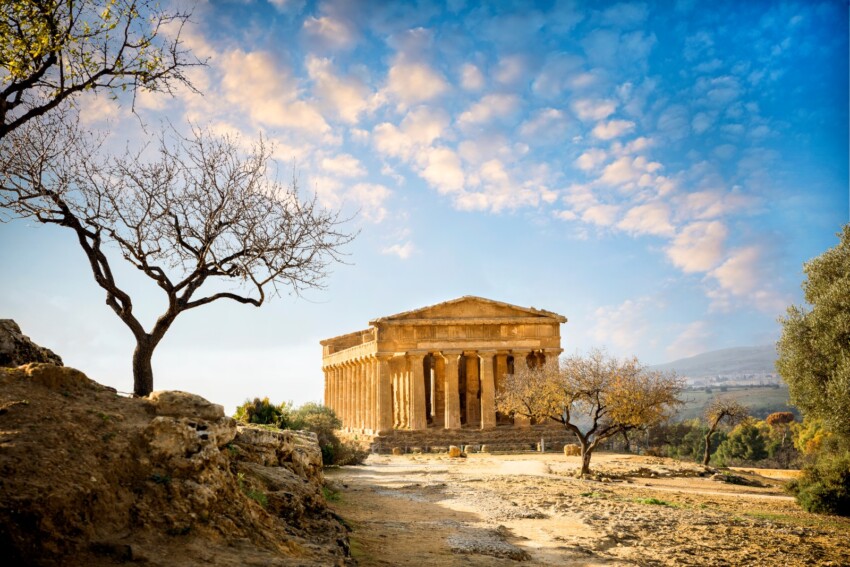
The emblem of the Valley of the Temples is the magnificent Temple of Concordia, an almost entirely preserved colossus that stands proudly as a testament to the grandeur of ancient Agrigento. This monumental temple is over 13 metres high and features 38 fluted columns, each 6.5 metres tall.
Built around 440 BC, it was used as a Christian church in the 6th century, and this fact contributed to its excellent state of preservation.
The temple’s name is a misnomer due to an error by historian Fazello: living between the 15th and 16th centuries, he found a Latin inscription near the temple that mentioned the goddess of Concordia, which was enough for him to assign this name to the temple. Later research revealed that the inscription had no connection to the temple.
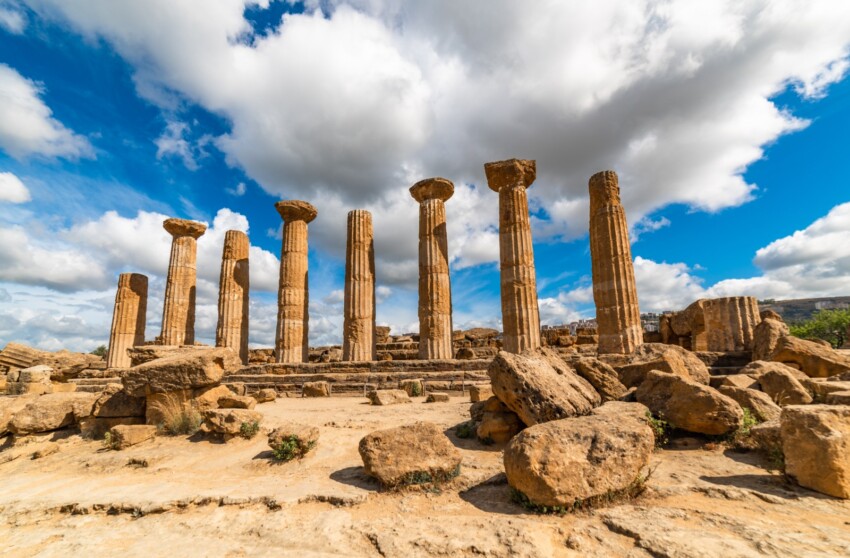
One of the oldest temples in the archaeological park, the Temple of Heracles was certainly a colossal monument in ancient times.
Today, sadly, we can only see nine columns, which were restored thanks to a substantial donation from Englishman Alexander Hardcastle. They are nonetheless an impressive and evocative sight.
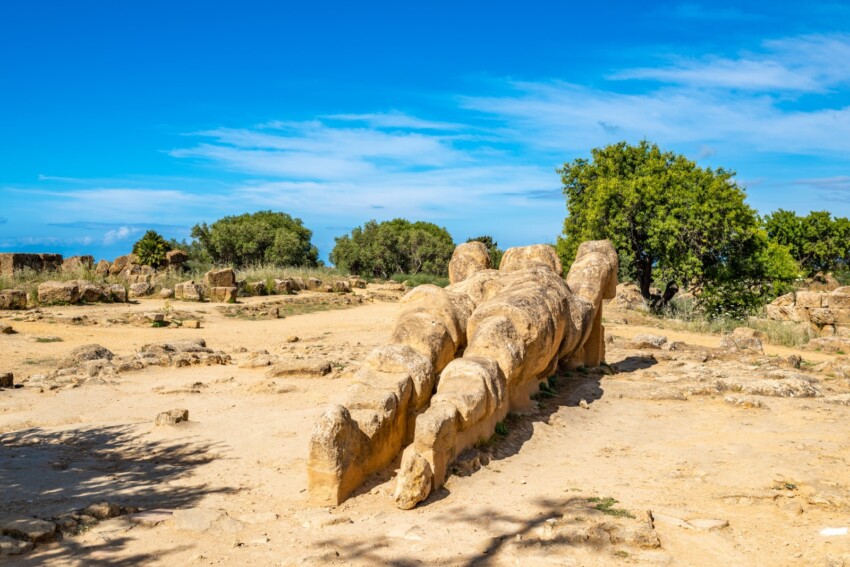
Even more impressive in antiquity, and far less preserved today, is the monumental Temple of Zeus, which covered a rectangular area of 112 by 56 metres, with columns nearly 20 metres tall.
Only a few fragments remain, but to gain an idea of the monumentality of this temple, you can admire one of the telamons that adorned it in the Archaeological Museum – enormous stone figures 7 metres tall that were placed between the columns. A copy is placed within the park, opposite the temple’s remains.
The three we’ve recommended are the most famous and most photographed, but all of Agrigento’s temples have their own story or a particular point of interest.
Other notable temples include:
Although what remains is truly minimal, a stroll through the Hellenistic-Roman quarter of the Valley of the Temples will transport you back in time.
In this area of the park, the imprint of ancient cities is evident, with the division of the main streets into cardines and decumani. There are remains of private dwellings (some modest, others more lavishly decorated with mosaics), shops, wells and thermal baths.
A visit to the Archaeological Museum is not included in the Valley of the Temples admission fee: you need to purchase a separate ticket or a combined ticket. It’s well worth spending the money to see one of Italy’s most important archaeological museums, with over 5,000 pieces that tell the story of Akragas and the ancient world in general.
It includes works and artefacts found within the park, pieces from private collections, and some objects donated by other museums. The standout pieces of the collection are the statue of the Ephebe and the telamon from the Temple of Jupiter.
In the following map you can see the location of the main places of interest mentioned in this article.
The Archaeological Park of the Valley of the Temples is divided into two sections, one to the east and one to the west of via dei Templi: the temples in the eastern zone are the most spectacular. You can easily pass from the eastern hill to the lower part thanks to an elevated walkway.
To visit the Valley of the Temples, you can enter from two entrances: one on via Panoramica dei Templi, at the Temple of Juno, and one on Contrada Sant’Anna at Gate V.
Tickets can be purchased online or directly at the archaeological park’s ticket offices. Opening hours vary depending on the season; during the summer period, some special evening openings are organised.
You can purchase a ticket just to visit the temples or combined tickets that include entry to the archaeological museum or archaeological museum plus Kolymbethra garden.
Admission is free for those under 18, Italian school teachers and other professional categories, while there is a 50% discount for young people aged 18 to 25.
You can visit the temples and museum independently, but taking part in a guided tour allows you to appreciate the beauty of this place with an expert guide who will be able to tell you about its history and interesting facts. You’ll definitely enjoy it more.
The Valley of the Temples is just 5 km from the centre of Agrigento and can be reached by local bus or on foot. By car it’s really straightforward: from the Juno roundabout, follow the signs.
To get to Agrigento, the recommended solution is to fly into Palermo, Trapani or Catania airport and hire a car from there. The distance between Agrigento and the three airports is much the same, so choose the airport that offers you the most convenient flights. Allow approximately two and a half hours to reach Agrigento from one of the three recommended airports.
Agrigento can also be reached by direct bus from Palermo, Trapani and Catania, whilst the train is not recommended as you often need to make many changes.
There are a couple of hotels and B&Bs in the immediate vicinity of the Valley of the Temples, including a luxury 5-star hotel with a pool that boasts an enviable view of the temples.
We recommend, however, staying in Agrigento’s centre as there is a wider choice of accommodation, including affordable options with good value for money; moreover, staying in the centre has the advantage that you won’t need to travel to dine out or enjoy the evening entertainment.

 Hotel
Hotel  Budget accommodations
  Apartments
  Family Hotel
  Luxury Hotel
  Resorts