Etna: Guided Summit Hiking Tour up to 3400m, Optional Pickup
5.822 reviews
Buy now
From 55,00€ per person
Sicily is one of the top destinations for summer holidays, thanks above all to its beautiful sea and warm temperatures that allow you to take part in countless cultural and outdoor sporting activities.
However, this doesn’t mean you can’t visit Sicily at other times of the year: in fact, the Mediterranean climate on the coast makes it possible to swim from June right through to October, months when flight and hotel prices drop significantly compared to the peak season of July and August.
And if it’s not the sea that draws you to Sicily but its ancient history, delicious cuisine, vibrant traditions or lush green spaces, then the best times to visit are spring and early autumn when you can enjoy the region’s attractions without the scorching sun and crowds of tourists.
During winter, Sicily sees a sharp drop in visitors, but its wide range of attractions means you can still experience an unforgettable holiday even in the coldest and darkest months.
To decide when to visit Sicily, another factor to consider alongside the climate and flight and hotel prices is the events on the calendar. Attending popular festivals, cultural events, sporting competitions, religious celebrations, food and wine festivals and local fetes is the best way to mingle with locals and experience unforgettable moments that can be moving, entertaining or touching depending on the occasion.
Below you’ll find the annual calendar of Sicily’s most important events: one or more reasons each month to book a holiday!
The first celebration of the year, which is also the last of the Christmas period, is the Epiphany: many cities and towns in Sicily celebrate it with rituals that blur the line between the sacred and the profane.
Among the most famous are the flight of the dove in Piana degli Albanesi (Palermo), the pagghiaru in Bordonaro (Messina) and the procession of the Three Kings in Mussomeli (Caltanissetta). Sweet treats and gifts are always present!
For over 15 years, the Ragusa Marathon has been one of the earliest running events in the Italian calendar: an important appointment for many keen runners, both Italian and international, who don’t want to wait until the end of winter to lace up their trainers. In addition to the classic marathon, there’s a half marathon and non-competitive routes on offer.
February is a time of pranks, sweet treats and colours that will then give way to the sobriety of Lent. Among the exuberant Carnival celebrations in Sicily, the most famous takes place in Acireale, a town in the province of Catania famous for its playful-religious festival that has international renown.
“Sicily’s Most Beautiful Carnival”, as locals call it, dates back over 500 years and continues to maintain a tradition fed by vivid imagination and stunning artisanal skills. The soul of the festival is the spectacular allegorical floats that parade through the streets of the city, accompanied by “lilliput”, smaller floats driven by children.
Another important Sicilian carnival is the one in Sciacca: the protagonist of the festival is the mask of Peppe Nappa, a highly appreciated distributor of wine and grilled sausages.
The third essential event is the Carnival of Termini Imerese, which dates back to the nineteenth century and is strongly tied to Neapolitan tradition.
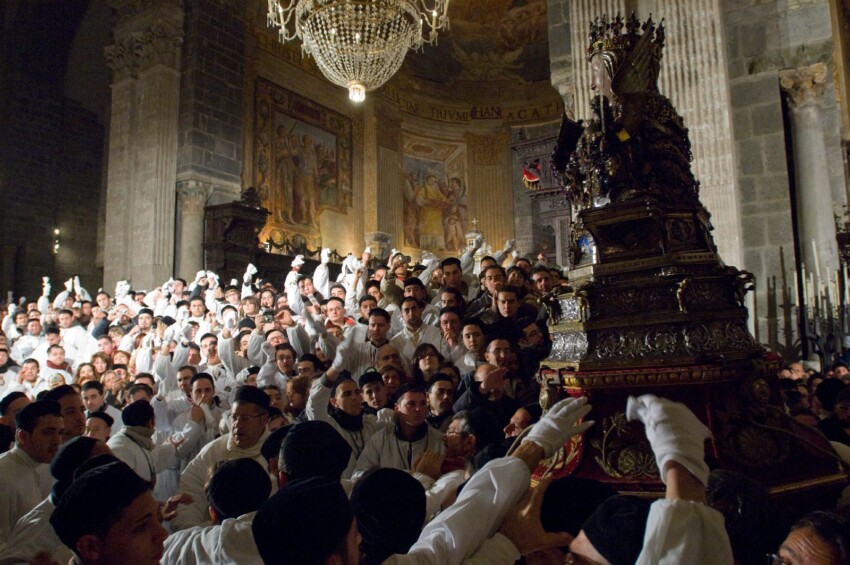
In early February, Catania celebrates its patron saint with three days of festivities during which religious celebrations, torch processions and fireworks follow one after another.
The highlight of the Feast of Saint Agatha is the procession of the saint’s bust through the city streets, followed with passion and solemnity by the city’s inhabitants. The celebration is not without its sweet moments, enhanced by traditional recipes such as cassatedde and Saint Agatha’s olives.
Two weeks before spring officially begins, Agrigento prepares to welcome it with a traditional festival lasting ten days set in the magnificent backdrop of the Valley of the Temples.
The programme of the Almond Blossom Festival is packed and includes folk performances, parades of Sicilian floats, popular music concerts, theatrical shows, activities for children and tastings of almond-based products.
The Dance of the Devils is a festival of pagan origins but with religious significance that takes place in Prizzi, a town in the province of Palermo, during the pre-Easter period.
Men in grotesque red costumes (the devils) and one in a yellow costume (death) stage a singular performance through the city streets that is rooted in ancient rituals and traditions.
The rituals of Holy Week in Sicily have ancient roots and are still experienced by locals with profound devotion. Each year thousands of tourists join them, some faithful, others not, drawn by the solemnity and in some cases the spectacle of the celebrations.
Each city has its own rituals that are based on complex symbolism and the influence of various cultures, all highly moving, but to witness the processions and ceremonies that see the highest level of popular participation, the best cities are Enna, Caltanissetta and Trapani.
The Giro di Sicilia is a historic stage road cycling race, founded two years before the Giro d’Italia; the route runs through seas and mountains, touching the most beautiful natural areas of Sicily.
Over the decades the race has had mixed fortunes, with several editions cancelled and a long period of hiatus between 1978 and 2018. In 2019 it was relaunched with the help of RCS Sport, the owner of the Giro d’Italia brand.
It has been held more than 100 times but its appeal remains intact: the Targa Florio, or “Cursa”, is one of the oldest car races in the world.
Devised by Vincenzo Florio, a dynamic entrepreneur also known for the historic Marsala wine cellars (and founder of the aforementioned Giro di Sicilia), it is a race held in the magnificent setting of the Madonie Park. Over the years it has been the stage for thrilling duels between champions who made motor racing history.
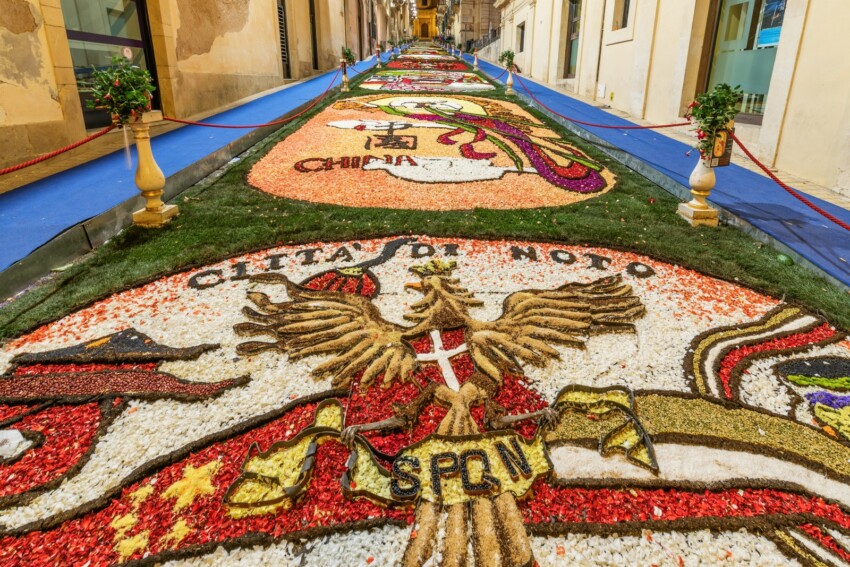
Flowers and art come together at this month-long celebration in Noto, the Baroque capital of Sicily.
The Infiorata of Noto transforms one of the town’s streets, lined with elegant palaces and topped by the elaborate facade of the Church of Montevergini, into an open-air work of art created with flowers of different species and colours. The floral compositions created by flower artists depict religious subjects or popular themes.
The event programme also includes exhibitions, food and wine events and performances.
Every year, the Greek Theatre of Syracuse comes back to life with an event that runs throughout the summer, from late May to July, staging the great masterpieces of Greek tragedy and Roman comedy.
It is one of Europe’s most important ancient theatre festivals, renowned for its spectacular location and the artistic quality of the productions.
Taormina Arte is a major umbrella for prestigious summer events featuring dance, theatre, modern music, classical music, cinema and literature in suggestive settings, first and foremost the Ancient Theatre, which is the city’s pride.
Two of these have particular resonance in the national media: the first is the Nastri Argento, the historic award from Italian film critics given to the best national films, actors and directors; the second is the Taormina Film Fest, a film festival featuring national and international premieres with a focus on Mediterranean production.
The Inycon Wine Festival in Menfi is an excellent excuse to treat yourself to a holiday in southern Sicily based on beautiful beaches, culture and food and wine.
This traditional wine festival has already surpassed its twentieth edition and has expanded year after year with new events and activities, all aimed at showcasing the finest wine productions in Sicily. Walks, cycling excursions, exhibitions and, above all, plenty of satisfying tastings await you.
In mid-July, the city of Palermo celebrates Santuzza, the city’s patron saint, and does so in grand style. U’Fistìnu, the Festival of Santa Rosalia, is a religious-folkloric celebration that commemorates the liberation of Palermo from the plague in 1624. It lasts five days and is celebrated with enthusiasm by locals and thousands of tourists every year.
The highlights of the festival are the procession of Santuzza’s float through the historic centre, the fireworks display at the marina and the procession of the saint’s relics. The festival is also a perfect opportunity to sample specialities of traditional Palermo cuisine.
Another important appointment with open-air theatre is the Dionisiache Festival of Calatafimi-Segesta, a modern event that has evolved from a previous festival created in the 1960s.
The focus is on classical theatre, but some modern performances are also staged; theatrical workshops for young people are also organised. The natural setting and the charm of ancient architecture help emphasise the emotions experienced by spectators.
The Illuminated Staircase in Caltagirone (province of Catania) is an event very much like the Infiorata of Noto, with the difference that here the artists use candles rather than flowers. The street that is transformed into an open-air work of art is the magnificent staircase that leads from the main square to the Church of Santa Maria del Monte.
The event takes place on two occasions: at the end of July in honour of Saint James and in mid-August in honour of the Blessed Virgin Mary. In both cases, the magic hour is at 21.30, when the city lights go out and the artistic composition comes to life.
While Ferragosto in Sicily is almost everywhere celebrated with beach parties, fireworks, barbecues and festivals, the three days before Piazza Armerina are entirely dedicated to the Palio dei Normanni: a historical re-enactment celebrating the expulsion of the Saracens from Sicily in 1060.
Set in the evocative backdrop of the city centre, you can watch colourful processions and a medieval tournament in which the four historic quarters of the city compete against one another.
Another unmissable traditional festival preceding Ferragosto is the Festival of the Vara and the Giants held in Messina.
The Vara is a votive float dedicated to the Madonna that is carried in procession on 15 August. This solemn ceremony is preceded by a more singular procession, repeated five times, in which the protagonists are two gigantic statues representing Mata of Messina and the Moor Griffon.
For more than twenty years, Ypsigrock Festival has enlivened the summer for young Sicilians with three days entirely dedicated to indie-rock and alternative music. Italian and international artists perform on the festival stage, set up in the suggestive backdrop of the Castello dei Ventimiglia.
The event is held in Castelbuono, in the province of Palermo.
Flavours and cultures meet at the Cous Cous Fest in San Vito Lo Capo, in the province of Trapani: it is one of Sicily’s most successful food and wine festivals, dedicated to a dish with many variations that represents the staple food of many Mediterranean communities.
The highlight of the festival is the National and International Cous Cous Championship in which chefs from around the world compete with imaginative and innovative recipes.
You can help decide the winner if you send in your entry request in time, but don’t worry if you can’t: you can console yourself with exciting cooking shows and tastings and in the evening enjoy free concerts in the square.
The Archeo Visiva Award is a review of documentary and archaeological communications that takes place in the small town of Licodia Eubea (Catania) and lasts three days. What began as a niche event has managed to carve out a loyal audience and win over spectators who are completely new to the subject.
The programme includes documentary and docufiction screenings, meetings with archaeology and documentary cinema professionals, exhibitions and associated events.
The Festival of Morgana is a fantastic opportunity to discover the Sicilian tradition of puppet theatre and immerse yourself in a world of marionettes and puppets.
Founded more than forty years ago, this important international festival transforms the city of Palermo into a distributed theatre for two weekends each year, where about ten Italian and European companies perform. It is organised by an association for the preservation of popular traditions founded by medical anthropologist Antonio Pasqualino.
The tradition of living nativity scenes holds great significance in Sicily, with numerous towns making considerable effort to recreate the Nativity scene in ways that captivate visitors.
An itinerary centred on living nativity scenes could be a wonderful way to explore the island in December and early January, but if time is limited, head straight to Custonaci (Trapani province).
The creation of the living nativity scene in Custonaci, one of Sicily’s most renowned and atmospheric, involves more than 150 people including craftspeople, performers and locals; the spectacular setting is Grotta Mangiapane in Scurati, a naturally beautiful location frequently used for television and film productions.
Still overlooked as a New Year’s Eve destination, overshadowed by more traditionally associated destinations, Palermo is in fact an ideal city to bid farewell to the old year and welcome the new one.
Those undeterred by the cold can join the locals for lively celebrations in the piazzas, featuring live music, champagne and inevitable fireworks, and perhaps continue the evening in a club open until dawn. If you prefer to celebrate in style, you can book an excellent restaurant or perhaps attend the New Year’s Concert at the Teatro Massimo.
 Hotel
Hotel  Budget accommodations
  Apartments
  Family Hotel
  Luxury Hotel
  Resorts