Hotel Diffuso Antichi Ricordi
Caltanissetta - Via Villaglori 45
Book now
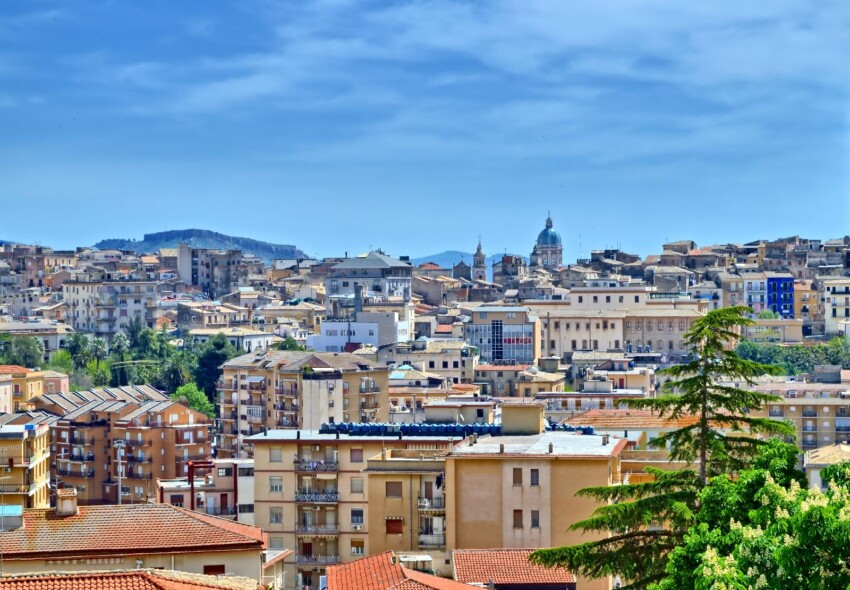
Although various archaeological artefacts testify to the city’s ancient origins, Caltanissetta appears to have been founded around the 10th century during Islamic rule in Sicily. The town sits in the central part of the island, perched atop undulating hills at an elevation of 568 metres above sea level.
Located in inland Sicily, Caltanissetta is a town well worth exploring, not only for its stunning historic centre, which features churches, historic palaces and interesting museums, but also for its archaeological sites that reveal part of its ancient history. The town’s name is thought to derive from the Arabic “Qal-atnisa”, meaning “Castle of the Women”, a reference to the present-day Pietrarossa Castle, which is believed to have housed an emir’s harem.
A little-known yet utterly fascinating city, Caltanissetta represents the ideal destination for those seeking to discover central Sicily at more reasonable prices whilst still enjoying excellent facilities.
The city’s historical, architectural and cultural heritage reflects the various rulers and cultures that have succeeded one another in this territory: from the Arabs to the Normans, from the Aragonese to the Savoys.
The heart of the city is Piazza Garibaldi, located in the historic centre where two of the main thoroughfares begin – Corso Umberto I and Corso Vittorio Emanuele. In this square you’ll find the town hall, the Cathedral, the Church of San Sebastiano and at its centre stands the magnificent “Fountain of Triton”.
For those who love markets and street food, we recommend the Strada ‘a Foglia area, where the city market is held in the mornings, whilst in the evenings, particularly at weekends, it’s one of the most vibrant zones for nightlife enthusiasts.
The Cathedral of Santa Maria La Nova (or Cathedral of Santa Maria La Nova) stands in Piazza Garibaldi and is the city’s principal religious building. Built between the 16th and 17th centuries, this cathedral was given its name to distinguish it from another church dedicated to Santa Maria that had been erected in the 1300s at the foot of Pietrarossa Castle and was later renamed “Santa Maria La Vetere”.
Severely damaged by bombing during the Second World War, the church features an impressive dome rising from its structure and a beautiful façade flanked by two bell towers. The interior has a Latin cross layout with three naves and approximately 14 arches. In the main nave hangs a panel painting by the Flemish artist Borremans depicting the Immaculate and the Saints, whilst to the right of the main altar stands a wooden statue of St Michael, the city’s patron saint.
The Church of Sant’Agata al Collegio is a splendid religious building constructed between 1600 and 1610 on a site that previously housed another church also dedicated to Sant’Agata. Located on Corso Umberto, the church and its adjoining college were erected at the behest of Prince Francesco Moncada to house the Jesuit order. The building boasts a beautiful red façade, whilst the interior is characterised by a Greek cross layout and rich decorations featuring marble, stucco and frescoes. The college, built in Baroque style, today houses the municipal library and the music academy.
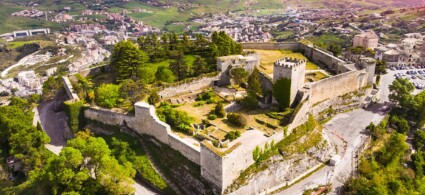
Located outside Caltanissetta’s city centre, Pietrarossa Castle is believed to have been built in the late 11th century near the ancient Arab quarter. Erected on a hilltop, this location affords a splendid panorama encompassing the city, the valley and the Salso river. From this complex, the defensive walls and remains of two of the three towers that once comprised the lookout system can still be seen. During the Middle Ages, the Castle was a strategic stronghold that even hosted the assembly where Sicilian nobles decided to proclaim Frederick of Aragon King of Sicily. In the mid-16th century, a powerful earthquake caused severe damage and led to the collapse of much of the structure.
At the beginning of the 20th century, Pope Leo XIII requested the construction of nineteen monuments dedicated to Christ the Redeemer – one for each region of Italy, which at that time numbered nineteen. Sicily answered the Pope’s call and decided to erect the statue on Monte San Giuliano, which rises to 727 metres and forms a natural frame for the city. The realisation of the Monument to the Redeemer was entrusted to Ernesto Basile, who completed this bronze statue in 1900.
Built with grey limestone quarried locally and inspired by the marble sculpture on the façade of the Basilica of San Giovanni in Laterano in Rome, the monument represents Christ the Redeemer. The summit of Monte San Giuliano not only hosts this magnificent work but is also one of Caltanissetta’s finest vantage points, offering breathtaking views across the entire city.
The Gibil Gabib archaeological site (from the Arabic Gebel Habib) lies not far from the town centre and contains two necropolises and remains of indigenous settlements dating to the 7th century BC.
Within this site, remains of a fortress used for military defence have been unearthed, along with vessels, everyday objects and oil lamps, some of which date back to the 6th century BC. Discoveries in this area have proved invaluable in reconstructing part of Caltanissetta’s history.
The Regional Archaeological Museum houses an extensive collection of archaeological artefacts, many made of bronze and ceramics, including statuettes of deities, vessels, amphorae, jewellery and various tools. Most of the objects were found in local settlements and archaeological sites, whilst others came from Pietrarossa Castle and were discovered in the 1950s. Among the items on display are some dating back to prehistoric times.
The Abbey of Santo Spirito stands approximately 3 km from Caltanissetta’s centre and is a religious building whose construction was commissioned by Roger I of Sicily and his wife Adelasia in the early 1000s. Located amid the countryside surrounding Caltanissetta, the church is one of the city’s finest-preserved monuments in Arab-Norman style. Initially constructed for defensive and surveillance purposes, it gradually assumed a religious function. Entirely adorned on the interior with 15th-century frescoes, including The Pietà and Christ Blessing, the abbey still retains a baptismal font built by the Normans and maintained in excellent condition.
In the following map you can see the location of the main places of interest mentioned in this article.
Regarded as one of the finest destinations for exploring central Sicily, Caltanissetta offers a wide range of accommodation options at truly affordable prices compared to other Sicilian cities.
If you’re staying in the city for a day, it’s advisable to choose a hotel in the heart of the historic centre to be close to the main points of interest, whilst if you’re using Caltanissetta as a base to explore other areas of the island, we recommend one of the properties outside the centre.
The Caltanissetta area is served by Fontanarossa-Catania airport, approximately 120 km from the city, or Falcone-Borsellino airport in Punta Raisi-Palermo, which is approximately 166 km away. Both airports receive flights from various budget airlines, with increased connections to other Italian and European cities particularly during peak season. From both Palermo and Catania, you can reach Caltanissetta by car in around two to two and a half hours.
Caltanissetta is easily accessible by car from the island’s main cities: from Palermo, take the A19 motorway followed by the SS626 state road, whilst from Messina, take the A18 motorway to Catania and continue on the A19 to the Caltanissetta exit.
Alternatively, coach services connect Caltanissetta to both airports as well as other towns on the island, whilst rail services on the Palermo-Caltanissetta and Caltanissetta-Syracuse lines also serve the city.
What's the weather at Caltanissetta? Below are the temperatures and the weather forecast at Caltanissetta for the next few days.
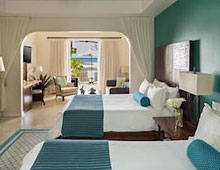 Hotel
Hotel 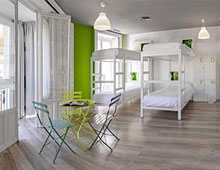 Budget accommodations
 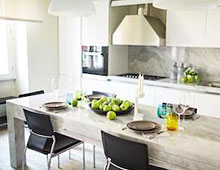 Apartments
 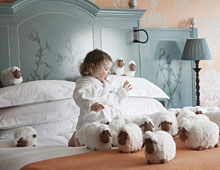 Family Hotel
  Luxury Hotel
  Resorts