Musmelia Rooms
Mussomeli - Piazza Umberto I 26
Book now
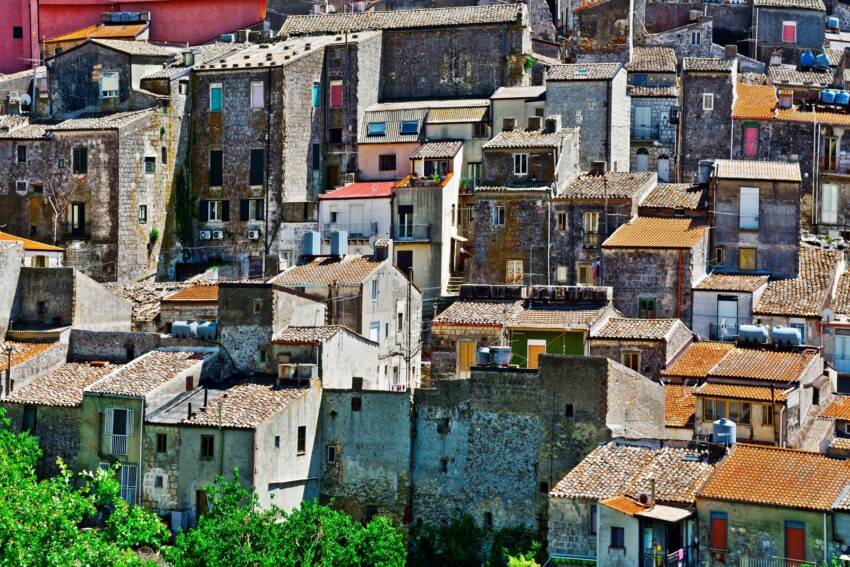
Perched atop a hillside in central Sicily sits the charming small town of Mussomeli, a place that captivates with its perfect blend of ancient history, local traditions and stunning landscapes. Mussomeli’s roots run deep – it’s believed that the Sicels once settled here, drawn by the land’s fertility. During Roman rule, Mussomeli, known as “Mussa”, was an important town because it served as the commercial link between central Sicily and the coast.
The town as we see it today, however, developed during the Middle Ages when Mussomeli became a thriving village dominated by an imposing castle that rose majestically above the surrounding landscape. Small, intimate and perfectly human in scale, Mussomeli is now surrounded by rolling green hills and olive groves, captivating visitors with its authenticity and timeless charm.
Mussomeli is a medieval borough that has managed to preserve its original layout and configuration over the centuries; this makes it possible to walk through winding narrow streets lined with stone houses, small churches and charming viewpoint terraces that offer spectacular views. The town boasts numerous historic churches built over the centuries (said to number over twenty) as well as grand palaces built by wealthy local families.
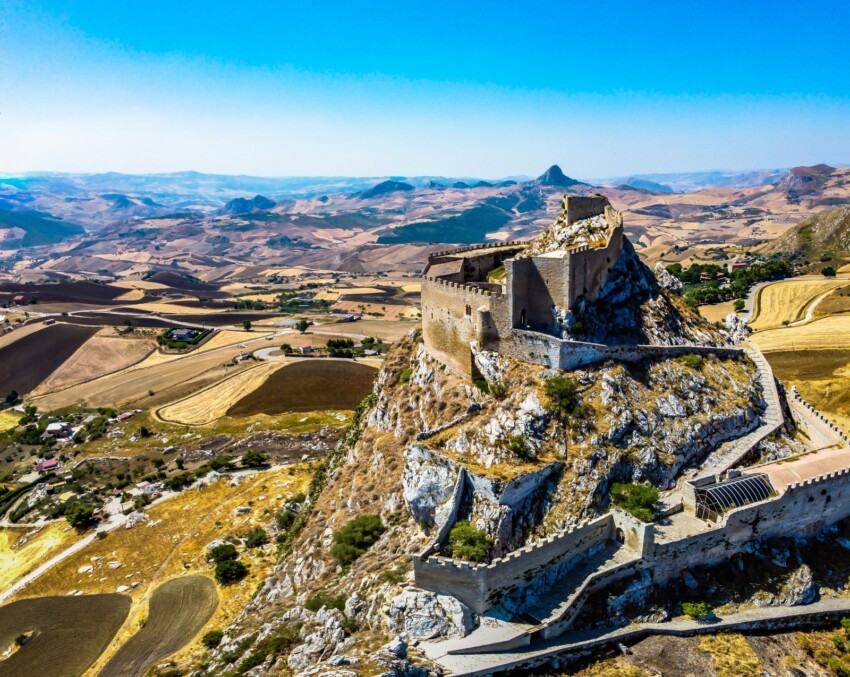
The undoubted symbol of the town is Mussomeli Castle, an imposing medieval fortress perched on a rocky crag at 778 metres altitude, commanding sweeping views of the surrounding territory. In 1370, Manfredi III of Chiaramonte, a leading figure of one of Sicily’s greatest noble families, had a Gothic-Norman style castle built on the site of a former Arab fortress.
Also known as the “Manfredonico Castle”, the fortress now offers breathtaking panoramic views and once served both defensive and lookout functions. Inside, you can explore the ancient rooms, still furnished, the frescoed halls and trace the history of this territory.
The Sanctuary dedicated to Maria SS. dei Miracoli (commonly known as the Madonna dei Miracoli) was commissioned by Father Francesco Langela, from one of the town’s most noble and prominent families. Originally dedicated to San Domenico, the sanctuary changed its name following a miracle that occurred here. The story goes that on 8 September 1530, a paralysed man travelling by mule stopped in the area to rest. Upon waking, he realised he could walk and cried out that he had witnessed a miracle. When the townspeople gathered in the area, they discovered an image of the Madonna and Child, and from that day the church became known as “Madonna dei Miracoli”.
The complex we see today is a Baroque-style reconstruction dating from the mid-eighteenth century, commissioned by the Dominican friars. Inside the Sanctuary’s crypt, you can admire a Madonna and Child painted on stone by Palma di Montechiaro, known as “The stone with the Madonna’s image”, which attracts pilgrims. The church itself houses several frescoes by Provenzani and wooden statues created in the nineteenth century by Francesco and Vincenzo Biangardi. Each year on 8 September, the feast of Maria is celebrated with a procession carrying the statue of Maria and various events commemorating this important occasion.
Mussomeli’s Mother Church is dedicated to San Ludovico and was originally built in the second half of the fourteenth century by Manfredi III of Chiaramonte, though it has been altered many times since. Initially dedicated to San Giorgio, protector of the Chiaramonte family, it was renamed in the fifteenth century following the rise of the Castellar family to San Ludovico of Toulouse, a saint venerated in Valencia, their city of origin. The original design featured a single nave which was modified over the centuries, with two side aisles subsequently added. Externally, you can admire a simple limestone facade beside a gabled bell tower; inside are works of considerable value. Notable pieces include a fifteenth-century painting of San Ludovico, a sixteenth-century San Pietro Martire, and an eighteenth-century wooden statue of the Madonna del Soccorso positioned above the high altar.
According to historical records, in the seventeenth century Don Ottavio II Lanza ordered the construction of the “Casa del Baglio” on this site. In the same century, Don Giuseppe Lanza had it largely rebuilt on a grander scale befitting his noble lineage. The structure features various decorative elements and the facade overlooking Piazza Roma boasts a long balcony supported by stone corbels. What survives is the noble section of the palace, which includes a magnificent staircase, several halls, a kitchen, stables, storerooms, hay lofts and administrative offices for managing the estates. The heart of the residence is the main hall, which Don Giuseppe decorated with a collection of paintings of considerable artistic merit by important local artists.
The Church of Santa Madonna del Carmelo was built around the mid-sixteenth century and was originally named Santa Marina, though it underwent various modifications over the centuries resulting in a change of name. Notably, in the seventeenth century, when it was managed by the Carmelites, it underwent initial expansion work, followed by significant alterations in the eighteenth century. At the beginning of the twentieth century, the current bell tower was added, while since the nineteenth century the interior has housed a nineteenth-century statue of the Madonna del Carmelo by Italian sculptor Francesco Biangardi (1832–1911).
Another architectural masterpiece in the town is the Church of Santa Maria delle Grazie, built in 1635 on the site of a small pre-existing chapel. Its facade is simple, built in stone with a gabled design, while inside are finely preserved frescoes of considerable value. For example, at the centre of the altar you can admire the fresco of the Madonna delle Vanelle, crowned by a wooden sculptural group of the Madonna and Child with the Archangel Michael.
Mussomeli is welcoming but small, especially compared to other Sicilian towns, so the range of accommodation is more limited. Most hotels are located in Mussomeli’s historic centre and offer not only comfortable rooms and excellent services but also easy access to the main attractions. For a more authentic experience, you might consider staying at one of the farm hotels nestled in the hills, offering the chance to immerse yourself in rural Sicilian life.
The best way to reach Mussomeli from other Sicilian towns is undoubtedly by car. From Palermo, you can reach Mussomeli in less than two hours via the SS21 and then the SS189. Those travelling from Catania can take the A19 motorway towards Palermo, then take the SS117 and SS640 in the direction of Mussomeli. The nearest airports are Palermo’s Falcone and Borsellino Airport 125 km away and Catania’s Fontanarossa Airport 150 km away.
What's the weather at Mussomeli? Below are the temperatures and the weather forecast at Mussomeli for the next few days.
 Hotel
Hotel  Budget accommodations
  Apartments
  Family Hotel
  Luxury Hotel
  Resorts