The home of Sicilian Baroque, Catania is a charming city that rises between the Ionian Sea and Mount Etna, and thanks to its marvellous architectural heritage, it is a UNESCO World Heritage site.
Situated on Sicily’s eastern coast, Catania is one of the finest art cities on the island, captivating visitors from around the world with its historical, architectural and natural heritage. Nestled between the azure waters of the Ionian Sea and the Mount Etna volcano, Catania is a vibrant, welcoming and elegant city that stands as the birthplace of Sicilian Baroque.
With truly ancient origins, Catania was founded by the Greeks in 729 BC and subsequently saw all the various civilisations that dominated the Mediterranean leave their mark on its territory. Each period of rule left traces that have largely survived to the present day, despite the city being struck by numerous natural disasters. It is said that Catania has been destroyed 9 times and rebuilt even more beautifully each time. Among the most significant events to strike Catania are the 1669 eruption of Mount Etna and the earthquake in the Val di Noto in 1693.
Following the earthquake, the city was largely rebuilt in the Baroque style that was fashionable at the time, transforming Catania’s centre into a place of extraordinary value. Its urban layout, its buildings—some constructed from lava stone—its proximity to the sea and the presence of Mount Etna, Europe’s highest active volcano, are all details that have made Catania a true gem of the island. Thanks to its appearance and unique architectural heritage, Catania has been designated a UNESCO World Heritage Site along with the other Val di Noto cities.
Worth noting is that Catania also boasts a rich gastronomic heritage, which includes cassata, cannoli with ricotta, iris pastries, arancini and many other specialities that can be discovered while walking through the city centre.
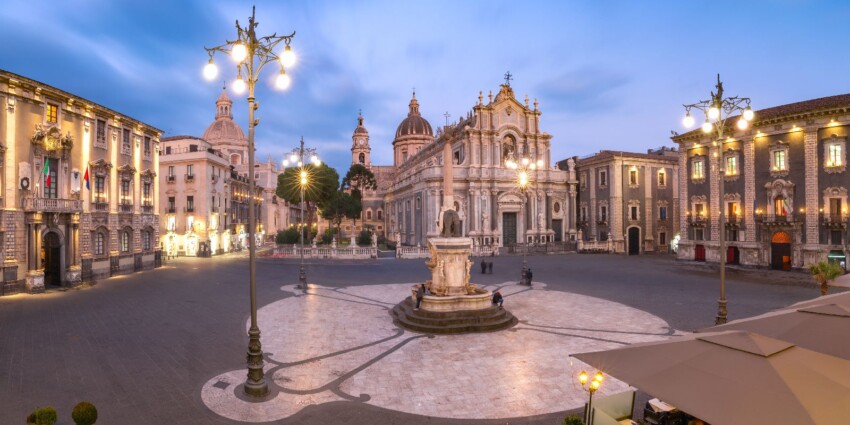
The heart of Catania, Cathedral Square is a concentration of Baroque masterpieces. As the meeting point of the city’s main streets, the square is home to the seats of municipal and ecclesiastical power: the Town Hall, the Cathedral and the Seminary. The slope of the surrounding streets affords impressive views of the square’s panoramic and architectural beauty.
The focal point of the square is the Elephant Fountain, created by reusing ancient decorative elements including a Roman-era lava stone elephant and an Egyptian obelisk. Surrounding the fountain are the Town Hall, housed in the Palazzo degli Elefanti and the Palazzo dei Chierici, which connects to the Cathedral via a passage above Porta Uzeda. Opposite the Town Hall is the Amenano Fountain, representing the river that flows beneath Catania.
Located in Cathedral Square, the Elephant Fountain is distinguished by a lava stone statue depicting an elephant, known as “Liotru” and the city’s symbol. Created by architect Giovan Battista Vaccarini between 1735 and 1737, as part of the city’s reconstruction following the devastating 1693 earthquake, the fountain combines several elements.
The base consists of a white marble pedestal positioned at the centre of a basin. On the base, two sculptures represent Catania’s two rivers, the Simeto and the Amenano. Above them stands the elephant statue, facing the Cathedral of Sant’Agata with its trunk. On the elephant’s back is a granite obelisk three and a half metres high, decorated with Egyptian-style figures. Its dating is uncertain, tentatively attributed to the Roman period and likely brought from Egypt to Catania during the Crusades.
At the top of the obelisk are mounted a globe, surrounded by a crown featuring a palm leaf (representing martyrdom) and a lily branch (representing purity). Above this is a metal tablet bearing an inscription dedicated to Sant’Agata, the city’s patroness, and finally a cross.
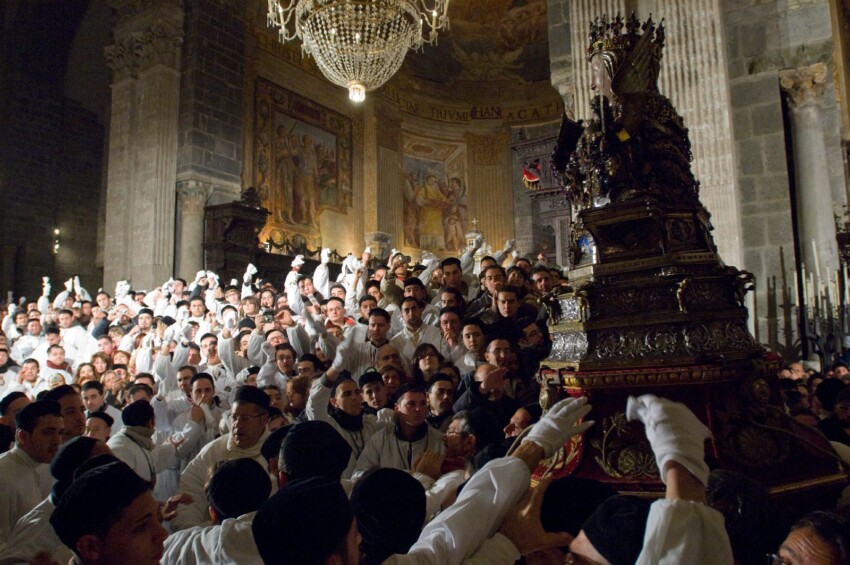
Erected during the Norman period, Catania’s cathedral retains from this construction phase its austere and powerful apses and transept. The church’s current appearance dates from the eighteenth-century reconstruction, which also involved reusing pre-existing elements such as the sixteenth-century portal inserted on the left side. Originally built over ancient Roman baths, its numerous modifications over subsequent centuries resulted from the damage caused by earthquakes that struck the city.
The impressive Latin cross interior, divided into three naves, houses notable artworks and contains celebrated tombs. Notable are the tomb of Vincenzo Bellini, the famous composer born in Catania, and two sarcophagi—one from the Roman period containing the remains of members of the Aragonese royal family, and the other Gothic, belonging to Costanza d’Aragona—located within the Norman chapel of the Madonna, one of the cathedral’s most precious works.
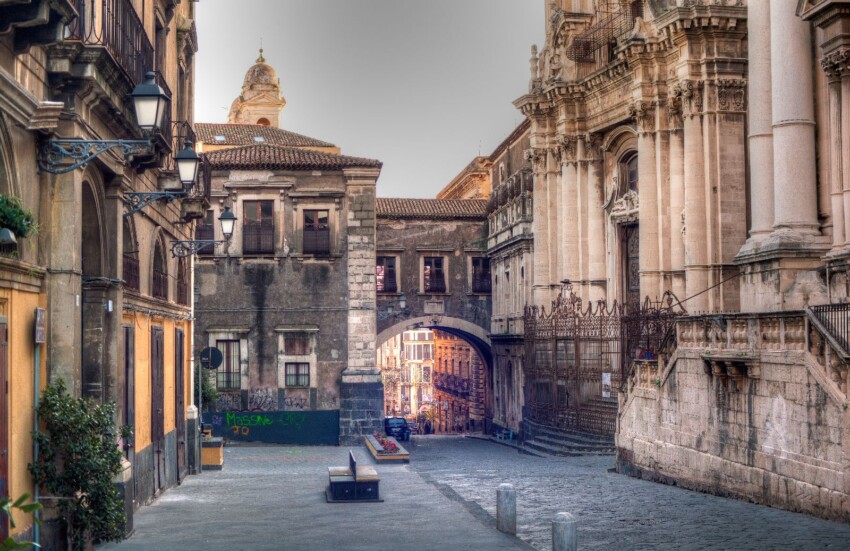
Due to the quality and beauty of its buildings, particularly its religious structures, Via Crociferi is considered the most representative street of Baroque Catania.
Among the most important buildings to see are the Church of San Giuliano with an attractive convex façade, the Collegio dei Gesuiti with four magnificent courtyards, the Church of San Francesco Borgia with a double-ramp staircase and the Church of San Benedetto with a richly decorated façade. The walk ends at Villa Cerami, a green oasis housing the Faculty of Law.
Via Crociferi runs parallel to Via Etnea and can be accessed from Via Vittorio Emanuele or Via Di Sanguliano.
Castello Ursino
5P.za Federico di Svevia, 21, 95121 Catania CT, Italy
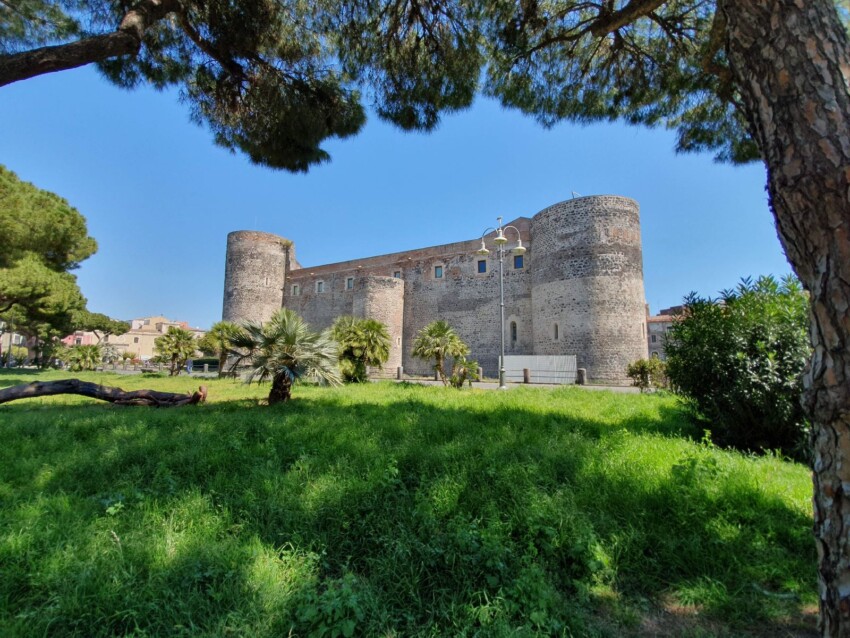
Built by Frederick II in the first half of the thirteenth century, originally on a promontory surrounded by sea, fortified with walls in the sixteenth century and subsequently damaged and restored several times, Castello Ursino features a square floor plan, surrounded by a moat, with four cylindrical towers at the corners. During the Sicilian Vespers, it served as the seat of Parliament and later, in the 1400s, became the residence of Aragonese rulers.
The lava flow of 1600 reached the castle and buried part of it, creating a new esplanade and moving it away from the sea.
In the early twentieth century, its original structure was recovered. Today it houses the Civic Museum.
This palace is particularly renowned for its unmissable façade on Via Dusmet: adorned with caryatids and richly framed balconies decorated with relief work enhanced by striking chromatic effects, it represents the epitome of Catania’s opulence in past centuries. The palace’s rear section overlooks Via Biscari instead.
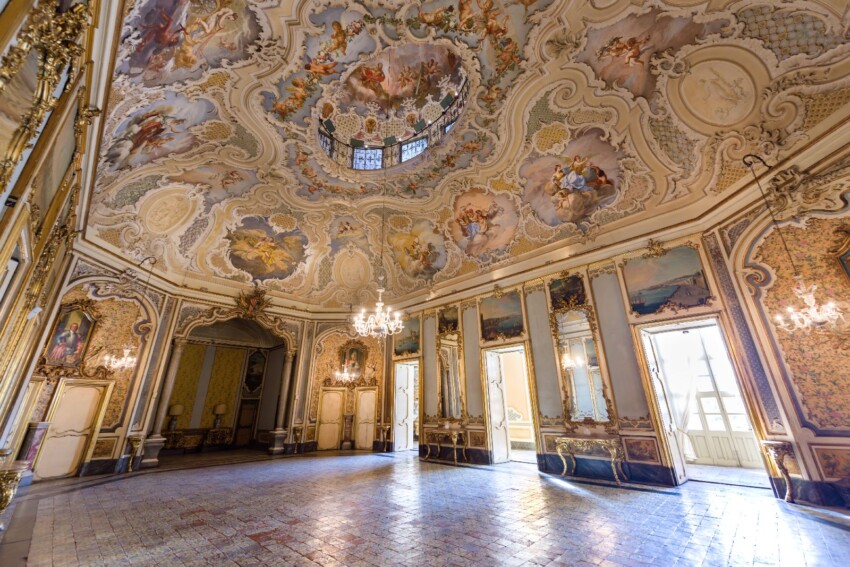
The interior features a sumptuous ballroom with a domed vault, Rococo decorations, mirrors, frescoes and a gallery with an extraordinary spiral staircase ingeniously designed to create a sense of lightness.
The palace hosted many important figures within its rooms, including Goethe.
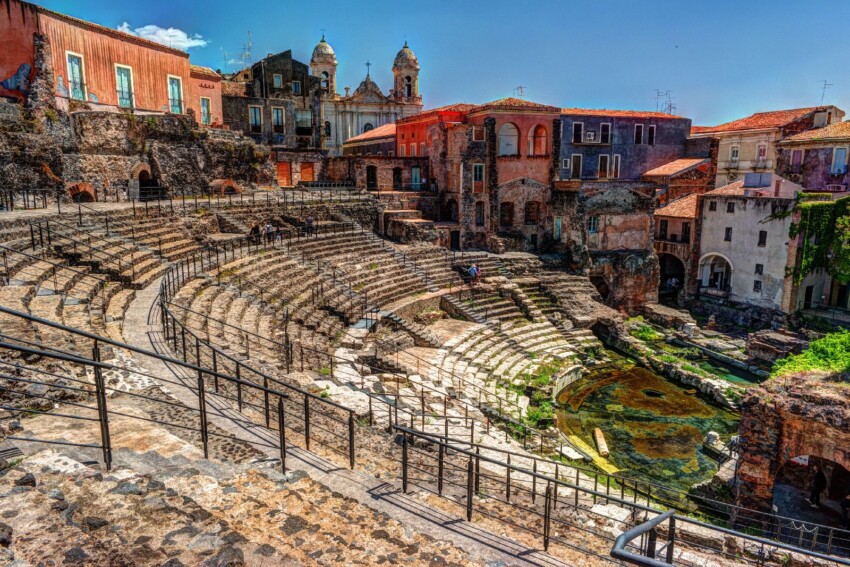
The underground thermal structures in Catania date to the fourth-fifth centuries, with only a small visible portion remaining beneath Cathedral Square. The name derives from an inscription on a marble slab, now fragmented into six pieces and displayed in the Civic Museum at Castello Ursino.
Access to the baths is gained through a barrel-vaulted corridor carved in the cavity between the cathedral’s foundations.
San Nicolò and the Benedictine Monastery
8Esedra di Piazza Dante, Piazza Dante Alighieri, 12, 95124 Catania CT, Italy
The Church of San Nicolò, begun in 1687, is the largest church in Sicily. The façade, never completed, is rhythmed by gigantic truncated columns. The interior is impressive for its vast space and lack of decorative elements. It contains some canvases from the seventeenth and nineteenth centuries placed on altars, a beautiful sundial enriched with zodiacal figures in the transept, one of the grandest existing organs and a splendid wooden choir.
Adjoining the church is the Benedictine monastery, one of Europe’s largest monastic complexes, a magnificent eighteenth-century building with a façade marked by pilasters and richly decorated window frames. The interior houses two cloisters, a refectory and libraries containing over 100,000 volumes and publications. Today it serves as the Department of Human Sciences of the University and hosts a cultural space where exhibitions, workshops and conferences are held.
Via Etnea is the main street, the most important and scenic thoroughfare in Catania’s historic centre, running in a straight line and stretching approximately 2.8 kilometres. It emerged at the end of the seventeenth century following the disastrous earthquake of 11 January 1693, and the palaces built along the street were constructed in Sicilian Baroque style by architects Giovan Battista Vaccarini and Francesco Battaglia.
Via Etnea runs from Cathedral Square to Tondo Gioeni, passing through Piazza Università with the Rectory and San Giuliano palaces and seven Baroque churches, including the splendid Collegiate Church.
Today it is the shopping street, pedestrianised and always bustling with activity, one of the most beloved places for locals and tourists alike.
Belliniano Civic Museum
10Piazza S. Francesco d'Assisi, 3, 95124 Catania CT, Italy
The current Belliniano Civic Museum occupies the house where composer Vincenzo Bellini was born on 3 November 1801 and spent his first sixteen years.
Inaugurated on 5 May 1930 in the presence of Vittorio Emanuele III, the museum is organised chronologically. The apartment comprises just five rooms, entirely filled with memorabilia tracing Bellini’s life and that of his family; paintings, books, original scores, musical instruments and the composer’s death mask.
Map
In the following map you can see the location of the main places of interest mentioned in this article.
Guided tours of Catania
Discover Catania through the eyes of expert guides who will take you on a tour of the city's hidden treasures. Participating in a guided tour will allow you to capture the true essence of Catania.
Just three kilometres from the city centre, La Plaia is Catania’s busiest beach and the main hub for both residents and visitors, boasting a beautiful stretch of fine sand.
Easy to reach and well-equipped with hotels, bars and restaurants, it’s the ideal spot to spend a few relaxing hours after exploring the city.
A stroll through Pescheria
Vibrant colours, pungent aromas and a creative display of wares characterise Pescheria, Catania’s market, located on Piazza Di Benedetto, Piazza Pardo and several adjoining streets.
Surrounded by lobsters and seafood arranged alongside succulent, colourful citrus fruits, a walk through here is the perfect way to immerse yourself in authentic Catanese life.
Baroque palace tour
Catania is renowned for its magnificent baroque palaces, built following the 1693 earthquake.
Palazzo Municipale, the Duomo and Badia di Sant’Agata are the most famous, though there are many others, particularly buildings such as the churches of Santa Chiara, Santa Maria dell’Aiuto and Casa di Loreto, San Biagio, SS. Trinità, San Nicola, alongside the Benedictine Monastery, Palazzo dell’Università, Porta Uzeda and Porta Ferdinandea.
A historical and cultural tour of the monuments and palaces of reconstructed Catania offers a wonderful opportunity to discover the city’s rich history and architecture in depth.
An excursion to Mount Etna
The Etna is a natural spectacle offering countless ways to explore and admire the unique landscapes of Europe’s highest volcano through nature hikes.
You can also take a train ride on the Ferrovia Circumetnea, which circles the lower ring of the volcano, go on a guided walk or join an off-road tour.
The walks combine adventure with learning and allow you to marvel at the Bove Valley and explore a lava cave: Mount Etna is home to around 200 caves, used since ancient times as refuges, cemeteries and sacred sites.
For an evening of cultural entertainment, catch a show at the renowned Teatro Massimo Bellini, one of Europe’s great temples of music.
The theatre is Catania’s premier opera venue and is celebrated for its opera and concert performances.
A visit to Le Ciminiere cultural centre
Near the central station, the Le Ciminiere cultural centre is a complex that once housed sulphur refineries.
Following a lengthy period of abandonment, the buildings were refurbished and integrated with new structures, creating one of the city’s most vibrant centres for cultural events, concerts and thematic gatherings.
In the footsteps of the Malavoglia
For literature enthusiasts, a tour retracing the life of Giovanni Verga, the celebrated Italian “verista” writer, is unmissable.
The Giovanni Verga trail begins on Via S. Anna, with the writer’s birthplace: on the second floor of an elegant building, you’ll find 2,800 books by the author, period photographs, self-portraits and original reproductions of his works. From there, the route moves to Corso Italia, where the Monumento alla Provvidenza depicts the shipwreck of the Malavoglia family’s vessel, the tragic event in which Bastianazzo, padron ‘Ntoni’s son, lost his life.
Finally, by bus you travel to Aci Trezza, where his celebrated masterpiece I Malavoglia is set.
 Hotel
Hotel  Budget accommodations
  Apartments
  Family Hotel
  Luxury Hotel
  Resorts