Capuchin Catacombs
With over two thousand perfectly preserved mummies, the Capuchin Catacombs in Palermo are a grim spectacle, yet fascinating in their own way.
The Capuchin Catacombs of Palermo are undoubtedly the world’s most extensive and extraordinary collection of mummies, as well as an exceptional testament to how the customs and habits of Palermo have changed over the centuries.
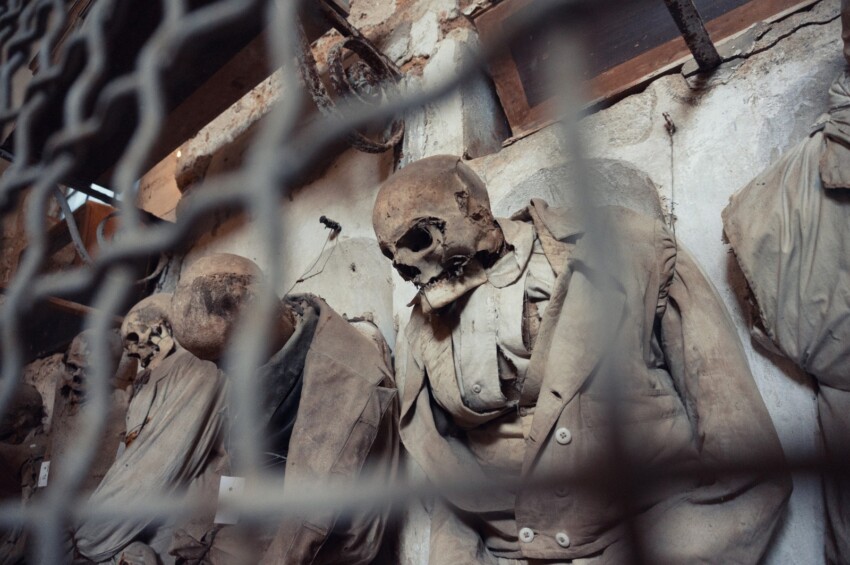
Across 300 square metres of galleries carved into tufa stone lie the mummified remains of thousands of Palermitan citizens of varying ages, social backgrounds and faiths, still dressed in their perfectly preserved clothing. Contrary to Sicily’s image as a sunny and vibrant place, one of Palermo’s most intriguing tourist attractions is therefore linked to death.
This macabre spectacle, born from a chance discovery, provokes mixed reactions: some find it eerie, others admire its historical significance, whilst others are simply fascinated by how these bodies have remained unchanged.
Whether you’re an enthusiast, simply curious about human oddities, or a traveller keen to journey through Palermo’s history, the Catacombs of the Capuchin Convent in Palermo are truly something unique to see.
Best-selling tickets and tours in Palermo
History of the Capuchin Catacombs
The Capuchin Catacombs originated as the burial place for the friars of the Capuchin convent. When, at the end of the sixteenth century, the bodies of deceased monks were transferred to a new cemetery, it was discovered that 45 of them had remained perfectly preserved.
These natural mummies, considered at the time a gift of divine benevolence, were displayed upright in niches set into the walls of the first corridor of the Catacombs. Following this discovery, increasingly more people requested to be buried in the Capuchin cemetery.
In 1783, burial was officially granted to all those who could afford the costs of the mummification practices, which the friars had perfected over time. It therefore became necessary to enlarge the catacombs with the construction of new corridors.
The cemetery closed in 1880. From the seventeenth century until closure, thousands of people were mummified and displayed in the cemetery, giving the relatives of the deceased the opportunity to visit them and “see” them.
Today, the Capuchin Catacombs of Palermo are the world’s most impressive museum of death.
Visiting the Capuchin Catacombs
The famous Palermo catacombs are located in the underground chambers of the Capuchin Convent, attached to the church of Santa Maria della Pace in Palermo’s Cuba district.
The mummies, many of which are preserved in an upright position, are displayed in white niches carved into the tufa galleries. A plaque records their name, surname and date of death.
Walking along an exhibition of over two thousand mummies dressed in period clothing is an experience that will not leave you unmoved. It may provoke reflection on the fleeting nature of life and earthly vanities, curiosity about these people’s lives, or perhaps a touch of fear!
To distract yourself, you can search among the thousands of remains for the mummified body of the Count of Cagliostro, which Napoleon unsuccessfully sought during a visit to the Capuchin Convent.
Corridors of Death
The mummies are carefully organised by age, social status and profession. During your visit, you’ll walk through the so-called “corridors of death”, areas where mummies of a specific social category are preserved:
- Corridor of Capuchin friars: this is the original core of the Capuchin Catacombs, where the mummies of friars are displayed still wearing their humble cassocks;
- Corridor of prelates: they stand in stark contrast to the humble Capuchin friars with their rich ecclesiastical vestments;
- Corridor of women: noblewomen rest in this area of the convent, dressed in embroidered gowns and adorned with ornamental headdresses. The bodies of virgin women who died before marriage are gathered in a chapel known as the “Crucifix”, and wear white dresses;
- Corridor of men: here you can admire the mummified bodies of wealthy Palermitan bourgeoisie. Notice halfway along the corridor the last visible drainage channel;
- Chapel of children and corridor of families: the bodies of young children and entire families are preserved in this area of the catacombs;
- Corridor of professionals: here you’ll find the mummies of doctors, lawyers, painters, officers and soldiers. Among the “famous” mummies are those of sculptors Filippo Pennino and Lorenzo Marabitti and surgeon Salvatore Manzella.
The World’s Most Beautiful Mummy
After the cemetery’s closure in 1880, only two further bodies were admitted. One of these is that of Rosalia Lombardo, a two-year-old Palermitan girl who died in 1920: her father, devastated by grief, entrusted the child’s body to the renowned Palermo embalmer Alfredo Salafia so that he would make her “live” eternally.
The artificial mummification techniques employed on the little girl’s body meant that Rosalia’s mummy has a serene appearance, far removed from the stereotype of a mummy as something macabre and frightening.
On the contrary, all visitors see Rosalia as simply a child with the ethereal beauty of an angel immersed in peaceful, restorative slumber.
Rosalia’s face is serene, her blonde hair falls softly across her forehead, her skin is smooth: because of the incredible sensation of life that emanates from her figure, Rosalia Lombardo has become known as “the world’s most beautiful mummy” or “the Sleeping Beauty of Palermo“.
The other body admitted to the cemetery after its closure is that of Giovanni Paterniti, United States Vice-Consul, in 1911.
The first body displayed inside the underground cemetery of the Capuchins immediately after its opening in 1599 is that of Fra Silvestro da Gubbio.

 Hotel
Hotel  Budget accommodations
  Apartments
  Family Hotel
  Luxury Hotel
  Resorts