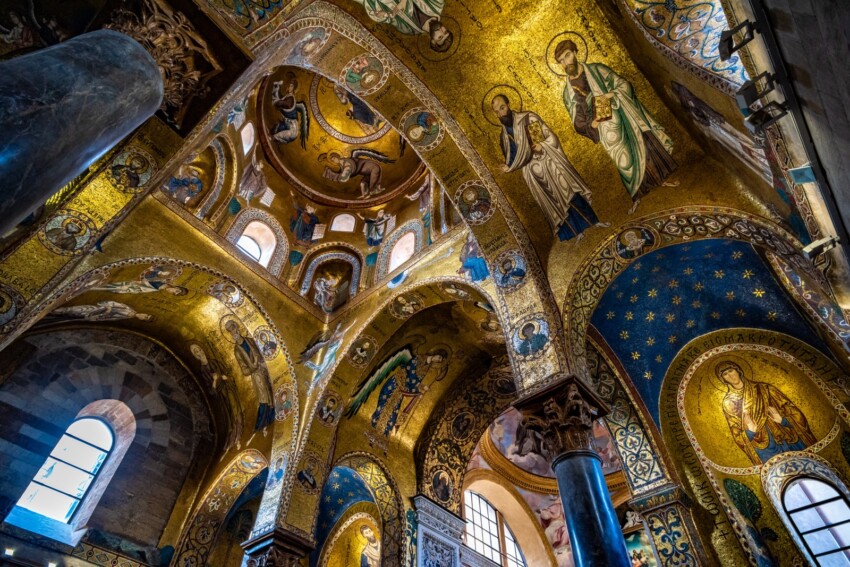
An unmissable stop on any Arab-Norman tour of Palermo is the Church of the Martorana, which conceals a magnificent display of mosaics and decorations behind a simple, linear façade.
Like other religious buildings in Palermo, the harmonious fusion of artistic styles that characterises the architecture and decorations of the Church of Santa Maria dell’Ammiraglio – the church’s official name – bears witness to the diverse populations who lived in and ruled over Sicily across the centuries.
The church is unique not only in its beauty but also in its religious function: it serves as the spiritual centre for more than 15,000 Albanian faithful of the Greek-Byzantine rite living in Italy.
The origins of the Church of the Martorana date back to the twelfth century. It was founded at the behest of George of Antioch, admiral of the fleet of King Roger II of Altavilla, to give thanks to the Virgin Mary for the protection she had afforded him throughout his years at sea.
The original church was built on an inscribed cross plan, typical of late-Byzantine churches and in keeping with George of Antioch’s intention that it serve for Greek-Byzantine worship.
Its current appearance is the result of work and restructuring over the centuries, particularly the baroque additions and the extensive restoration carried out by Giuseppe Patricolo in the late nineteenth century.
Today the church belongs to the Eparchy of Piana degli Albanesi, a Catholic diocese with Greek-Byzantine rite: a community that, whilst belonging to the Catholic Church, follows the rite and traditions of the Eastern Orthodox Church, a form of worship introduced to Sicily by Albanians who sought refuge here to escape Turkish persecution.
The Church of the Martorana is a true gem that never fails to captivate its visitors. Upon entering, you’ll be dazzled by the beauty and glitter of its gilded mosaics.
The mosaic cycle adorning the Church of the Martorana was completed before 1151: it is the oldest in all of Sicily and of immeasurable artistic value.
The centrepiece of this artistic composition is the image of the Christ Pantocrator in the dome, with four angels prostrated at his feet in an act of adoration. Eight prophets are depicted in the drum of the dome, and the four evangelists in the niches of the corner pendentives.
Other elements worthy of attention during a visit to the Church of the Martorana include:
The church’s full name is Church of Santa Maria dell’Ammiraglio, but everyone calls it the Church of the Martorana after Eloisa Martorana, the founder of a convent of Benedictine nuns who inherited the church in 1453.
It was these nuns who invented martorana fruit, the typical marzipan sweet that Sicilians eat on All Souls’ Day.
The idea for a colourful sweet shaped like fruit came to the sisters during the Norman period, following a papal visit: unable to serve fresh fruit as the harvest had already passed, the nuns set about crafting little almond paste fruits to hang on the trees, which could then be removed and eaten to impress their distinguished guest.

 Hotel
Hotel  Budget accommodations
  Apartments
  Family Hotel
  Luxury Hotel
  Resorts