Bestseller
Palermo: Cappella Palatina and Palazzo dei Normanni Tour
From 39,00 €
Buy the ticket
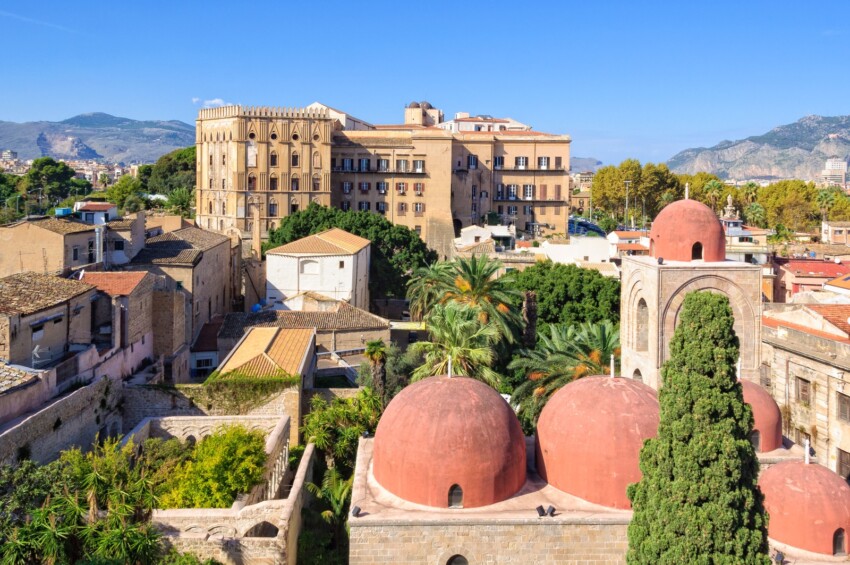
It is called the Palazzo dei Normanni, but its current appearance is the result of construction, demolition and successive layers added over centuries of history by Arabs, Spanish, French, Italians and, of course, Normans.
It is worth noting that the palace was built over one of the first Punic settlements, in the highest part of Palermo’s ancient city centre.
This austere fortress, also known as the Palazzo Reale, is therefore the result of diverse peoples and cultures—a characteristic shared by many other buildings in Palermo.
Over the centuries it served as the seat of administrative activities (a function it still retains today), as workshops for goldsmiths and textile production, and as a centre for cultural activities, most notably the Sicilian School of Poetry.
Because of its particularly distinctive structure, its remarkable history and the splendour of the Cappella Palatina housed within it, the Palazzo dei Normanni attracts countless visitors eager to explore one of Europe’s oldest royal residences.
The structure of the Palazzo dei Normanni is truly unique, comprising tower-shaped buildings linked together by porticoes and gardens.
To the original towers that existed in the Arab fortress and in the first palace of Roger II were later added the Pisana, Ioaria, Chirimbi and Greca towers: the first two are believed to have housed the apartments of the Norman monarchs and Frederick II of Swabia.
Located within the medieval Ioaria tower, the Sala dei Venti is one of the palace’s most enchanting rooms: it takes its name from the magnificent wooden ceiling, which features a compass rose.
Named after King Roger II, the extraordinary mosaics depicting hunting scenes and allegorical images of Norman power were commissioned by his son William I.
These halls were lavishly frescoed in the first half of the 17th century to transform the original spaces into summer audience chambers.
The Sala d’Ercole has been home to the Sicilian Regional Assembly since 1947, which means it is not open to the public on certain days.
Its name refers to the mythological Greek hero Hercules, depicted here in an 18th-century fresco cycle by the artist Giuseppe Velasco, nicknamed “the Velázquez of Sicily”.
The Sala dei Vicerè, the Sala Cinese and the Sala Pompeiana are furnished with 18th and 19th-century furniture and take their names from the fresco motifs that adorn them.
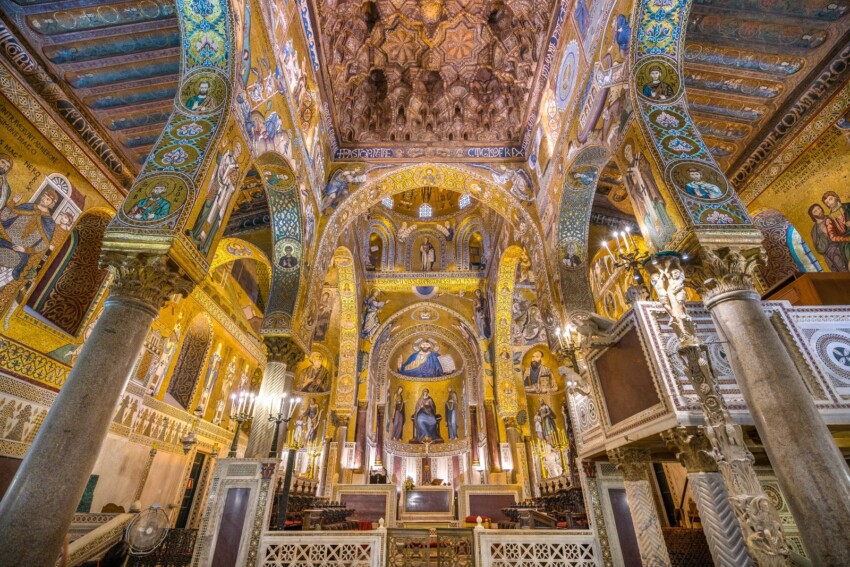
The jewel of the Palace, if one can speak thus of a religious building, is the extraordinary Cappella Palatina, which at the time of its construction in 1132 formed the centrepiece of the various structures that made up the palace.
Climb to the first floor of the palace to admire this magnificent three-naved basilica dedicated to Saints Peter and Paul, which writer Guy de Maupassant described as “the most beautiful church in the world”.
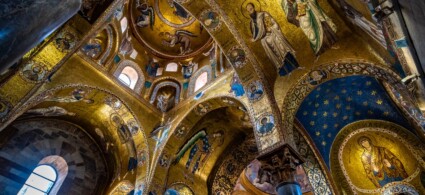
The glittering golden hue of the extraordinary mosaics adorning the dome, transept and apses is undoubtedly the defining feature of the church’s interior. The Byzantine mosaics of the Cappella Palatina tell stories from the Old and New Testaments, with exceptional skill in depicting details and expressions.
Don’t be dazzled by all this gold: look upward to also admire the particularly unusual wooden ceiling in the muqarnas style, a decorative solution characteristic of Islamic architecture.
The Chapel was consecrated in 1140 and its original external appearance was completely different from what we see today: the church originally stood isolated, but was later engulfed by more recent structures, which is why virtually nothing remains of the original façade.
The structure and decoration of the Cappella Palatina are infused with elements that reflect the policy of tolerance and openness towards other cultures promoted by King Roger II:
Bear in mind that the palace is home to the administrative offices of the Region, so the royal apartments may not be open to visitors on certain days.
There are several entrances to the Palace: the entrance for visitors is located in Piazza Indipendenza.
The Palazzo dei Normanni is one of the monuments included in the Arab-Norman route of the cities of Palermo, Monreale and Cefalù, designated a UNESCO World Heritage site.
Alternatively, take part in a guided tour—it’s the best way to explore the Palazzo dei Normanni and the Cappella Palatina.
The original nucleus of this monumental building is the qsar, a fortress built for defensive purposes by the Arabs in the first half of the 9th century AD.
The fortress became a royal palace in 1130 by the will of Roger II, Sicily’s first Norman king; two years later, the chapel now known as the Cappella Palatina was built within the palace and over a pre-existing church.
The transformation from fortress to palace was continued by Roger II’s successors, William I and William II, resulting in an articulated complex of towers connected by passages with rooms and spaces characterised by elegant architectural solutions and refined decoration, designed to welcome a noble and cosmopolitan audience.
The palace remained a royal residence until the end of the 14th century, when the Aragonese, then rulers of Palermo, abandoned it for reasons of security.
It was not until the 16th century that the palace regained its function as a royal residence, with the arrival of the Spanish viceroy: during this period, major works of modification, demolition and construction began, radically changing the palace’s appearance.
In the 18th century the new royal “residents” were the Bourbons, and following Italian unification, several ministerial offices were established in the palace.
Today the Palazzo dei Normanni is home to the Sicilian Regional Assembly, whilst one wing is owned by the Army.
 Hotel
Hotel  Budget accommodations
  Apartments
  Family Hotel
  Luxury Hotel
  Resorts