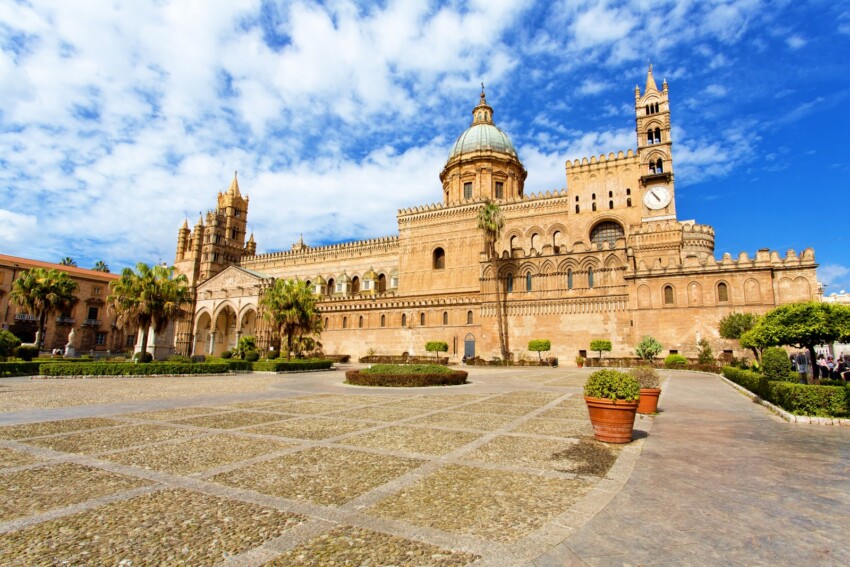
The Cathedral of Palermo – its full name is the Metropolitan Primatial Cathedral of the Assumption of the Blessed Virgin Mary – is one of the city’s most distinctive monuments: visiting it is like leafing through a history book of Sicily. It is the principal place of worship in Palermo and has been designated a UNESCO World Heritage Site.
Its remarkably original blend of styles, featuring elements of Greek, Roman, Arab, Norman, Catalan and Gothic art, is a direct consequence of the many different peoples who ruled over Sicilian soil throughout the centuries.
Dominating all others is the style of the twelfth century, the Norman style, though the appearance of the church as we see it today is owing to modifications and additions from the eighteenth century.
The cathedral is a magnificent edifice that will undoubtedly captivate you with the uniqueness of this harmonious fusion of different styles, the splendour of its richly adorned façade and its long and complex history.
It’s worth noting that for much of the year this architectural masterpiece stands out against a brilliant blue sky: truly enchanting.
The people of Palermo built their first cathedral as early as the fourth century AD, following Constantine’s Edict of Toleration. Nothing remains of that original construction, destroyed by the Vandals.
A new temple, dedicated to the Virgin Mary, was consecrated in 604 and subsequently modified by the Muslims, who in 831 transformed it into a mosque. When the Normans took Palermo, they restored the mosque to Christian worship in 1072.
A new cathedral, commissioned by Archbishop Gualtiero Offamilio, was completed in 1185: this is the first nucleus of the present-day cathedral.
The cathedral’s current appearance is the result of countless additions, modifications and restructurings over the centuries. Important structural changes took place during restoration work that began in 1781 according to a design by Ferdinando Fuga, carried out at the behest of the Bourbon king Charles III.
Palermo Cathedral is one of the unmissable monuments for anyone on holiday in Sicily’s capital. You could spend hours admiring the artistic and historical treasures that abound in the cathedral, both inside and out.
The Archdiocese of Palermo suggests three themed itineraries for those wishing to visit the Cathedral, which offer different ways of understanding the complex history and architecture of this most important monument:
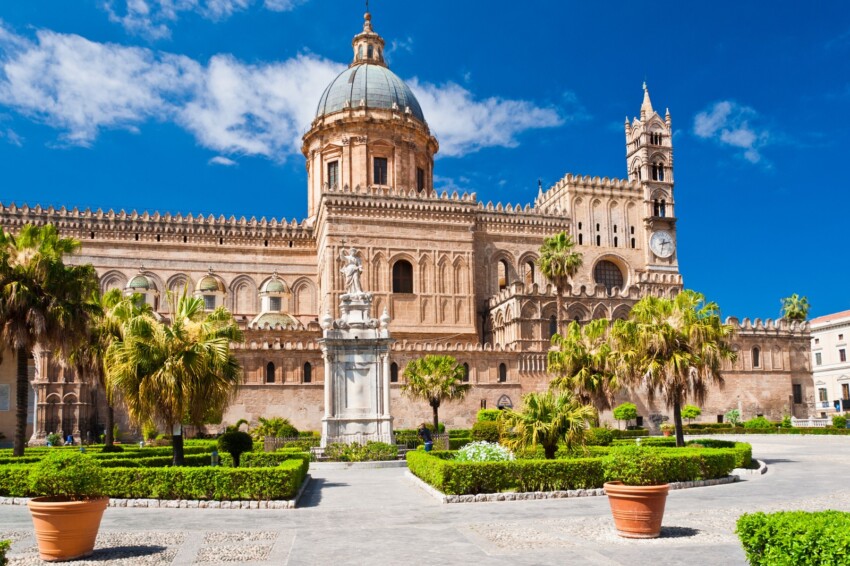
A tour around the exterior of Palermo Cathedral will give you the opportunity to admire the architectural and decorative work from 1170 to the present day.
The recommended route for admiring the magnificent exterior of Palermo Cathedral, richly decorated in different styles that reflect the city’s vicissitudes over the centuries, begins at the eastern elevation, made up of the façade of the crypts.
Continue with the southern elevation that opens onto Corso Vittorio Emanuele: stop to admire the sumptuous portico of the southern façade, a work created in the first half of the fifteenth century by Antonio Gambara, master of the Cathedral building works. This is a true masterpiece of Sicilian art, with stylistic features that draw on Catalan Gothic architecture at its most ornate.
Your tour concludes with the western elevation along Via Matteo Bonello.
The interior of Palermo Cathedral as we see it today is the result of transformation work carried out between 1781 and 1801, during which the original Norman architectural layout was replaced with a neoclassical one, in keeping with the tastes of the period.
The spacious central nave is flanked by two side aisles, which open onto numerous chapels, including the Chapel of the Royal Tombs. An important place of veneration for the people of Palermo is the Chapel of Saint Rosalia, where the remains of the city’s patron saint are preserved in a precious silver urn.
The crypt, consisting of two aisles with cross vaults, dates back to the sixth century AD and was subsequently modified by the Normans.1781-1801L
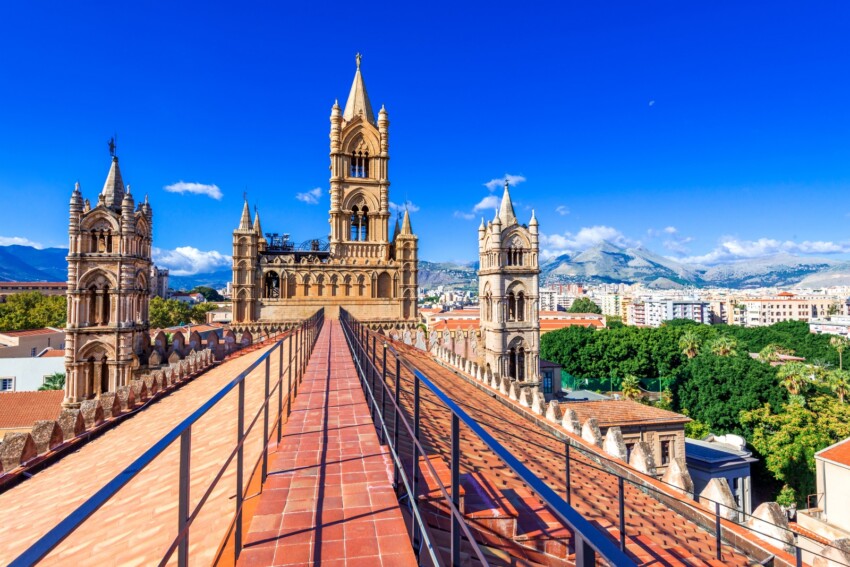
A highly evocative experience is the evening visit to the cathedral roofs, which allows you to discover the artistic and architectural elements of the monument’s outer walls and enjoy a view of Palermo from above.
Allow the charm of the city illuminated at night to captivate you; don’t forget your camera at home as you’ll certainly want to capture this breathtaking panorama in a photograph worthy of framing.
Please note! Unfortunately, due to the Cathedral’s structural conditions, roof visits are not permitted for people with heart conditions, claustrophobia, psychophysical disabilities or anxiety disorders.
One of the main attractions for those visiting Palermo Cathedral are the tombs of the Sicilian monarchs, the most famous of whom is undoubtedly Emperor Frederick II, known by the epithet “Stupor Mundi”.
His tomb of red porphyry is certainly striking, surmounted by a baldachin and resting on a base formed by two pairs of lions: it is a work of solemn and grand simplicity.
Besides the celebrated emperor, Frederick II’s father, mother and grandfather are also buried in Palermo Cathedral: Emperor Henry IV, Empress Constance of Altavilla and King Roger II of Sicily.
In a marble sarcophagus decorated with mosaics is buried Archbishop Gualtiero Offamilio, founder of the Norman Cathedral.
Palermo Cathedral houses works of the highest historical and artistic value. We highlight only a few of particular note:
In the rooms of the Cathedral Treasury you can admire vestments, furnishings, sacred silver, altar frontals and other precious objects created between the thirteenth and sixteenth centuries, but the most interesting pieces in the collection are without doubt the crown and jewels of Constance of Aragon, wife of Frederick II.
Entrance to the Cathedral is free, but you must pay a ticket to access the monumental area consisting of the treasury and crypt rooms, the royal tombs area and the roofs.
To visit the monumental area you can choose from different tickets at various prices, which give access to the whole area or only parts of it.
Palermo Cathedral is part of the sacred art circuit of the Palermo area, an agreement that allows ticket holders at one of the participating sites to enjoy a discounted ticket at the other monuments.
The monuments included, besides Palermo Cathedral, are:

 Hotel
Hotel  Budget accommodations
  Apartments
  Family Hotel
  Luxury Hotel
  Resorts