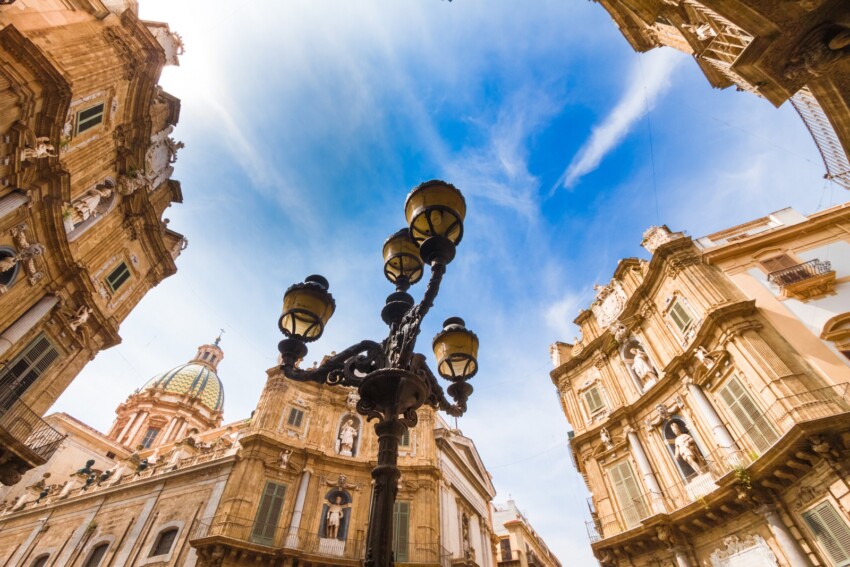
In the heart of ancient Palermo, where two of the city’s main streets meet, lies an unusually octagonal piazza that locals call the Quattro Canti.
The octagonal piazza is actually called Piazza Vigliena and is formed by the intersection of Via Maqueda with Via Vittorio Emanuele, framed by architectural façades.
Overlooking the piazza are the convex façades of four magnificent Baroque buildings: known as cantoni, they mark the ancient division of Palermo into four easily recognisable districts: Kalsa, La Loggia, Capo and Albergheria.
It is a place rich in history and culture, waiting to be discovered and admired during a leisurely stroll through the historic centre of one of Italy’s most captivating cities.
In 1609, nine years after Via Maqueda was inaugurated, at the behest of viceroy Giovanni Fernandez Paceco, Duke of Villena, the octagonal piazza was created, which would later become known as the Quattro Canti.
The eastern and western cantoni were completed that same year, though it would take three years to finish the southern cantone and eleven years for the northern one.
The arrangement of the statues, carried out by Mariano Smiriglio, engineer of the Palermo Senate, began only in 1617.
The architectural splendour of the cantoni of Piazza Vigliena will certainly captivate you, with their four richly adorned Baroque façades spanning three levels.
The three levels of the cantoni are decorated with classical architectural orders (Ionic, Doric or Corinthian depending on the level), coats of arms and statues; a further decorative feature of the lower level is a fountain symbolising one of the rivers that once flowed through Palermo.
In total, twelve statues adorn the three levels of the four cantoni. On the first level are statues representing the four seasons, whilst the second level features the statues of Spanish kings Charles V, Philip II, Philip III and Philip IV.
The statues adorning the third order of the façades of the buildings in Piazza Villena represent four saints who were patrons of Palermo before Santa Rosalia was elected the city’s patron saint.
Less famous than “Santuzza”, Saint Agatha, Saint Christina, Saint Ninfa and Saint Oliva were once the subject of profound devotion, and statues dedicated to them can be found in various churches throughout the city, including the magnificent Cathedral.
Quattro Canti is not the only name by which Piazza Vigliena is known: the piazza is also renowned by the names of:
Piazza Vigliena is also called Piazza Villena.
The Quattro Canti feature as a location in the film Palermo Shooting: several key scenes from Wim Wenders’ film, presented at the Cannes Festival, were shot here.
“I Quattro Canti” is also the title of an episodic novel set in Palermo in the early 1980s, written by Palermo-born journalist Giuseppe Di Piazza and published in 2012.
There are no statues of Santa Rosalia in Piazza Vigliena, though one can be found in the nearby Piazza Pretoria.
After admiring the Quattro Canti, a short walk will lead you to another of Palermo’s marvels. In the vicinity of the Quattro Canti stands another important piazza, Piazza Pretoria, home to a true jewel of the Florentine Renaissance.
The sixteenth-century Fontana Pretoria, which graces its namesake piazza, was created in Florence by sculptor Francesco Camilliani and subsequently purchased by the city of Palermo, dismantled into over 600 pieces and transported to the Sicilian capital. Damaged during transport, it was reassembled and adapted by Camillani’s son, who completed the work in 1581.
Elliptical in shape, the monumental fountain occupies the centre of the piazza and is decorated with statues representing pagan deities, animals, men and women.
These artistic nudes are responsible for the epithet “Piazza della Vergogna” (Piazza of Shame) by which Piazza Pretoria is known: it seems the first to be scandalised by the nudity of the figures represented were the nuns of a convent of enclosed sisters that once stood beside the piazza.

 Hotel
Hotel  Budget accommodations
  Apartments
  Family Hotel
  Luxury Hotel
  Resorts