Bestseller
Palermo: Teatro Massimo Opera House Guided Tour
From 14,00 €
Buy the ticket
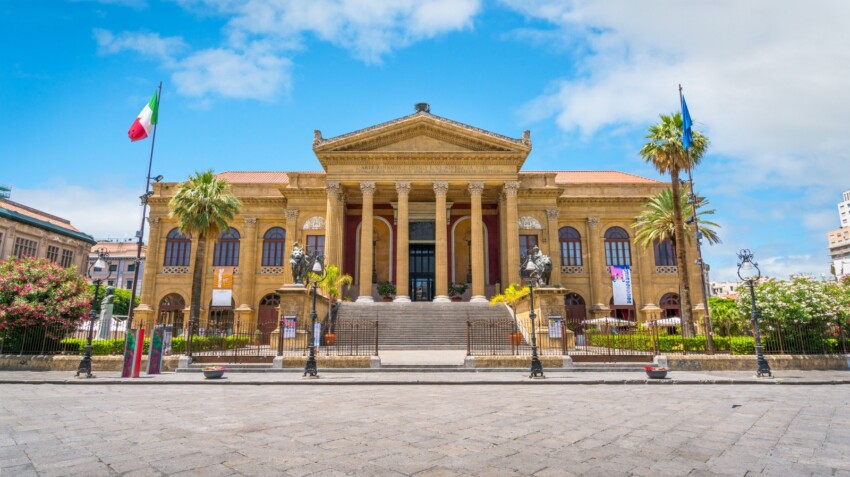
In the heart of Palermo’s Piazza Verdi stands the Teatro Massimo, Italy’s largest opera house and one of Europe’s grandest theatres.
This magnificent neoclassical building, constructed in the late nineteenth century, has become an iconic symbol of Palermo: essential viewing for opera and ballet enthusiasts, yet its beauty will captivate even those who rarely venture into a theatre.
The exterior will leave you breathless with its monumental scale, featuring an enormous dome and a magnificent staircase flanked by two proud bronze lions. Inside, you’ll find a riot of brocades and inlaid woods, mirrors, chandeliers and marble.
The theatre welcomes visitors daily through guided tours: as you explore its halls, you’ll discover the secrets of artistic production, experience the refined atmosphere of a bygone era, and feel like a nineteenth-century nobleman on an official outing.
Yet the true magic of this historic venue lies in attending one of the scheduled performances: let your heart be stolen by a romantic pas à deux, by the poignant notes of a piano, or by the piercing soprano of an internationally renowned diva.
The story of Palermo’s Teatro Massimo begins before Italian unification, born from the city’s desire for a new, spacious and modern theatre.
A public design competition was announced in 1863 for the theatre’s construction, though the final ranking wasn’t determined until 1868. The competition was won by Palermitan architect Giovan Battista Filippo Basile.
Construction began in 1875; following the architect’s death, his son Ernesto oversaw the remaining work.
On 16 May 1877 came the theatre’s official opening with Verdi’s Falstaff, performed in Palermo for the first time.
From 1974 to 1997 the theatre remained closed for restoration; the Berlin Philharmonic’s concert, conducted by Franco Mannino and Claudio Abbado, marked the theatre’s reopening.
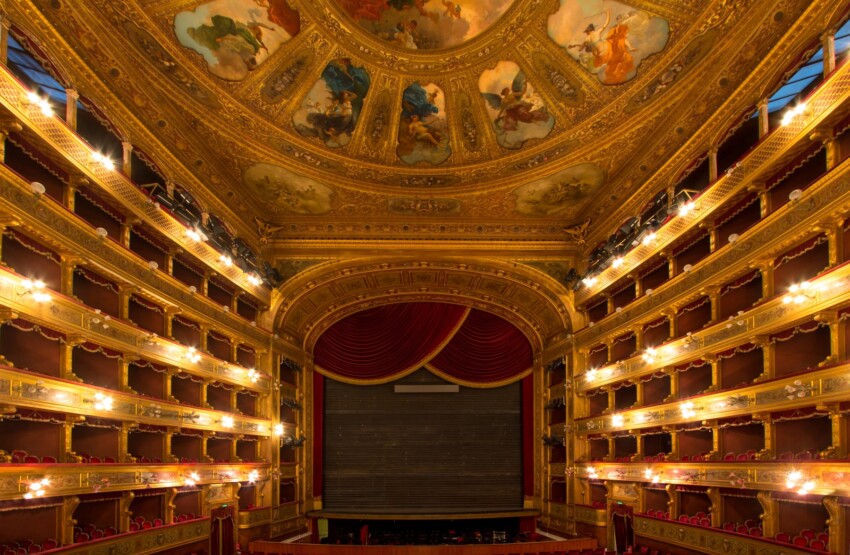
The renowned Teatro Massimo’s main hall, shaped like a horseshoe and praised by theatre enthusiasts worldwide for its perfect acoustics, was originally designed to hold 3,000 spectators; for safety reasons, current capacity is “only” 1,381 seats.
Upon entering the Main Hall for a tour or performance, you’ll be dazzled by the magnificence of its decorations.
Look upwards to admire the ceiling, the famous “Symbolic Wheel“, consisting of eleven painted canvas panels arranged in a wheel around a central roundel depicting the Triumph of Music. Thanks to an ingenious pulley system, these panels can open upwards to ventilate the hall—a masterpiece of art and engineering!
Once reserved for nobility, the sumptuous Royal Box could seat up to 27 people. Today everyone can admire this marvel of mahogany and brocade, mirrors and Murano glass chandeliers.
Adjoining the box is a private foyer, known as the Royal Salon or Sovereign’s Salon.
Once reserved for the nobility, the elegant Pompeian Room with its circular form and decorations clearly echoes the Temple of Vesta in Tivoli.
The decorations all reference the number 7 and its multiples—a symbolism tied to the seven planets and seven lunar days, the seven deadly sins and seven virtues, the seven musical notes and seven strings of the lyre.
The ballet company’s rehearsal room is a rectangular hall characterised by warm terracotta tones evoking nineteenth-century ballroom salons.
The coats of arms that give the hall its name belong to noble Sicilian families whose emblems decorate the walls.
Once a gathering place for artists, nobles and intellectuals, the Bellini Box today hosts meetings and elegant cocktail parties. The box’s walls display signed photographs of artists, testament to its former role as an intellectual hub.
The Teatro Massimo’s foyer is a sumptuous introduction to the magnificence awaiting you within. In a red reminiscent of autumn leaves—hence called “October red”—this rectangular hall is decorated with bronze statues and candelabras and serves as a venue for concerts and exhibitions.
The UN Hall is a circular room decorated with 14 cherry wood columns, hired out for events and concerts.
During the UN’s 2000 World Conference on Transnational Organised Crime held in Palermo, a concert conducted by Zubin Mehta and performed by the Teatro Massimo Orchestra and Choir featured Beethoven’s Ninth Symphony. This occasion gave the hall its name.
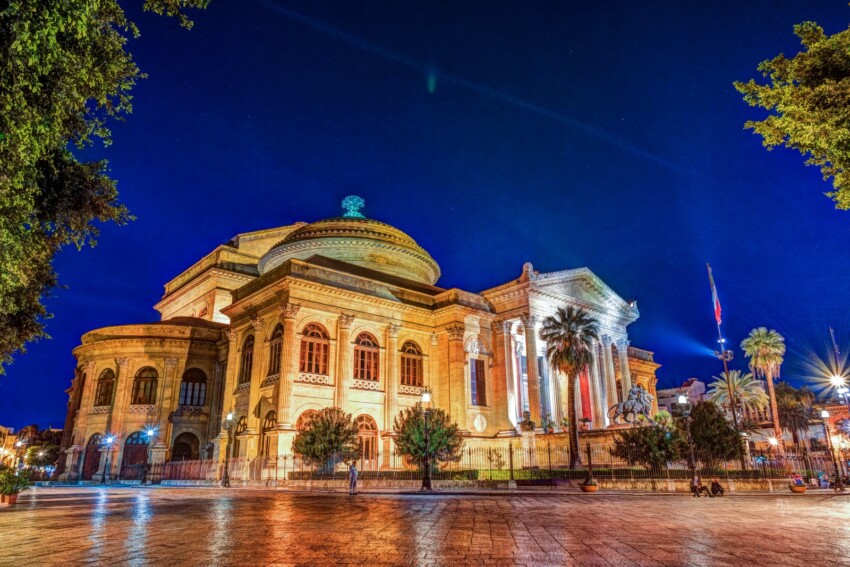
One of Palermo’s most thrilling experiences is a tour of the Teatro Massimo: a fascinating journey through the theatre’s halls granting you access to backstage areas and spaces normally off-limits to the public.
The standard guided tour includes the Main Hall, the salon adjoining the Royal Box, the Pompeian Room, the Hall of Coats of Arms and the Foyer.
You can also experience the thrill of stepping onto a stage like an opera star or prima ballerina: for a small additional fee, you can visit the stage and discover the secrets behind theatrical magic.
The format of stage visits varies according to the theatre’s production and artistic requirements.
In addition to the guided tour, you can book a visit to climb onto the theatre’s terrace for breathtaking views across Palermo from one of its most iconic monuments.
Groups of at least 10 people can book an exclusive aperitif in the Royal Salon adjoining the Royal Box, sipping a drink from an elegant red velvet armchair, just as a nineteenth-century nobleman would have.
If you’re a group of at least 30 people, you can reserve an exclusive tour featuring a visit to the halls and boxes, a private concert in one of the theatre’s foyers and time spent in the Royal Salon.
The theatre offers café facilities, cloakroom, bookshop and library services.
Located in central Palermo, the Teatro Massimo is easily accessible by city buses or on foot. It’s about a 10-minute walk from the Quattro Canti, whilst from Palermo’s central station, port and cathedral allow roughly 15 minutes.
If you’re driving, you can park at Piazzale Ungheria or Piazza Vittorio Emanuele Orlando.
 Hotel
Hotel  Budget accommodations
  Apartments
  Family Hotel
  Luxury Hotel
  Resorts