Etna: Guided Summit Hiking Tour up to 3400m, Optional Pickup
5.822 reviews
Buy now
From 55,00€ per person
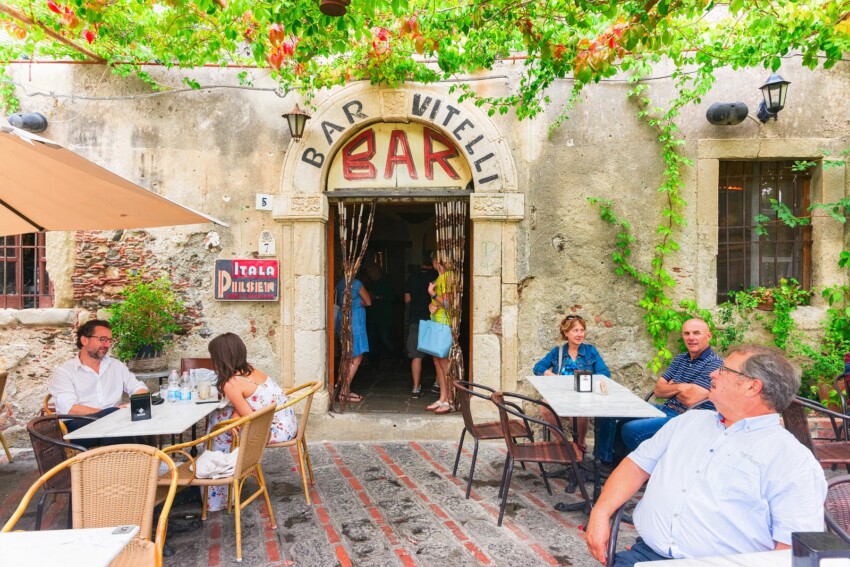
Sicily has been one of the world’s most beloved film sets for decades. Its layered landscape — golden baroque, crystal-clear sea, smoking volcanoes and alleyways steeped in history — has inspired Italian and international directors, transforming villages, piazzas and cliffs into visual icons recognised by millions of viewers. It’s no coincidence that the island has returned to the global spotlight with productions like The White Lotus, confirming a cinematic tradition that goes back to post-war masterpieces.
Visiting Sicily following film locations means discovering authentic places that mass tourism often overlooks: a hilltop village in the Ragusa hinterland where Coppola shot scenes from The Godfather, an ancient Greek theatre that served as a backdrop for international productions, a coastline that the world has come to know through the eyes of Inspector Montalbano. Sicilian film tourism is not mere nostalgia: it’s a concrete and compelling way to read the territory.
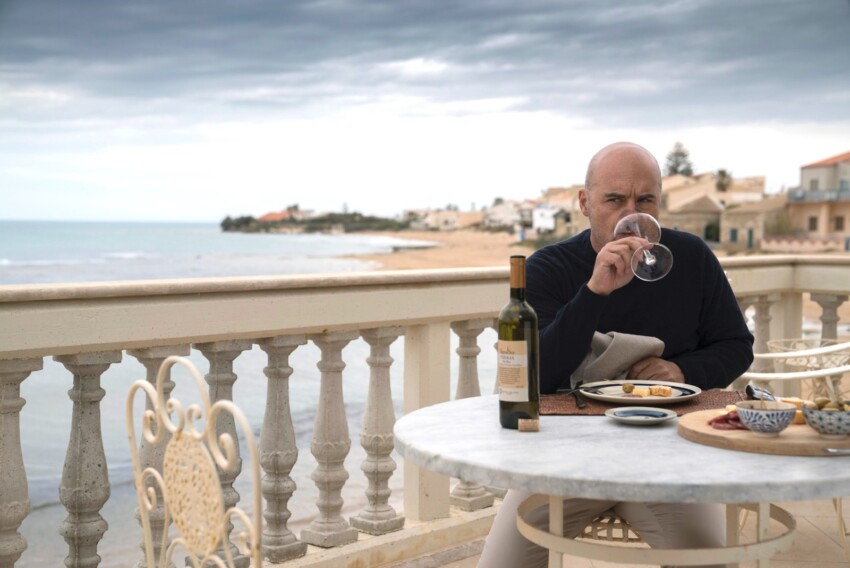
No production has done more than Inspector Montalbano to shape the tourist image of eastern Sicily. The RAI series based on Andrea Camilleri’s novels, which aired from 1999 to 2021, transformed a handful of towns in the province of Ragusa into pilgrimage destinations for fans from around the world.
Ragusa Ibla plays the role of Vigata, the imaginary city where the inspector operates. The limestone alleyways, baroque churches and panoramic staircases are instantly recognisable to regular viewers. The Piazza del Duomo, with the Church of San Giorgio, is probably the most replicated shot from the entire series. Walking through Ragusa with film stills in hand becomes a game of continuous recognition.
Scicli is home to Vigata Police Headquarters, housed in the Palazzo Municipale on Corso Mazzini. This is where Montalbano works, argues with the police chief and returns punctually after investigations. The historic centre of Scicli, a UNESCO World Heritage site alongside other Sicilian baroque towns, deserves a visit regardless of the series connection: rupestrian churches, noble palaces and an atmosphere suspended in time that the camera captured perfectly.
At Punta Secca, a seaside hamlet of Santa Croce Camerina, you’ll find Montalbano’s sea-facing house, which has become one of the most photographed locations in all of Sicily. The building is recognisable by its veranda and the rocks in front where the inspector takes his morning swim in opening scenes. Not far away is Modica, another recurring series location, also famous for its renowned spiced chocolate.
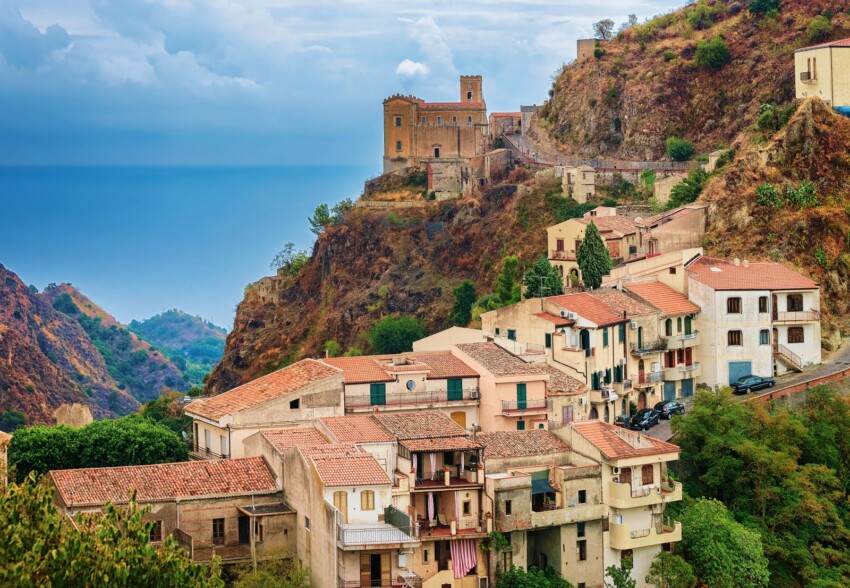
In 1971 Francis Ford Coppola brought the Godfather crew to Sicily to film scenes set in Michael Corleone’s homeland. He chose two villages in the Peloritani mountains in the Messina hinterland, which in appearance and atmosphere perfectly embodied the idea of arcane, untouched Sicily that the film required.
Savoca, perched on a rocky outcrop just a few kilometres from Taormina, is the village where Michael asks Apollonia’s father for permission to court her. The Bar Vitelli, where the scene was filmed, still exists and has become a must-visit for film fans: inside it displays scene photographs, newspaper clippings and memorabilia that tell the story of those filming days. The Church of San Nicolò, with its panoramic forecourt, is another recognisable set.
Forza d’Agrò, just a few minutes’ drive from Savoca, is home to the Chiesa della Trinità which appears in the film during the wedding scene. The village has remained extraordinarily intact, with a Norman-Aragonese castle and lava-stone alleyways that seem unchanged since the Seventies. Those renting a car can easily connect these two stops to a visit to Giardini Naxos and the Ionian coast, creating an itinerary of great landscape variety.
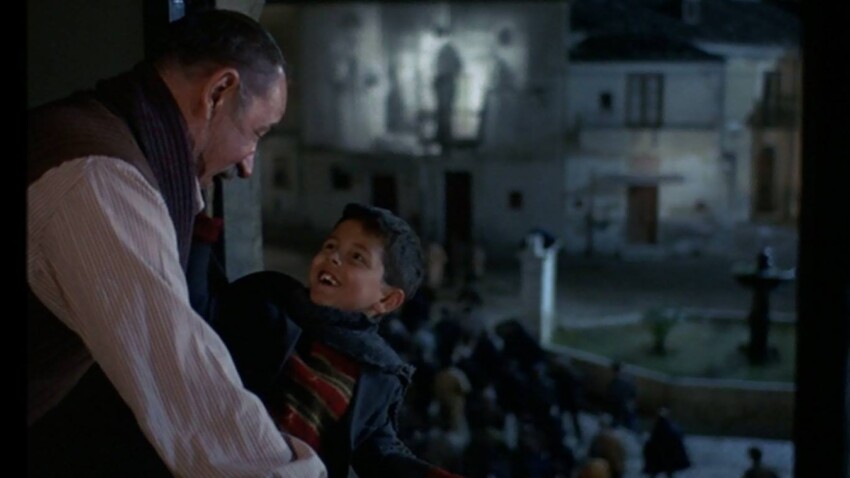
Giuseppe Tornatore’s film, awarded the Oscar in 1990, is perhaps the most moving testament to Sicilian cinema’s love for its own places. Cinema Paradiso was filmed mainly in Palazzo Adriano, a small town in the heart of the Madonie mountains, about 70 kilometres from Palermo.
Piazza Umberto I in Palazzo Adriano is the film’s main location: here you’ll find the mother church, the fountain and the spaces that young Totò runs through. The town, Albanian-speaking and with a unique cultural history linked to the Arbëreshë communities, still retains an old-world atmosphere that Tornatore had intuited perfectly. Many local residents participated as extras and maintain a living emotional bond with the film.
Some scenes were also filmed in Cefalù, the Tyrrhenian coastal town with its famous Norman cathedral. Cefalù appears in some sequences as a backdrop to coastal Sicily, and its compact beauty — the waterfront, the Rocca, the medieval centre — makes it an unmissable stop in its own right. Those visiting the Palermo hinterland following Tornatore’s footsteps can combine Palazzo Adriano with a stop at the Madonie Park.
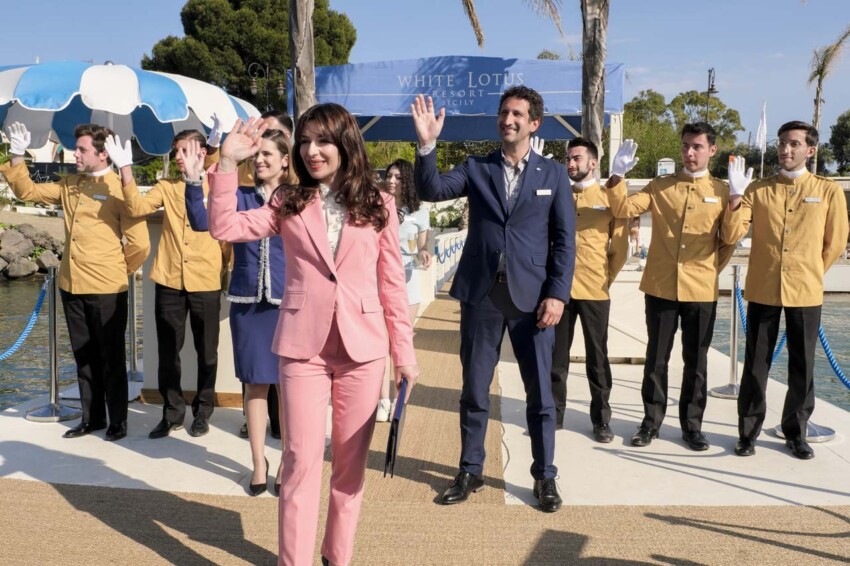
In 2022 the second season of The White Lotus, the HBO series created by Mike White, transformed Taormina into a global trend destination. Filming took place mainly inside and around the San Domenico Palace, a hotel housed in a 15th-century Dominican convent, with views over Mount Etna and the sea.
Taormina has been one of Sicily’s most frequented destinations for over a century, but the series introduced the city to a younger international audience. The Ancient Theatre, with its framing of Mount Etna, appears in several series scenes and remains one of the best-preserved Greek amphitheatres in the Mediterranean. The Corso Umberto staircase, the ceramic shops, the Public Garden with its views: everything the series frames is real and accessible.
Filming extended to Noto, Syracuse and some private villas on the eastern coast. Those following the series route can build an itinerary crossing the Syracuse province, stopping in Noto for its pristine baroque and Ortygia for sea views.
Insular Sicily has an equally rich cinematic history. Roberto Rossellini filmed Stromboli in 1950 with Ingrid Bergman as the star, using the volcanic island as a naturally powerful dramatic set. Stromboli was chosen precisely for its untamed nature: the active volcano, the rough sea, the little fishing village. The film is also the story of the love affair between Rossellini and Bergman, one of the most famous in cinema history.
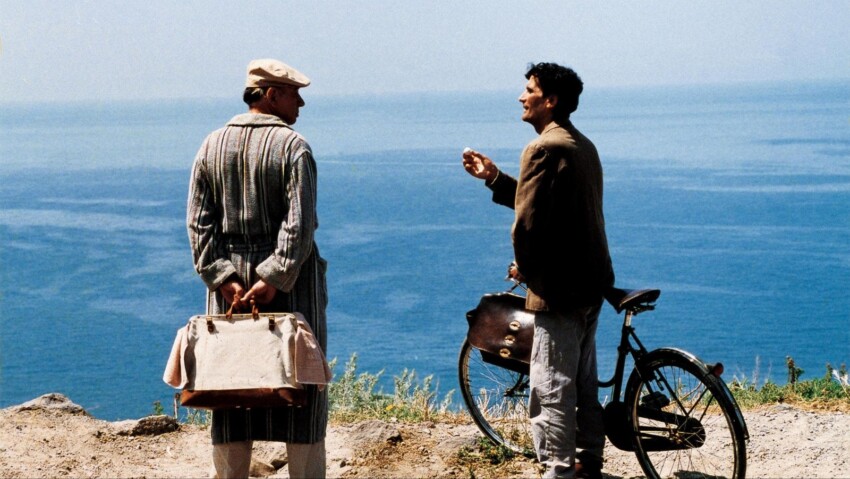
Salina is the island where Michael Radford’s Il Postino (1994) was filmed, with Massimo Troisi playing Mario Ruoppolo. Filming took place mainly in Pollara, a hamlet overlooking a bay of rare beauty formed inside a volcanic crater. Pollara beach, accessible only on foot or by boat, has remained faithful to the image the film gave it. Salina is today one of the Aeolian Islands most appreciated for slow and nature tourism.
Pantelleria hosted the set of Luca Guadagnino’s A Bigger Splash in 2013, with Tilda Swinton, Ralph Fiennes and Dakota Johnson. The film uses the island as a character in its own right: the dammusi, the empty streets, the wind and white sunshine. Pantelleria remains an authentic and uncrowded destination, ideal for those seeking a Sicily far from the beaten path.
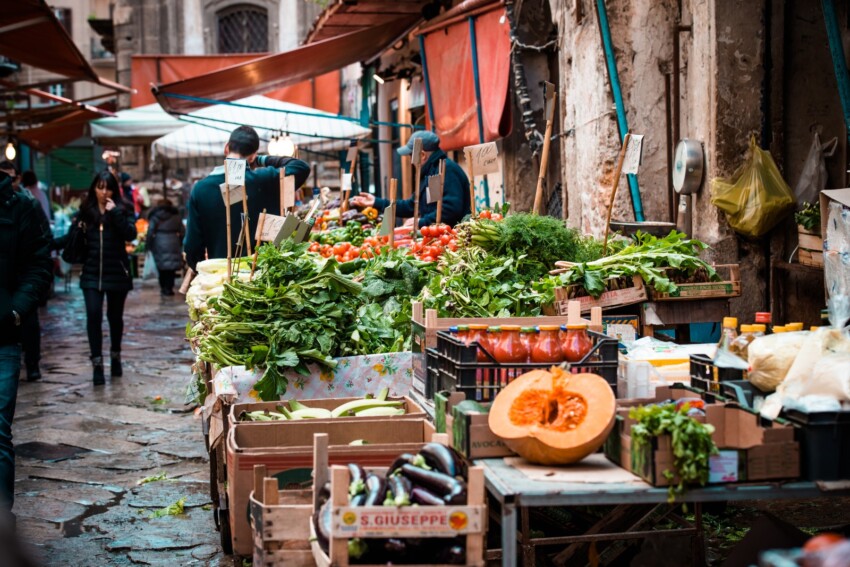
Palermo has hosted numerous national and international productions, exploiting its unique architectural layering: Arab-Norman, baroque, Art Nouveau and contemporary coexist within just a few square kilometres. The Montalbano series occasionally used Palermo, but the city has particularly attracted productions requiring complex and contrasting metropolitan aesthetics.
The Massimo Theatre has appeared in scenes from international films, including the final sequence of Coppola’s The Godfather Part III (1990), where the monumental staircase serves as a backdrop to the final tragedy. It’s one of Europe’s largest opera houses and a visit inside — with or without the film reference — is a hugely impressive experience. Palermo’s historic markets, such as the Vucciria and Ballarò, frequently appear in documentaries and dramas as symbols of the city’s chaotic vitality.
The Scala dei Turchi, the white limestone cliff in the territory of Realmino, has been chosen for international music videos and advertising campaigns. Its naturally stepped form and contrast with the blue sea make it visually irresistible. Nearby are Agrigento and the Valley of the Temples, also set for historical productions and documentaries on classical antiquity.
The geographic spread of Sicilian film locations makes car rental practically essential for those wanting to follow more than one location. Many of the most cinematic villages — Savoca, Forza d’Agrò, Palazzo Adriano, Punta Secca — are located away from main public transport routes and are conveniently reachable only by car.
Those with a week available can divide their stay between eastern and western Sicily: the first three days dedicated to the Ragusa and Syracuse area (Montalbano, The White Lotus, Noto), the central days to the Ionian coast and the Messina region (The Godfather, Taormina), the final part to Palermo and surroundings (Cinema Paradiso, The Godfather Part III). For a two-week itinerary you can add the islands: the Aeolian Islands for Stromboli and Salina, or Pantelleria for those passionate about Guadagnino cinema.
A practical tip: many villages of Sicilian film tourism are also UNESCO World Heritage sites or of the highest architectural value, so a visit has dual merit regardless of the film connection.
 Hotel
Hotel  Budget accommodations
  Apartments
  Family Hotel
  Luxury Hotel
  Resorts