El Homs Palace Hotel
Comiso - Via Gen Girlando 49
Book now
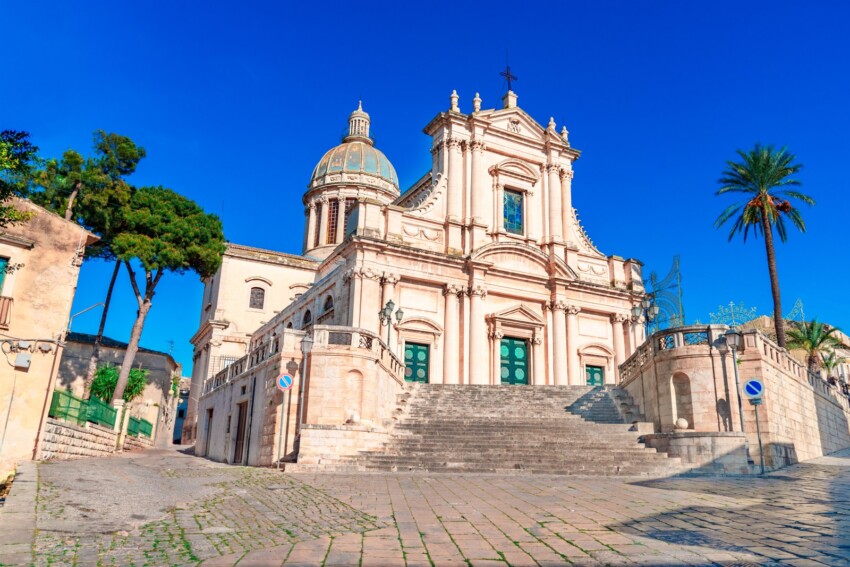
Located in the heart of the Dirillo Valley, Comiso is a town in southern Sicily that sits at the foot of Monte San Nicola, surrounded by notable places such as Vittoria, Ragusa and Chiaramonte Gulfi. Comiso’s origins are truly ancient, though the first urban settlement developed mainly during the medieval period, initially under Arab rule and later under the Normans, with significant growth occurring during the Renaissance. Its history largely mirrors that of Sicily itself, having been ruled successively by the Aragonese, Bourbons and finally the House of Savoy.
The town enjoyed a period of particular splendour and development from the 16th century onwards, when it came under the control of the Naselli family, who governed it for nearly three centuries, constructing not only churches, convents and monasteries but also an important public hospital. Over the years, the family commissioned buildings of considerable artistic value, including Castello dei Naselli d’Aragona, the Theatre and the Church of Santa Maria delle Stelle. The family’s control of the town continued until the abolition of feudalism in Sicily, decreed by Ferdinand of Bourbon in 1816.
Comiso came into the spotlight during the Second World War after establishing the Republic of Comiso in 1945, an independent territory governed by a popular government that opposed the war and had enacted its own laws. With the end of the war, the town remained at the centre of public attention because one of NATO’s most important military bases during the Cold War had been created at its airport. The presence of this base was always the subject of debate and controversy, as it was viewed unfavourably by many citizens and peace activists.
Today, Comiso is a charming Sicilian destination that attracts visitors for its historical and architectural heritage, natural beauty and gastronomic traditions. Moreover, although the town has no beaches, it is considered an excellent base for reaching the coastlines of nearby beach resorts such as Marina di Ragusa and Pozzallo. Comiso Airport, originally opened as a NATO military facility, has been converted to civilian aviation since 2013 and offers connections to various Italian and European cities.
The town is characterised by a well-preserved historic centre whose heart is Piazza Fonte Diana, an area that houses the Town Hall and features a statue of the goddess Diana at its centre. According to legend, the statue was placed here because the goddess would come to bathe at a spring that once flowed in this spot. From the square, narrow and picturesque alleyways lead off in various directions, lined with ancient churches, stately mansions, shops and restaurants, eventually reaching Piazza delle Erbe, which once housed the town market.
The powerful earthquake that struck Sicily in 1693 caused deaths and destruction in Comiso as well, and afterwards the town was rebuilt by the Naselli family following the baroque style that was very popular at the time.
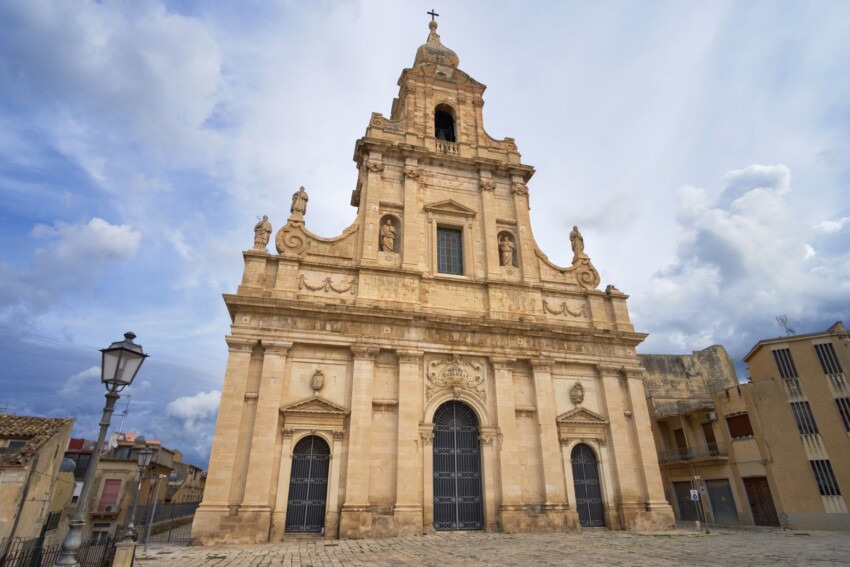
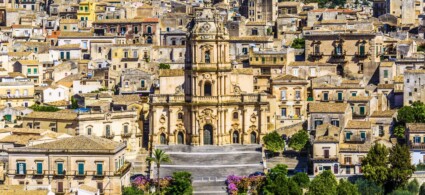
One of Comiso’s architectural jewels is the Mother Church of Santa Maria delle Stelle, which was originally built in the 15th century on the remains of an ancient temple but was largely destroyed during the severe earthquake of 1693. In the early 18th century, the church was rebuilt thanks in part to the contribution of Count Baldassare IV Naselli, whose funeral monument can still be seen here.
Despite being the result of several construction campaigns, the church is harmonious and elegant, with an imposing façade that rises above the rooftops of neighbouring houses and is crowned by a bell tower. Upon entering the building, you can admire the three internal naves separated by columns, the finely frescoed wooden ceiling of the central nave, and numerous sumptuous decorations including a marble statue of the Madonna of Mount Carmel and a high altar in polychrome marble and lapis lazuli.
The Castello di Comiso is one of the must-see stops during a visit to the town, as it has been an important protagonist in the history of this territory. According to some finds, a fortress had already been built here in Roman times, which was later expanded in the Byzantine period and finally partly destroyed in the 15th century to make way for a new noble residence.
The structure we can admire today dates back to work carried out at the end of the 15th century thanks to the renowned Naselli family, who had made Comiso an autonomous county separate from that of Modica, and it thus bears their name. The oldest part of the complex is the Baptistery dedicated to San Gregorio Magno, dating back to around 1000 with remnants of Byzantine-era frescoes. Other restored areas remain accessible and allow you to retrace part of the town’s history, whilst from the castle’s towers you can enjoy a breathtaking view of the surrounding territories.
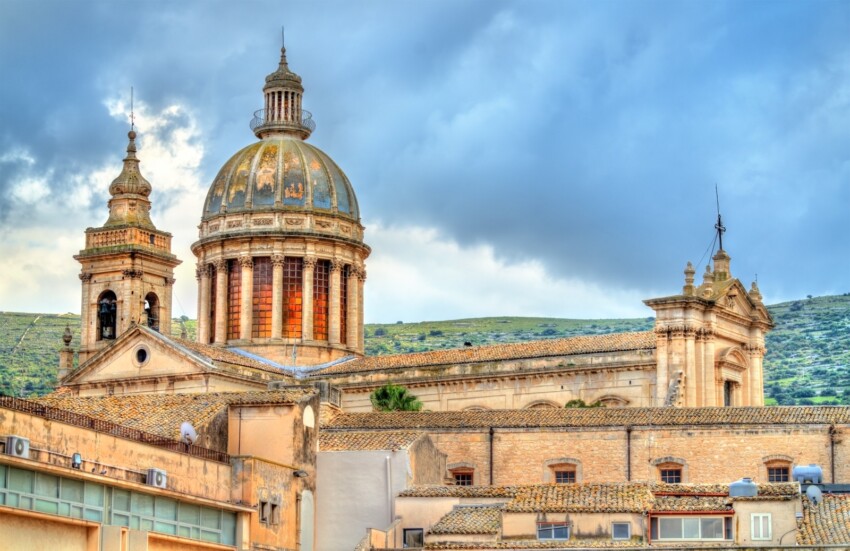
The Basilica of Maria SS. Annunziata as we see it today is an elegant neoclassical building, the result of reconstruction work following the damage caused by the 1693 earthquake. The first church on this site was a Romanesque-Byzantine building dedicated to San Nicola, which was followed in the mid-15th century by the first church dedicated to the Blessed Annunciation. Rebuilt after the earthquake, the Basilica features a Latin cross layout and is divided into three naves with barrel vaults supported by 10 large round arches, whilst the imposing dome, constructed in the mid-19th century, rises above the crossing.
Inside are housed works of considerable value including two canvases by Salvatore Fiume depicting the Resurrection and the Nativity, a 16th-century polychrome wooden statue of San Nicola, and a fine canvas of the Assumption of Mary signed “Narcissus Guidonius”. There is also a beautiful organ created by the Polizzi brothers of Modica in 1922.
Another of Comiso’s architectural jewels is the Church of San Biagio, whose origins are truly ancient and whose history is a troubled one. Built in 1500 on the remains of a previous chapel, the Church of San Biagio was also destroyed during the 1693 earthquake and was rebuilt in the 18th century in baroque style. This religious building now features a simple façade with pilasters and niches and an 18th-century doorway crafted by local craftsmen. Inside, the nave displays elegant decorations and paintings depicting the life of San Biagio, created in the 19th century by Gaetano Di Stefano of Chiaramonte and Giuseppe La Leta.
The Town Hall overlooks Piazza Fonte Diana and was erected on a site that once housed a monastery and the Church of San Giuseppe, though remains discovered in the 20th century testify that there were Roman baths here in antiquity. Built in the 19th century to designs by Cascione Vaccarini, it features a very simple neoclassical façade that extends over three storeys with two windows per side and a large central window on each level. Inside is an imposing staircase in Carrara marble designed in the mid-19th century by architect Fianchini, who had previously worked on the construction of the town market. Adjacent to the palace is the Civic Museum of Natural History, which houses a collection of archaeological finds and artefacts that tell the story of this territory.
Comiso is also home to the Peace Pagoda, one of the few Buddhist monuments in Europe, which was inaugurated in 1998 at the instigation of Buddhist monk Gyosho Morishita. The pagoda was built on the hill of Canicarao on a site that had been for years a gathering place for peace activists protesting against the presence of the NATO base in Comiso. Standing 16 metres high with a diameter of 15 metres, it features the classic white stupa that houses a statue of Buddha in a niche, and is crowned at the top by an elegant spire. Important festivals and commemorations are celebrated in this temple, such as the Flower Festival in April and the Peace Festival in July.
The centre of Comiso offers various accommodation options ranging from hotels to welcoming bed and breakfasts, all perfect for exploring the town. Staying in the heart of the historic centre allows you to reach the main sites of interest, restaurants and bars on foot and to become completely immersed in the town’s atmosphere.
Those who prefer to stay amid nature can find numerous farmhouse hotels in the vicinity of Comiso that often offer a truly authentic and hospitable experience.
Comiso is easily reached by car from the main Sicilian cities. From Catania, you need to travel first along the A19 motorway heading south until the Comiso/Chiaramonte exit, then take the SS 514 and SS 115 to reach Comiso in approximately 90 minutes. From Palermo, you must also take the A19 but heading south-east, then take the SS 514 and SS115 for a total journey of almost 4 hours.
Comiso also has a railway station located on the Caltanissetta Xirbi-Gela-Siracusa line. The Comiso Airport is also located within the municipal territory. Built during the fascist period and later converted into a NATO military base during the Cold War, the airport has now returned to civilian aviation use and is named after Italian politician Pio La Torre. It boasts numerous connections to Italian and European cities.
What's the weather at Comiso? Below are the temperatures and the weather forecast at Comiso for the next few days.
Comiso is a charming town in the Ragusa province and a true gem of Sicilian Baroque architecture. The town lies 110 km from Syracuse, 100 km from Catania and 240 km from Palermo.
 Hotel
Hotel  Budget accommodations
  Apartments
  Family Hotel
  Luxury Hotel
  Resorts