Scicli Albergo Diffuso
Scicli - Different Locations in Scicli city centre (Check-in at Piazza Italia, 38)
Book now
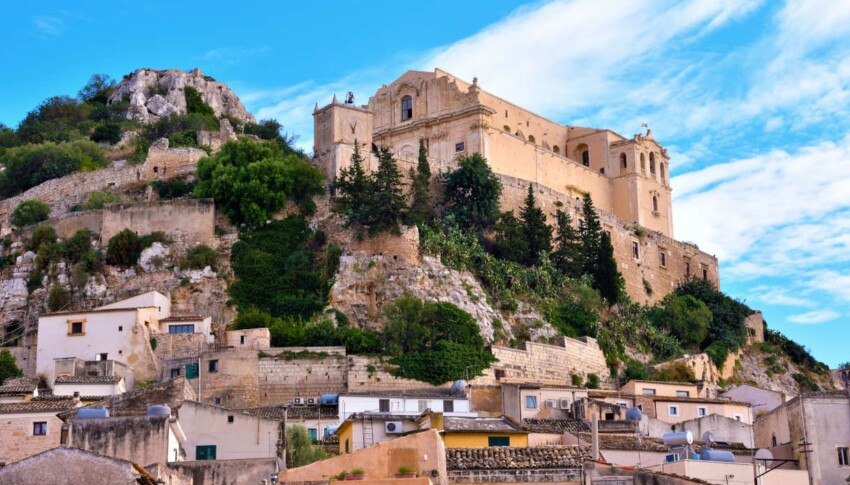
The charming Scicli, a town of just over 25,000 inhabitants in the province of Ragusa, sits at the confluence of three valleys at the southernmost tip of Sicily, and is truly a destination not to be missed. Together with seven other towns, it forms part of the late Baroque towns of the Val di Noto, which in 2002 became a single UNESCO World Heritage site.
Prosperous and wealthy since the 12th century, Scicli was the centre of numerous battles and changed hands repeatedly from the Arabs to the Normans, from the Swabians to the Aragonese; but it was only the earthquake of 1693 that succeeded in destroying it, causing over 3,000 deaths. In the years that followed, the town was rebuilt in Baroque style, which can still be admired today in numerous palaces and squares throughout the historic centre.
Despite its compact size, there is plenty to see in Scicli: here are the highlights, so you won’t miss anything during a visit of a few hours or days.
The symbol of Scicli is the Church of San Matteo, located on the summit of the hill bearing the same name, where the town stood in ancient times. Completed in 1762 in Sicilian Baroque style, it was built after the 1693 Val di Noto earthquake on the ruins of another church dating from the early medieval period, in whose chapel, according to tradition, Saint William the hermit was buried in 1404.
For more than 100 years from its opening, it served as Scicli’s cathedral; when the seat of the mother church was moved in 1874, the building fell into rapid decline, stripped of its vaults and roof; fortunately in the 1990s it was restored, and despite some design challenges it has been returned to its former splendour.
Among the many other churches in Scicli, don’t miss the Church of San Giovanni Evangelista: it stands on the right side of the town hall, and its unmistakable features are the concave-convex façade with three storeys and an interior with an elliptical floor plan, covered by a dome. Inside, 19th-century stuccowork is on display, while the contrast between different styles is striking.
Don’t miss the 1841 pipe organ, a work by Salvatore Andronico Battaglia, and the Cristo di Burgos, a Spanish painting dating from the 17th century, affectionately known as the “Christ in a Skirt” because of the distinctive priestly vestment worn by Jesus.
Santa Maria della Croce is an interesting religious complex, consisting of a convent, a church, an oratory and two courtyards. It is one of the oldest buildings in the town, situated on the summit of Croce Hill. The founding date is unknown, but is somewhere between the late 15th and early 16th century. After Italian unification, the Santa Maria della Croce complex was sold at auction and purchased by private owners, but at the end of the 1990s the Sicily region expropriated and fully restored it, with a final cost of around 3 million euros.
The church with a single nave and the convent have a late Gothic appearance, in sharp contrast to the Baroque that dominates Scicli. Beside it stands the oratory, dedicated to the Madonna of Sion, distinguished by a cross in high relief placed at the top of the façade arch.
For a stroll through the heart of Scicli, take Francesco Mormino Penna street, the former Corso San Michele, right in the historic centre. Nearly 300 metres long, it is lined with souvenir shops and outdoor restaurants, as well as numerous historic buildings constructed from local limestone.
The pedestrian street is rich in monuments: the churches of Santa Teresa and San Michele with their attached convents, as well as elegant palaces such as Palazzo Spataro, Palazzo Bonelli-Patanè and Palazzo Papaleo. The street ends at Piazza Municipio, one of the main squares of the historic centre.
The Palazzo Bonelli-Patanè stands on Via Francesco Mormina Penna and is a neoclassical palace with a rather austere exterior, but an interior that is truly remarkable, blending neoclassical, Liberty and Neo-Gothic styles. It is exceptionally rich in icons, among the most extensive collections in the entire town, created by artist Raffaele Scalia, who is also responsible for the frescoes on the main staircase and in the ballroom, as well as the lounges, dining room and master bedroom. Don’t miss the view of the internal garden from the terrace, which also offers a beautiful vista across the town.
Palazzo Bonelli-Patanè was a filming location for the 2019 film La stagione della caccia – C’era una volta Vigata, an adaptation of the novel “La stagione della caccia” by Andrea Camilleri.
In the following map you can see the location of the main places of interest mentioned in this article.
The historic centre of Scicli is compact and easily navigable on foot, with all amenities at hand. The majority of accommodation options are here, predominantly private apartments, bed and breakfasts and guest houses run by local residents. There are also boutique hotels housed within historic palaces. We recommend staying right in the centre to best experience the atmosphere of the place, but those seeking greater peace and quiet can venture a few kilometres outside town, where you’ll find a different world entirely, one of silence, nature, olive groves and cultivated fields.
Scicli is located in the province of Ragusa, at the far south of Sicily. Despite its rather isolated position, it is well connected to the rest of the region, as several provincial roads depart from the town: the SP42 leading to Modica, the SP40 heading to the coast and the SP95 to Marina di Ragusa. The nearest airport is Comiso, about 40 kilometres away, while the journey from Catania takes 1 hour and 40 minutes.
Scicli is also easily accessible by train, as it lies on the Caltanissetta Xirbi-Gela-Siracusa line. The station is about a 10-minute walk from the town’s historic centre.
What's the weather at Scicli? Below are the temperatures and the weather forecast at Scicli for the next few days.
 Hotel
Hotel  Budget accommodations
  Apartments
  Family Hotel
  Luxury Hotel
  Resorts