Etna: Guided Summit Hiking Tour up to 3400m, Optional Pickup
5.481 reviews
Buy now
From 55,00€ per person
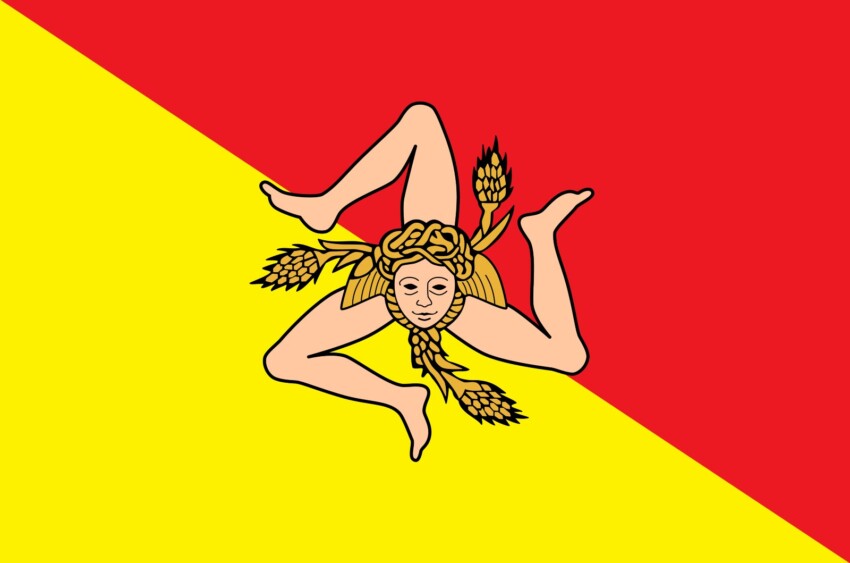
The Sicilian flag is one of the most symbolically rich regional standards in the entire European landscape: a rectangular banner divided diagonally in red and yellow, with the celebrated Trinacria at its centre — an ancient symbol that has identified the island to the world for centuries. What makes this standard truly extraordinary is its documented antiquity: a notarial deed certifies its birth on 3 April 1282, making it the world’s fourth oldest flag and Italy’s oldest.
The symbol at the centre of the banner — technically called the Triskelion or Trinacria — is the depiction of a female head (the Gorgoneion) from which three legs bent at the knee extend, surrounded by wheat ears. Each element carries precise meaning, layered across millennia through Greek, Roman, Norman and Aragonese influences.
The flag was officially adopted by the Sicilian Region through regional law no. 1 of 4 January 2000, although the regional symbols — coat of arms and gonfalon — had already been regulated by law no. 12 of 28 July 1990. Today it flies on institutional buildings, souvenirs and craft shops throughout Palermo and all of Sicily, recognisable in every corner of the Mediterranean.
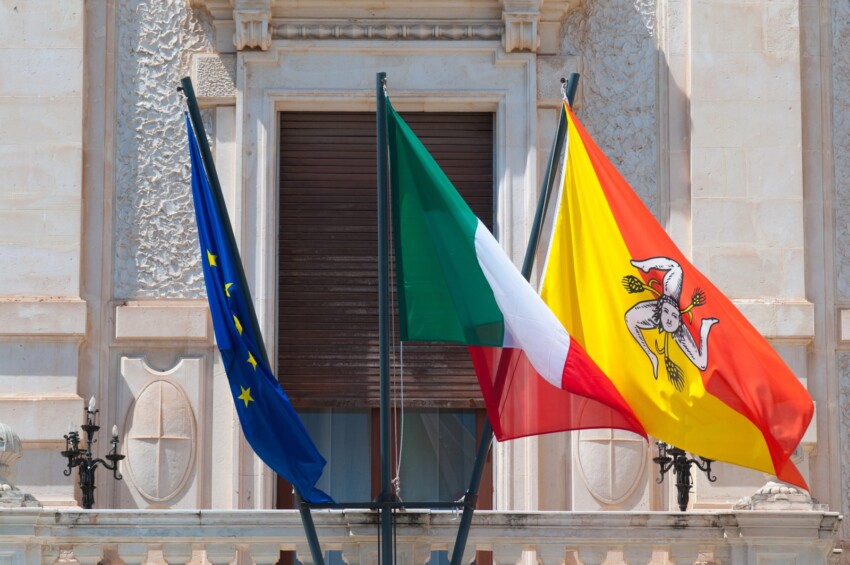
Red and yellow were not chosen for aesthetic reasons, but carry with them precise historical memory. The two colours respectively evoke the cities of Palermo (red) and Corleone (yellow), which in the spring of 1282 united in the anti-French uprising of the Sicilian Vespers.
The diagonal division of the banner — an oblique line running from the upper left corner to the lower right — mirrors the one present in the coat of arms of Peter III of Aragon, testament to the bond that formed between Sicily and the Aragonese crown in the aftermath of the revolt. This graphic structure, inspired by the Aragonese palets, was later formalised in 1296 with Frederick III’s accession to the throne of Sicily.
It is worth noting that the colours in the current flag of the Sicilian Region are arranged in reverse order compared to the original historical banner: red occupies the upper left triangle and yellow the lower right, as established by the 2000 regulations.
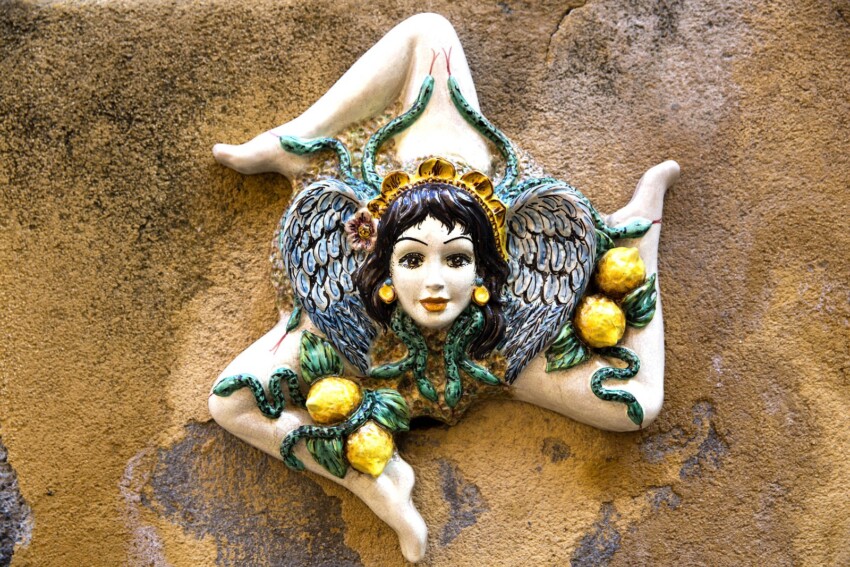
The word Trinacria is the Greek name for the island — from the Greek τρίναξ, “three promontories” — and described its triangular shape with three capes: Cape Peloro (north-east), Cape Passero (south) and Cape Lilybaeum (west). The Trinacria symbol, also known as the Triskelion (from the Greek τρισκελής, “three legs”), is the visual expression of this natural geometry.
The three legs bent at the knee, which rotate around the central head in clockwise motion, form the most iconic part of the symbol. In their most archaic interpretation, of solar and pre-Hellenic origin, they represent the eternal movement of the sun and the cycle of seasons: spring, summer and winter. The Greeks later transformed it into a territorial emblem, associating it with the island’s three capes. Today the Trinacria is recognised worldwide as Sicily’s unmistakable symbol.
At the centre of the Trinacria lies the Gorgoneion, the head of the Gorgon Medusa. In Greek mythology, the three Gorgons — Euryale, Stheno and Medusa — embodied perversion in three forms: sexual, moral and intellectual. Medusa was the sole mortal among her sisters, and her head possessed the power to petrify anyone who gazed upon it.
In a variant of Sicilian iconographic tradition, the head at the centre of the Trinacria is not that of Medusa, but of a female deity, sometimes depicted with wings to signify the relentless passage of time. Her hair, originally serpents — a symbol of wisdom — was partly replaced in Roman times with wheat ears, emphasising Sicily’s role as the principal granary of the Empire.
The Gorgoneion held profoundly apotropaic value in Sicilian culture: the Gorgon’s head was regarded as a powerful talisman against the evil eye and malevolent forces, a protective function that the Normans helped spread further following their conquest of the island in 1072.
The wheat ears intertwining the Gorgoneion’s hair are a Roman addition and tell the economic and geopolitical history of Sicily in antiquity. The island became the first Roman province, conquered in 241 BC following the First Punic War, and soon became indispensable to Rome’s grain supply and that of the entire Empire.
The wheat ears thus represent the fertility of Sicilian land, its millennia-old agricultural vocation and the central role the island played in Mediterranean trade for over seven centuries of Roman rule. It is no coincidence that Demeter — known as Ceres by the Romans — was venerated in Sicily with particular intensity: Greek mythology placed the abduction of her daughter Persephone by Hades precisely in this land.
The flag’s historical origins are tied to one of the most dramatic episodes in medieval Sicilian history: the Sicilian Vespers uprising, which erupted in Palermo on 30 March 1282. According to tradition, the insurrection began near the church of the Holy Spirit, when a French soldier insulted a woman from the people: the spark was enough to trigger a revolt that within weeks spread throughout the island, ending Angevin rule.
The red and yellow banner bearing the Trinacria was used by the rebels as a symbol of unity and identity, binding the standard to the idea of a free Sicily for the first time indissolubly. A notarial deed of 3 April 1282 officially attests to the use of the symbol, granting it that documented birth date which renders it unique in the world.
The Trinacria’s moment of greatest institutional consecration came on 30 August 1302, with the Peace of Caltabellotta that ended the Vespers War. The agreement established Sicily as a Kingdom of Trinacria, formally under the sovereignty of Frederick II of Aragon but effectively independent from Angevin possessions in southern Italy. The kingdom’s name coincided with the symbol: the Trinacria was no longer merely an icon, but the official name of a state.
After centuries of eventful vicissitudes, the Trinacria experienced a new season of political prominence during the Risorgimento movements. On 27 May 1848, amidst the Sicilian revolution, the island’s Parliament formally decreed: “That henceforth the coat of arms of Sicily shall be the sign of the Trinacria without any legend whatsoever”. The symbol was placed at the centre of the Italian tricolour, uniting Sicilian identity tradition with national unification aspiration.
With Garibaldi’s expedition of 1860 and the end of the Kingdom of the Two Sicilies, the Trinacria disappeared once more from official use, yet survived in popular consciousness and re-emerged periodically as a symbol of Sicilian separatism in the decades following Italian unification.
The path towards formal recognition culminated with regional law no. 1 of 4 January 2000, which officially adopted the Sicilian flag as we know it today. The regulation describes the banner with precision: rectangular, with tangerine-red and yellow colours divided diagonally, at whose centre stands the regional coat of arms — the flesh-coloured Triskelion with the Gorgoneion and wheat ears — with dimensions equal to three-fifths of the flag’s height.
One of the lesser-known aspects of the Trinacria’s history is its spread beyond Sicily, facilitated by Norman expansion throughout the Mediterranean. The Normans, who arrived on the island in 1072, carried knowledge of the symbol to the British Isles: the Trinacria was adopted by the Isle of Man as its own heraldic symbol, replacing its ancient banner with a ship, and still today features on its flag in a variant with three armoured legs.
The symbol also appears in the coats of arms of various European noble dynasties: the Stuarts of Albany in England, the Rabensteiner of France, the Schanke of Denmark, the Drocomir of Poland, and even in the gonfalon of Joachim Murat, King of the Two Sicilies in the early nineteenth century. This spread testifies to the cultural and political prestige that Sicily exerted over the medieval and modern Mediterranean.
Today the Trinacria is used by millions of Sicilians worldwide as a symbol of identity: it appears on the coat of arms of the University of Palermo, was impressed on medals for the Universiade held in Sicily in 1997, and features on ceramics, fabrics, jewellery and souvenirs throughout the island. For visitors to Sicily, recognising the Trinacria symbol means understanding more deeply the soul of this territory.
 Hotel
Hotel  Budget accommodations
  Apartments
  Family Hotel
  Luxury Hotel
  Resorts