In ancient times, Syracuse was a city that rivalled Athens in importance and beauty. The splendour of those distant days still echoes through the city’s streets and mingles with medieval atmospheres and baroque magnificence. Piazzas, streets and palaces – everything in Syracuse seems to be a hymn to beauty and immortality.
Easily reached from Catania airport, Syracuse is today one of Sicily’s most visited cities. With its magnificent beaches, archaeological treasures, and inviting open-air bars and restaurants serving exquisite local cuisine, Syracuse encapsulates everything that has made Sicily a world-famous destination.
Things to do in Syracuse
A city of truly ancient history, Syracuse is now recognised as a UNESCO World Heritage Site and was already defined by Cicero as “the greatest and most beautiful of Greek cities”. This location boasts not only the presence of splendid archaeological sites dating from both the Greek and Roman periods, but also beautiful beaches where you can relax after exploring the city. Must-see stops in Syracuse include Piazza del Duomo, the Greek Theatre, Piazza Archimede and Castello Maniace.
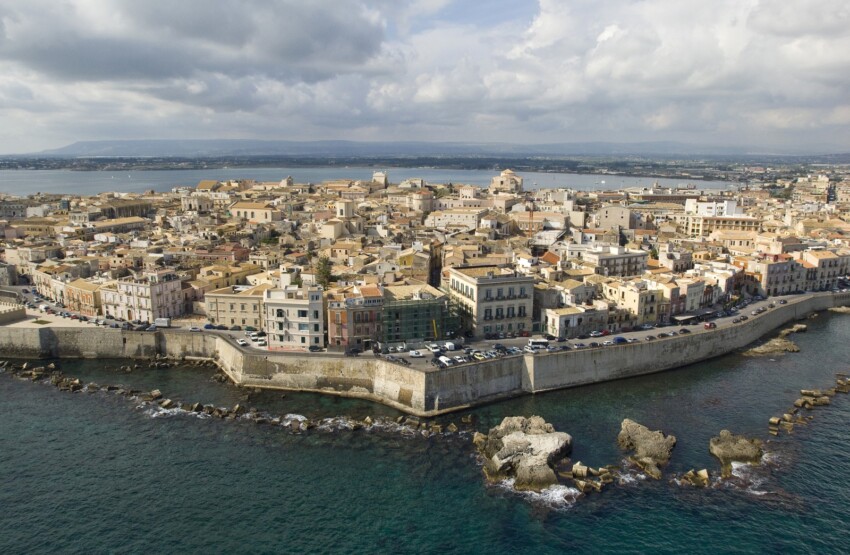
The true heart of Syracuse is Ortigia Island, an area stretching for just over a kilometre that represents the oldest part of the city. Ortigia is not, in fact, a true island as it is connected to the mainland by the Umbertino Bridge and the Santa Lucia Bridge.
This area is considered an open-air museum for its truly unique archaeological and architectural heritage, ranging from temples from the Greek era to buildings constructed during the Fascist period, including traces left by the Aragonese and Arabs.
Divided into small historic quarters, Ortigia is the oldest zone of Syracuse that houses sites such as the Cathedral, the Castello Maniace from the Swabian-Norman period, the Church of Santa Lucia alla Badia, the Temple of Apollo dating back to the 6th century BC and the Temple of Athena. The heart of Ortigia Island is certainly Piazza Archimede, a meeting place where you can admire the magnificent Fountain of Artemis, built in 1907 by Giulio Moschetti.
With a 30-minute walk from Ortigia, you can reach Syracuse’s most famous tourist attraction, the Neapolis Archaeological Park.
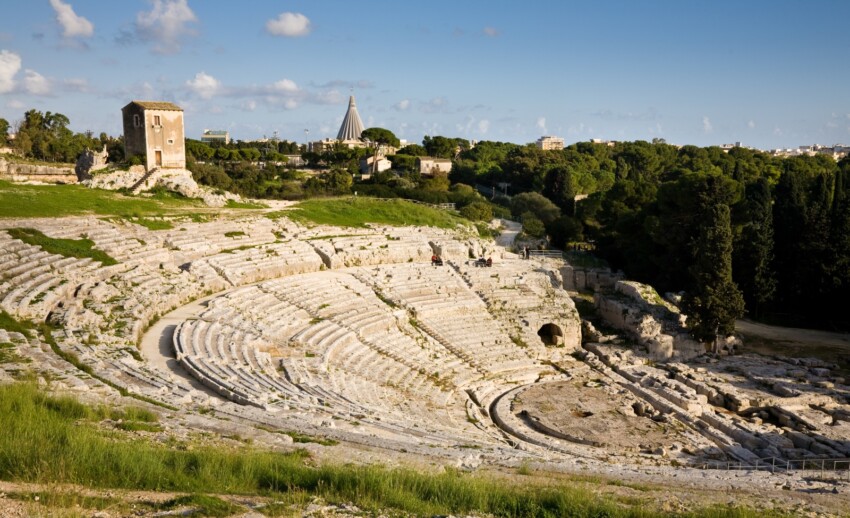
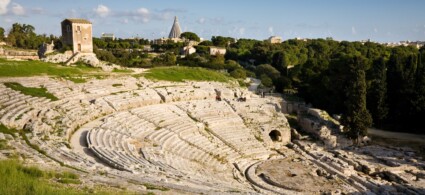
Within a single area are concentrated ancient ruins of exceptional beauty and historical value, among which stands out the marvellous Greek Theatre dating from the 5th century BC, where the last tragedies of Aeschylus were performed in the presence of the author. A symbolic place for history and theatre lovers, it will captivate even those without a particular interest in these disciplines.
A mysterious place with intriguing charm is the Latomia del Paradiso, a stone quarry with an S-shaped cave three metres deep that Caravaggio named the Ear of Dionysius, famous for its particular acoustic effect.
Other attractions in the park include the Roman amphitheatre and the Ara of Hiero II.
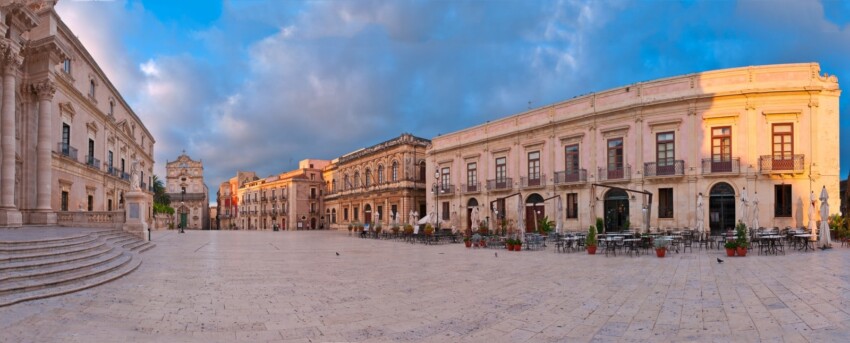
The Syracuse Cathedral, also known as the Cathedral of the Nativity of the Most Holy Mary, is a religious building that tells the story of the city and the various rulers who succeeded one another. During the 5th century BC, an impressive Doric temple dedicated to Athena was built here. The temple remained as such until Christianity arrived on the island, when the building was transformed into a church and became the first Christian church in the Western world.
Later, with the arrival of the Arabs, the building was transformed into a mosque and underwent various architectural modifications. Subsequently, however, the Normans restored the Cathedral to its function as a Catholic church and carried out restructuring work on the building. In 1693, a devastating earthquake struck Sicily and several cities located along the eastern coast of the island suffered considerable damage, including Syracuse. The Cathedral, however, managed to withstand it and although much of its façade was destroyed, the internal structure and columns of the Greek temple remained intact. The reconstruction of the façade took place during the period of Spanish rule and was rebuilt in a baroque style.
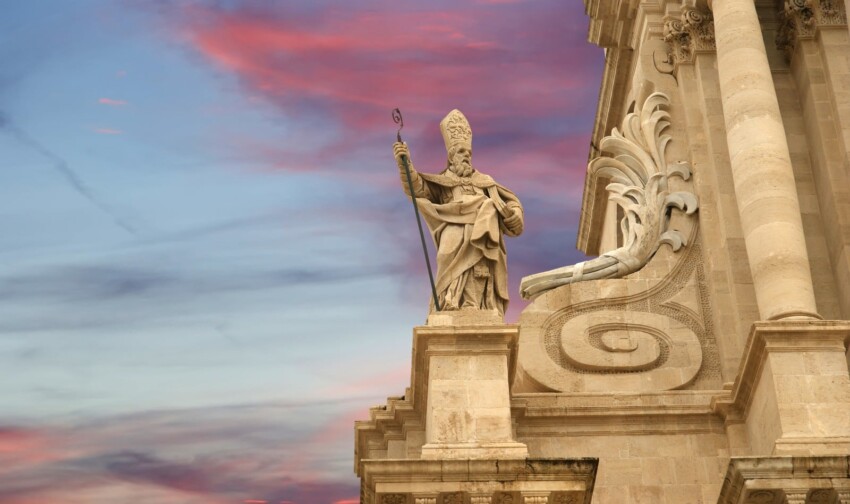
Considered the most important church in the city, the cathedral presents itself externally in baroque and rococo style, whilst inside you can admire both parts belonging to the Greek temple and parts built by the Normans. The numerous chapels present also house statues, relics, the remains of saints and frescoes of great value.
Castello Maniace
4Piazza Federico di Svevia, 5, 96100 Siracusa SR, Italy
Castello Maniace was built by Frederick II between 1232 and 1240 and is therefore one of the oldest and most important monuments of the Swabian period. Located at the end of the Alfeo waterfront, the castle takes its name from George Maniace, a Byzantine commander whose family was connected to the royal house of Altavilla, from which Frederick II descended.
The complex was constructed for defensive purposes and was initially surrounded by a wide moat which was later covered in the 16th century. The fortress is characterised by a quadrangular structure with four cylindrical towers built at the corners. In addition to its defensive role, over the years Castello Maniace has hosted royal families but has also served as a prison and barracks for the Italian Army.
Church of Santa Lucia alla Badia
5Via Santa Lucia alla Badia, 2, 96100 Siracusa SR, Italy
Located in Piazza Duomo, the Church of Santa Lucia alla Badia forms with the adjacent monastery a complex dating from the mid-15th century. The church is dedicated to Saint Lucy, the city’s patroness, who in the 17th century is said to have saved Syracuse from a terrible famine.
The façade features two superimposed orders. The lower part is characterised by a baroque portal inserted between twisted columns that support a pediment decorated with images of the saint’s martyrdom, whilst in the upper order there are lesenes in rococo style.
The interior has a single nave that houses four baroque altars dating from the 18th century, and the vault features frescoes depicting the Triumph of Saint Lucy. In the apse are the main altar and a large canvas painted in 1608 by Caravaggio.
The Regional Archaeological Museum of Syracuse is named after archaeologist Paolo Orsi, who was director of the site for over thirty years. The museum is considered one of Europe’s most important archaeological centres for the quality and quantity of the artefacts it contains. The building is set within the green expanse of a vast park that houses the tomb of German poet August von Platen.
The building is shaped like a daisy and consists of three sections that house artefacts belonging to three different periods. The first section displays rocks, fauna and fossils from the Quaternary Era, the second displays artefacts from Greek colonies in Sicily and the third is dedicated to Syracuse’s sub-colonies (Eloro, Akrai, Casmene and Camarina) and excavations carried out in the territories of Gela and Agrigento.
Just outside the ancient walls of the city, near the Neapolis Archaeological Park, lies the Basilica of San Giovanni, a beautiful open-air church dating from the 6th century. The church has suffered damage from various earthquakes over time and has been rebuilt several times.
In the underground chambers of the building, where the Greek aqueduct once stood, the Romans built the Catacombs of San Giovanni, a place suitable for housing family tombs. The structure consists of a main gallery (Decumanus Maximus) from which ten secondary tunnels (Cardines) branch off, leading to various chapels. These chapels, circular in shape, were created from what were once ancient water storage cisterns and were used by the Romans for the burial of illustrious figures.
The Byzantine Crypt, on the other hand, is the burial place of San Marciano, Syracuse’s first bishop. Here you can still see the remains of the flooring, Ionic columns, four marble capitals depicting the Evangelists and splendid frescoes dating from the Norman period.
Castello Eurialo was built around 400 BC by the tyrant Dionysius as part of a defensive system called the “Dionysian Walls”, but underwent numerous modifications over time. The fortress is located in the Epipoli district, outside the historic centre of Syracuse, and currently only part of its remains can be admired.
The castle entrance is protected by four moats whilst the main keep of trapezoidal shape is defended by five towers. Inside the building, numerous galleries were constructed to allow troops to move easily and quickly in case of attack, and some of these tunnels are still visitable.
Due to its position, the castle dominates the entire city and coast from above and is therefore considered one of the best places to watch the sunset.
Puppet Theatre and Museum
One of Syracuse’s symbolic places is the historic Puppet Theatre9, a space where the ancient Sicilian tradition of armed marionettes is passionately preserved. A true art form through which Sicilians express their sense of belonging to their island and awareness of a shared identity.
The small theatre has been recently restored to offer greater comfort to spectators but thanks to the red drapes of the wings and other classy details, it retains the charm of bygone days, when puppets were a popular form of entertainment.
Performances are held throughout the year, with one or two daily shows depending on the days and seasons.
To learn more about this ancient theatrical form you can visit the Puppet Museum10, housed within the elegant Midiri-Cardona palace. Puppets, stage objects and scenographic material are on display, tracing the history of Sicily’s most famous puppet masters.
An original museum you can visit during your holiday in Syracuse is the one dedicated to papyrus, a plant that grows abundantly in the surroundings of the Ciane river (now a nature reserve) and which until the 17th century was used locally for paper production.
Syracuse Beaches
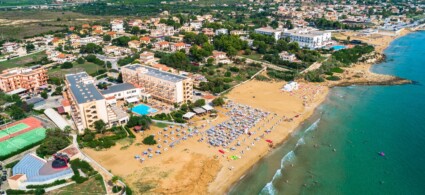
Syracuse’s city beach is the tiny Cala Rossa Beach12 in the Ortigia area. Easy to reach, it’s perfect for a dip in the afternoon after visiting monuments or returning from an excursion, but can feel a bit claustrophobic for a full day at the seaside.
Two larger city beaches are Arenella Beach and Fontane Bianche Beach, both sandy and reachable by bus from the centre.
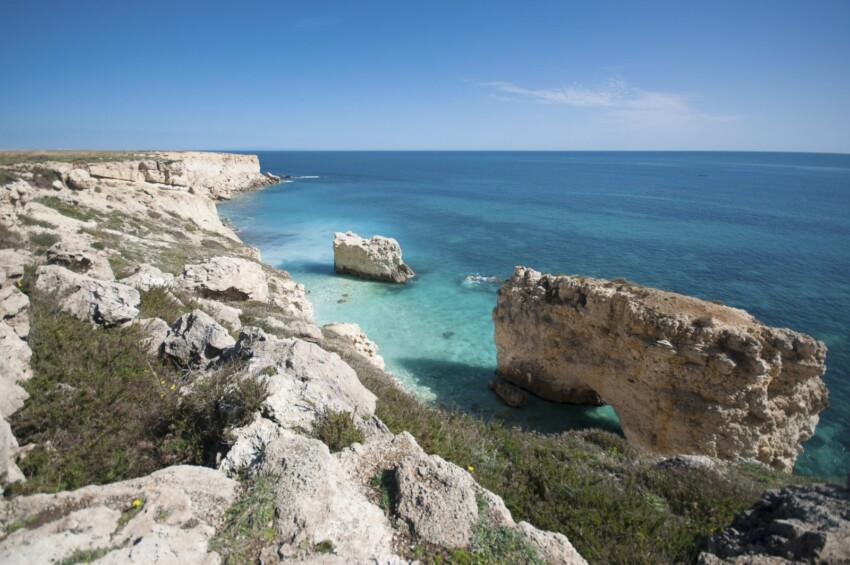
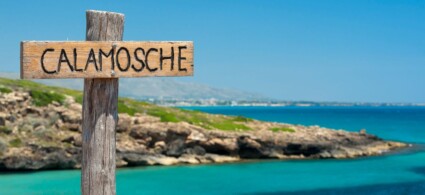
One of the most beautiful beaches near Syracuse is Calamosche, an enchanting beach located within the Vendicari Natural Oasis.
It’s a wide beach nestled between two rocky promontories that shelter it from the wind, with a rocky area and one of very fine sand; the sea is calm and crystal-clear, a true paradise for those who love swimming and snorkelling. To reach the beach you must leave your car in a car park within the oasis and continue on foot for about a kilometre.
Other beaches not to miss in Syracuse and surroundings are Eloro, Brucoli, Carratois, Plemmirio Reserve, Gallina, Granelli and Minareto.
Map
In the following map you can see the location of the main places of interest mentioned in this article.
Tours and activities
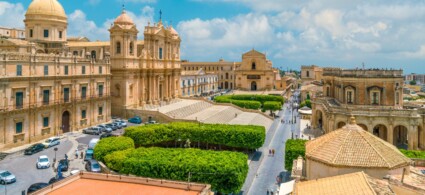
Syracuse is an ideal city for those who want to combine sea and culture in a single holiday. The two unmissable activities during a Syracuse holiday are a boat excursion and a day trip to Noto, a town about 40 km away that is universally considered the Baroque Capital of Sicily.
These two tours alone are enough to fill yourself with emotions, enjoying the best of the Syracuse coast and elegant historic palaces, but while you’re there don’t miss one of Sicily’s most popular attractions, namely an excursion to Mount Etna, Europe’s largest active volcano.
If you’re passionate about cooking you could take advantage of your holiday to attend a Sicilian cooking course: on your return you’ll be able to prepare the specialities that made your mouth water on holiday!
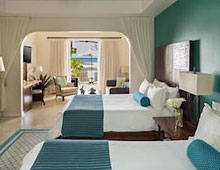
Syracuse has an extensive range of accommodation options, making it easy to find a hotel with excellent value for money.
The best area to stay in Syracuse is Ortigia, an island connected to the rest of the city by a bridge. It’s a particularly charming neighbourhood, where you’ll find boutique hotels, three-star hotels housed in historic palaces, and delightful bed & breakfasts with rooms featuring balconies.
Budget hotels are concentrated around the railway station.
We offer best rates If you find it cheaper we refund the price difference.
Free cancellation Most properties allow cancellation without penalty.
We're available 24 hours a day For any problem call Booking.com.
The nearest airport to Syracuse is Catania-Fontanarossa, located approximately 60 km away. Getting to Syracuse from the airport is straightforward – by car via the E45 motorway, it takes just 45 minutes! Direct buses also run to and from the airport, taking around an hour and 15 minutes to get you to your destination.
The railway station is about 2 km from the city centre. Direct trains connect Syracuse to Catania in just over an hour and to Messina in two and a half hours. There are no direct trains to Palermo: to reach Syracuse from Sicily’s capital, the best option is to hire a car; alternatively, you can take a direct bus, though services are infrequent.
Regional trains and local buses connect Syracuse to other destinations in southeastern Sicily such as Noto and Ragusa.
Syracuse Weather
What's the weather at Syracuse? Below are the temperatures and the weather forecast at Syracuse for the next few days.

 Hotel
Hotel 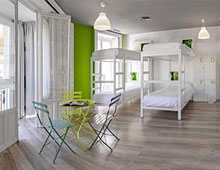 Budget accommodations
  Apartments
  Family Hotel
  Luxury Hotel
  Resorts