Bestseller
Syracuse: Neapolis and Greek Theater guided tour
From 29,90 €
Buy the ticket
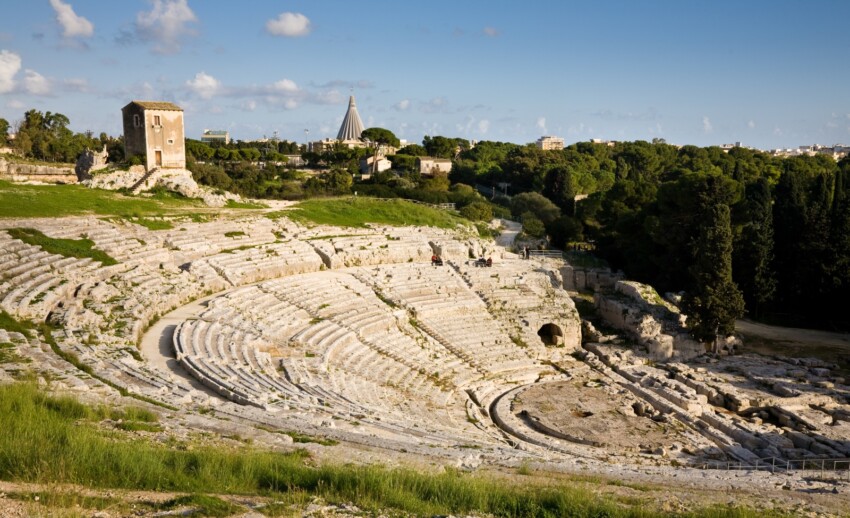
Within the Neapolis archaeological park, in Syracuse, stands the magnificent Greek Theatre, built in the 5th century BC on the southern side of Temenite Hill and today one of the city’s most iconic symbols.
With a seating capacity of 15,000 spectators, the theatre was used by the Greeks for assemblies and theatrical performances; later, under Roman rule, it was substantially modified, though it never lost its importance. Today it is a UNESCO-protected site and is included on the World Heritage List alongside the entire city, under the designation “Syracuse and the Necropolis of Pantalica“.
In modern times, the Greek Theatre of Syracuse is used for open-air performances, particularly during summer, featuring opera and dance, thanks to authorisation from the Regional Department of Cultural Heritage granted in 2014. Of course, as part of the Neapolis archaeological park, it can be visited from both inside and outside, allowing you to be captivated by its beauty and grandeur.
A visit to the Greek Theatre of Syracuse allows you to appreciate up close this remarkable example of Hellenistic architecture. Originally the most important performance building in the ancient Greek world, after centuries of neglect it has fortunately been restored to its former glory.
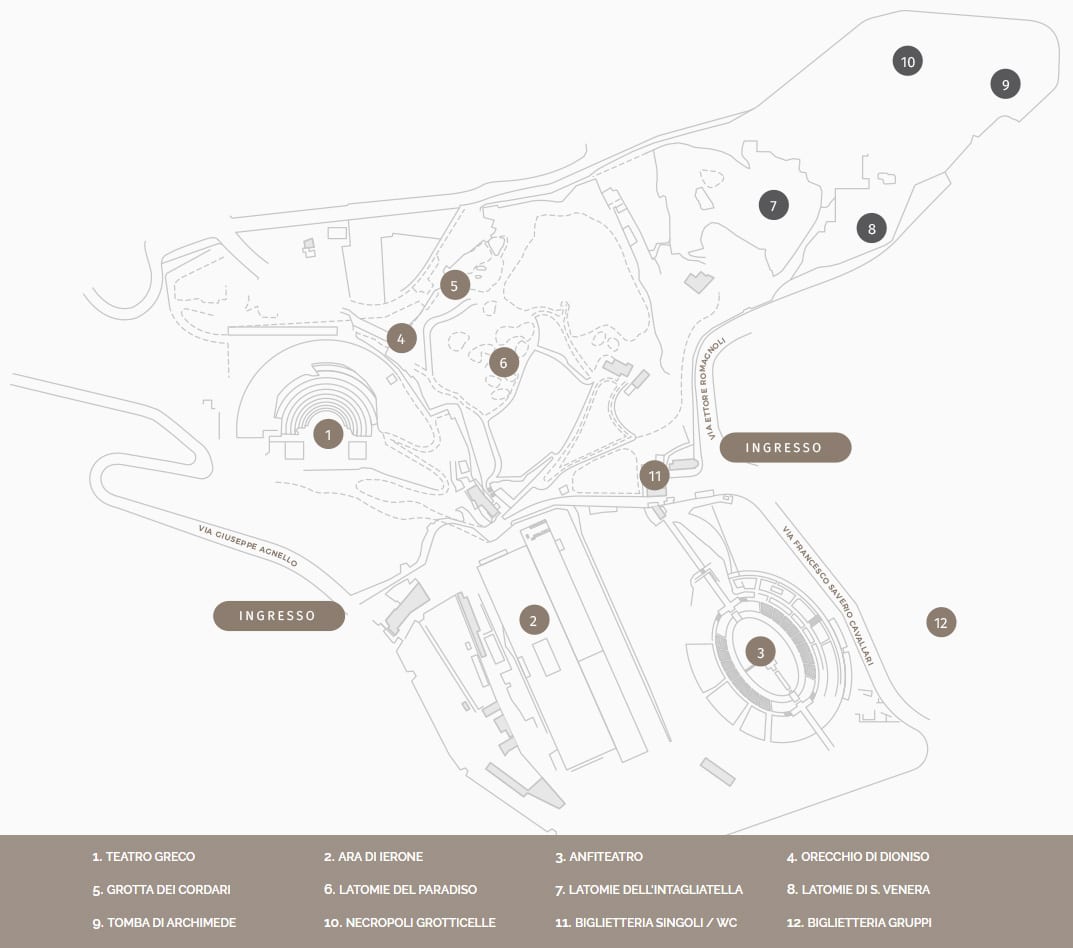
During a visit you can admire the imposing Roman amphitheatre, hewn from rock except for the southern side, measuring 140 metres in length and 90 metres in width, with an elliptical shape. Near the theatre stand the Latomies, stone and marble quarries also used as prisons. The most famous is the Latomia del Paradiso: from here you can access the artificial cave known as the “Ear of Dionysus“, carved into limestone, over 20 metres high and up to 11 metres wide. The curious name derives from its shape, which resembles an ear; needless to say, the acoustics are virtually perfect, capable of amplifying sounds up to 16 times.
The Greek Theatre of Syracuse is a sight to behold, and once inside, among the many things to see there are numerous remains and testimonies of ancient splendour. The stage, for example, has long since disappeared, but in ancient times it was framed by two large pylons. Also noteworthy is the aqueduct system – a Roman construction – that supplied water to the theatre: it was located inside a cave, the Grotta del Ninfeo, which could be reached via the central staircase, which ended on a road known as the via dei Sepolcri.
The Ear of Dionysus is an artificial cave located in an ancient stone quarry beneath the Greek Theatre of Syracuse. Caravaggio visited the cave in the early 17th century and named it the “Ear of Dionysus” for its characteristic S-shaped form, which gives it acoustic properties capable of amplifying sound.
Approximately 23 metres high and between 5 and 11 metres wide, the cave extends for a depth of about 65 metres. According to legend, the tyrant Dionysus confined his enemies here so he could secretly listen to their conversations amplified by the echo.
You can visit the Greek Theatre of Syracuse by purchasing a ticket for the Neapolis Archaeological Park directly online on the official website. The cost is €10, with 50% reductions for visitors aged 18 to 25, and free admission for those under 18, teachers and students of humanities. The Neapolis Archaeological Park has also taken part in the “Museums on Sundays” initiative, so entry is free on the first Sunday of every month.
The park is open every day, Monday to Saturday from 08:30 to 17:30, and on Sundays and public holidays from 08:30 to 13:40. The ticket office closes one hour earlier.
You can take part in official guided tours on Mondays, Wednesdays and Fridays at 10:30 and on Tuesdays, Thursdays and Saturdays at 16:00. The cost is €25 for adults and €20 for children. Those visiting Syracuse outside these times, or who would prefer a private tour of the Neapolis archaeological park or the Greek Theatre itself, can book in advance online to find the best deals.
Alternatively, you can take part in a more comprehensive tour that includes a guided visit to Ortygia island and the Neapolis Park.
The Greek Theatre is located north-west of Ortygia island and immediately west of the Madonna of Tears Sanctuary Basilica. Access is via the gate of the Neapolis Archaeological Park, which can be easily reached from Ortygia and other parts of Syracuse by the electric shuttle bus provided by the city council, which terminates at Molo Sant’Antonio, near the entrance to Ortygia; a bus departs from here every 30 minutes. Timetables vary depending on the season, but services typically start around 9-10 in the morning and run until evening.
Built in the 5th century BC by the Greeks, presumably by the architect Damocopos, the theatre was the cultural heart of ancient Syracuse. During the Roman period it underwent radical aesthetic and structural modifications, yet remained nonetheless highly important to the civilisation of the time.
It subsequently lay abandoned for many centuries, so much so that the Spanish, in 1526, began dismantling its stone blocks to build some fortifications in Ortygia. In the 18th and 19th centuries the theatre was rediscovered and several excavation campaigns were undertaken to remove the earth that had accumulated over the centuries.
In 1914 the Syracuse theatre was ready once again to host performances of various kinds: unfortunately the outbreak of war brought everything to a halt until 1921, and from then on it has been one of the city’s most iconic symbols and one of the main things to see throughout Sicily.

 Hotel
Hotel  Budget accommodations
  Apartments
  Family Hotel
  Luxury Hotel
  Resorts