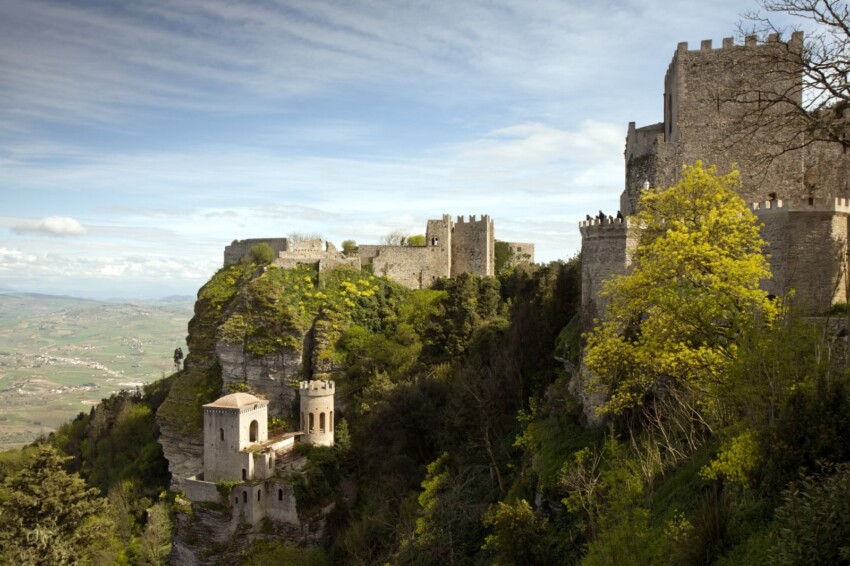
Picture a charming medieval village with azure sea in the distance: that’s Erice in a nutshell, one of Italy’s most beautiful hilltop towns, perched on the slopes of a 750-metre mountain.
A town protected by none other than Venus itself is bound to be captivating: for a romantic stroll or a cultural tourism itinerary, lose yourself in the labyrinth of narrow lanes and alleyways of the characteristic historic centre, with towers, churches, cobbled squares, artisan workshops and inner courtyards.
Countless breathtaking views await you over the sea, salt marshes and medieval rooftops, thanks to panoramic viewpoints such as towers, gardens and cable cars scattered throughout the Erice territory.
Let your gaze drift towards the horizon: if you’re fortunate enough to arrive on a particularly clear day, your eyes may catch sight of the Tunisian coast, just 170 km away from Erice.
When to visit Erice
Erice is stunning to visit year-round. It truly shines during summer, when the powerful sunlight brings the city’s architecture to life with spectacular light displays, revealing stunning panoramic views across the valley and out to sea.
In autumn and winter, mist and clouds lend it a mysterious, timeless charm. Few tourists opt for the colder seasons to visit Erice: you’ll therefore enjoy greater tranquillity.
The town centre immediately reveals its medieval layout, with a tangle of lanes, extremely narrow alleys, squares and courtyards enclosed within a perimeter of walls and bastions. The city walls date back to the Norman period, with the oldest sections even dating to the Phoenician era.
Since cars aren’t permitted in the town, you’ll have to explore the medieval village on foot: you’ll be glad you did, as a visit to Erice’s centre is like taking a step back in time.
Among the most interesting buildings to visit in the historic centre is certainly the 14th-century Cathedral of the Assumption1 – or Real Chiesa Madrice Insigne Collegiata – which, together with the adjacent Bell Tower2, creates a striking ensemble.
The imposing forms and crenellated crowning betray the church-fortress function of this building, constructed using remains of the Temple of Venus near Porta Trapani3, one of three entrances to the city set within the Elymian-Punic walls.
The top of the tower, reached by climbing 110 steep steps, is one of Erice’s best panoramic viewpoints, but if you prefer a less touristy vantage point, head to the Spanish Quarter4, a 17th-century construction that was meant to house a garrison of Spanish soldiers but was never completed.
Also take a look at the 15th-century Church of Sant'Orsola5, where the sculptural groups of the Mysteries are kept, carried in procession on Good Friday.
Castello di Venere
The Ancient Eryx6, the original nucleus of present-day Erice, was not only one of Sicily’s most important fortresses, but also the centre of worship dedicated to one of the most intriguing deities of pagan mythology: Aphrodite, or Venus to the Romans, goddess of fertility and, a less well-known detail, protector of seafarers.
A temple was dedicated to her, where the priestesses of Venus offered their bodies in exchange for donations to the goddess in a form of “sacred prostitution”.
During the Norman era, the now-ruined Temple of Venus was transformed into a defensive structure known as the Castello di Venere7, which you can visit today.
Climb up here to be enchanted by the seductive allure of ancient mythology (or simply by the breathtaking views over Trapani and the Egadi Islands) and stroll through the charming Giardino del Balio8 that surrounds the castle and its namesake tower, named after the Norman governor who once lived there.
Museums in Erice
In the town of Erice you can visit three small but interesting museums:
Museo Cordici: inside the town hall you can admire a collection of archaeological finds, paintings, statues and manuscripts. The highlight of the collection is the sculptural group of the Annunciation created by Antonello Gagini in 1525.
Museo agro-forestale San Matteo: this museum dedicated to nature lovers and traditional crafts, set up on forestry land a few kilometres from Erice’s centre, includes a rich collection of flora and fauna typical of the area, a series of ancient agricultural tools and a traditional oil press.
Malacological Museum: don’t collect shells on the beach – come and admire them in this museum, which displays not only shells, but also collections of crustaceans, echinoderms and marine fossils dating back to prehistoric times.
Map
In the following map you can see the location of the main places of interest mentioned in this article.
Local products from Erice
In the shops of Erice it’s still possible to buy artisan products made using traditional methods, such as typical ceramics: handcrafted with meticulous care, they’re characterised by decorations with floral or geometric motifs in bright colours (blue, green, yellow and orange).
Discover Erice’s ancient pastry-making tradition by stepping into one of the numerous pastry shops in the town, where traditional sweets are still made today, mostly based on almond paste, including belli e brutti, morsels filled with citron preserve and cinnamon, and chocolate balls.
Another local delicacy absolutely worth trying is Liquore Ericino, a digestive bitter with a characteristic green colour.
The Trapani – Erice cable car
There’s a truly evocative way to reach Erice that will make you fall in love with it from the moment you arrive: a modern cable car with 8-seater cabins takes you from Trapani directly to the top of Mount Erice in just ten minutes.
During the journey you can enjoy an unparalleled panoramic view over Trapani and the Egadi Islands or admire the illuminated city from above: by day or night it will certainly be an exciting journey, but only if you’re not afraid of heights!
In addition to the cable car, you can reach Erice from Trapani by direct bus service. There are no direct buses from Palermo.
Where to stay in Erice
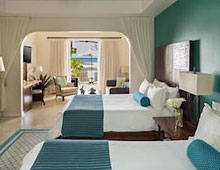
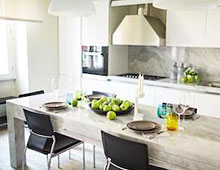
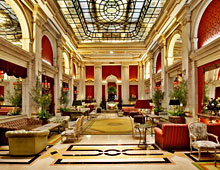
If you’re planning an itinerary in western Sicily, a visit to Erice is an absolute must: we recommend spending at least one night in this splendid village in the Trapani province, in one of the many hotels, bed & breakfasts or apartments housed in historic buildings.
We offer best rates If you find it cheaper we refund the price difference.
Free cancellation Most properties allow cancellation without penalty.
We're available 24 hours a day For any problem call Booking.com.
 Hotel
Hotel 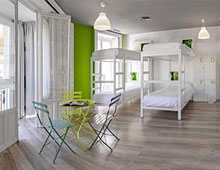 Budget accommodations
  Apartments
  Family Hotel
  Luxury Hotel
  Resorts