Hotel Carlton
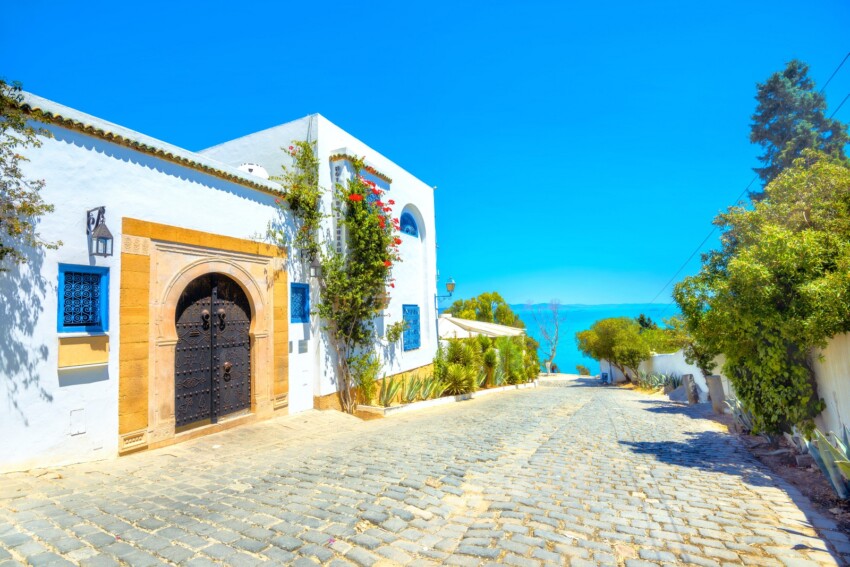
Less than 150 kilometres from Sicily’s southern coast, Tunisia is Africa’s closest destination to Europe and one of the Mediterranean basin’s most captivating destinations. The first African country easily reached by sea from Sicily, this former French protectorate boasts exceptional historical layering: world-class Punic and Roman ruins, Islamic medinas designated as UNESCO World Heritage Sites, Saharan oases and a coastline stretching over 1,300 kilometres dotted with some of the Mediterranean’s finest sandy beaches.
The geographical proximity to Sicily is more than just a matter of distance: profound historical ties between the two shores of the Strait of Sicily stretch back to antiquity. Carthage, the powerful Phoenician city-state founded in the 9th century BC near present-day Tunis, was Rome’s principal rival for centuries and maintained intense commercial relations with Sicily. Today, the cultural and gastronomic affinities between Sicilian and Tunisian cuisine remain evident in their shared use of almonds, raisins, saffron and oriental spices—a legacy of shared history shaped by Arab, Norman and Spanish rule.
Whether you choose a weekend in Tunis to explore the medina and the ruins of Carthage, or a longer stay to venture into the Sahara Desert and the oases of Tozeur, Tunisia offers a range of experiences that can scarcely be compressed into a single visit. Its proximity to Sicily—reached by ferry from Palermo or by plane from Catania—makes it one of the most natural additions to a Sicilian itinerary.
Tunisia is a country of extraordinary contrasts, where the modern city coexists with the medieval medina, azure sea blends into ochre desert and Roman remains emerge among palm trees. Below are the unmissable destinations, selected for historical depth, landscape uniqueness and tourist appeal.
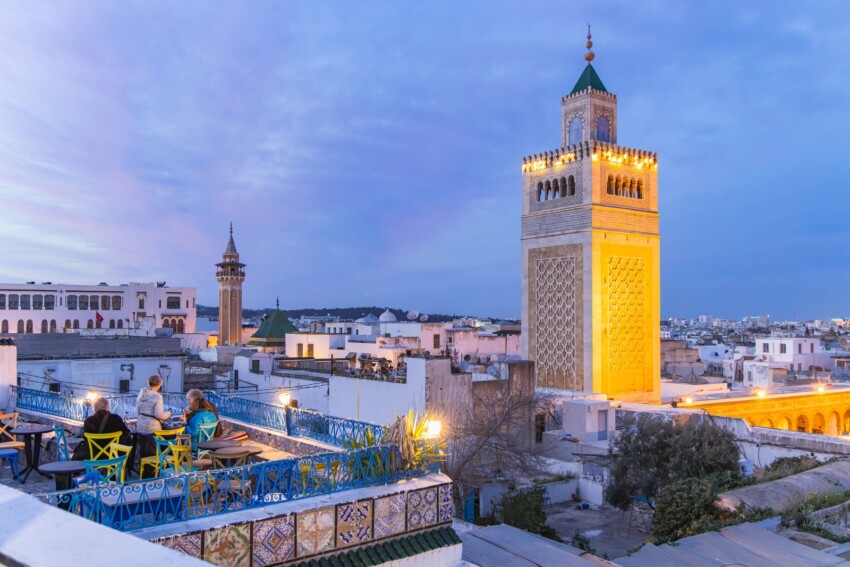
Tunisia’s capital is a dual city: on one side the ville nouvelle built by the French in the 19th century, with its tree-lined avenues and open-air cafés; on the other the medina of Tunis, designated a UNESCO World Heritage Site in 1979, a labyrinth of covered alleyways, artisan souks and white mosques spanning approximately 270 hectares with over 700 classified historical monuments.
The heart of the medina is the Great Zitouna Mosque, founded in 732 AD, one of the most important places of worship and learning in the medieval Islamic world. Around it radiate specialised souks organised by merchandise category—the goldsmiths’ souk, the textile souk, the spice souk—much as they were in the Middle Ages. Not far from the medina lie the National Museum of the Bardo, which houses one of the world’s largest collections of Roman mosaics, and the Sidi Bou Saïd quarter, the picturesque village of white houses and blue doors perched on a cliff 20 kilometres from the centre, which became a haunt for European artists and intellectuals in the 20th century.
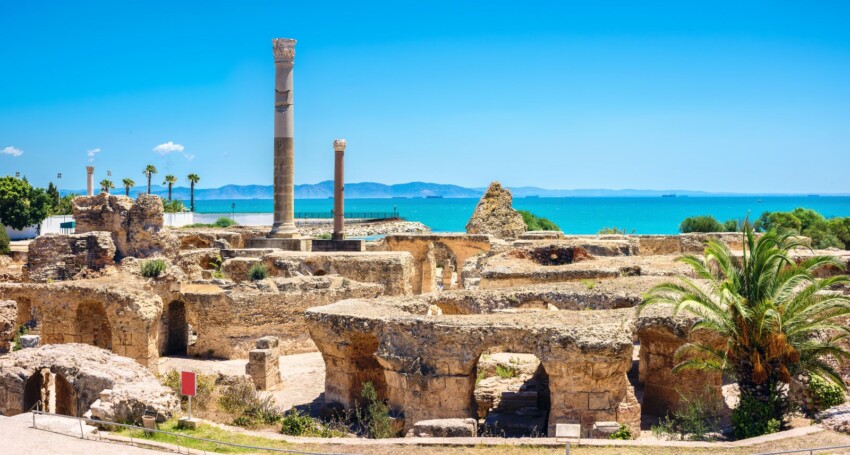
Founded, according to tradition, by the Phoenician queen Dido in 814 BC, Carthage was for centuries the most powerful city in the western Mediterranean, with over 700,000 inhabitants at the height of its splendour. Destroyed by Rome in 146 BC at the end of the Third Punic War and later rebuilt as a Roman city, its remains lie today in a residential area on the north outskirts of Tunis, approximately 17 kilometres from the centre.
The archaeological site, also a UNESCO World Heritage Site, includes the Punic Quarters of Byrsa, the Antonine Baths—among the largest in the Roman Empire after those of Caracalla in Rome—the Tophet, the controversial Phoenician sanctuary, and the circular military harbour of which the shape survives in the present-day lagoon. The National Museum of Carthage, on Byrsa Hill, houses the site’s principal finds and provides an overview of both Carthages, the Punic and the Roman.
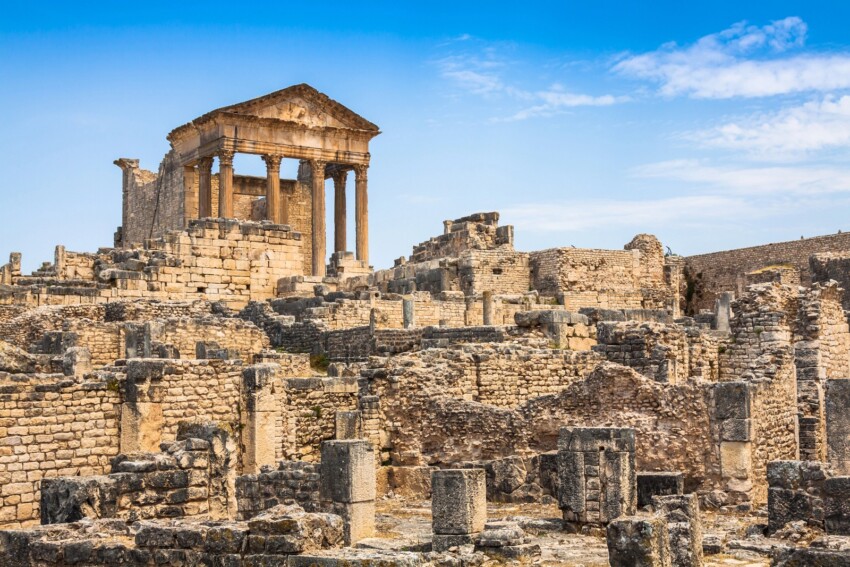
Dougga is considered the best-preserved Roman site in North Africa and one of the most intact in the entire Mediterranean basin. Situated about 110 kilometres south-west of Tunis, on a hillside plateau commanding expansive views of the valley below, the city occupies 70 hectares and preserves structures of exceptional quality: a 2nd-century AD Roman theatre with an original capacity of 3,500 spectators still used today for summer performances, the Capitol with its three chambers dedicated to Jupiter, Juno and Minerva, the baths, forum and over a hundred identified buildings.
What sets Dougga apart from other North African sites is the layering of the pre-existing Numidian city and subsequent Roman urbanisation, still legible today in the irregular structure of the urban fabric. The site has been a UNESCO World Heritage Site since 1997 and can be visited independently; its distance from the sea and mass tourism circuits ensures a rarely crowded visit.
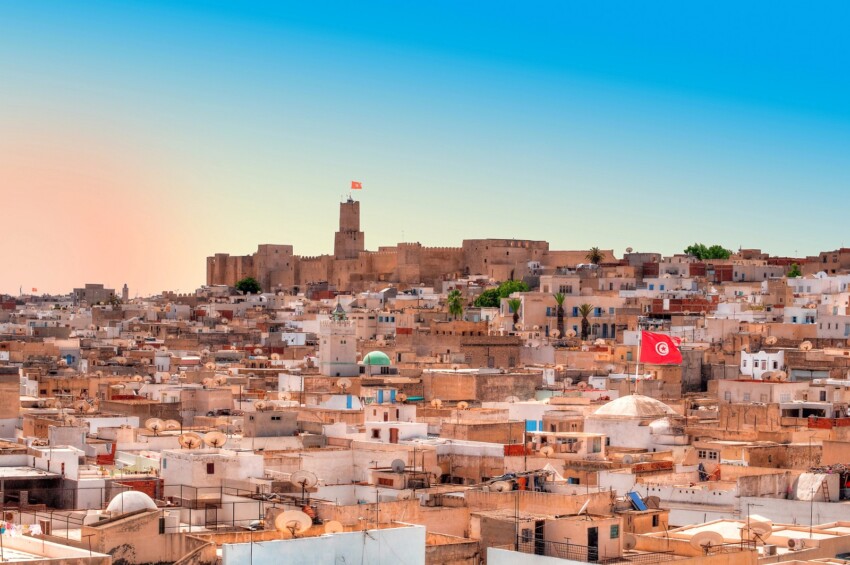
Sousse, 140 kilometres south of Tunis, is the country’s third city and one of the best-preserved Islamic historic centres in the Maghreb. Its medina—another UNESCO inscription—is encircled by 8th-9th-century walls and overlooks the port with the Ribat of Sousse, a medieval monastic fortress whose towers offer one of the finest panoramic views of Tunisia’s coast. Within the walls lie the Great Mosque, the Archaeological Museum with its extraordinary collection of late antique mosaics, and a network of commercial alleyways that have remained substantially unchanged since the Aghlabid period.
Sousse is also the main gateway to the tourist zone of Port El Kantaoui, a purpose-built marina developed in the Seventies and surrounded by resorts and golf courses. For those seeking authenticity, just 12 kilometres to the north lies El Djem, a small town that preserves one of the world’s largest and best-preserved Roman amphitheatres, with a capacity of 35,000 spectators, surpassing the Colosseum in the ratio of size to preservation.
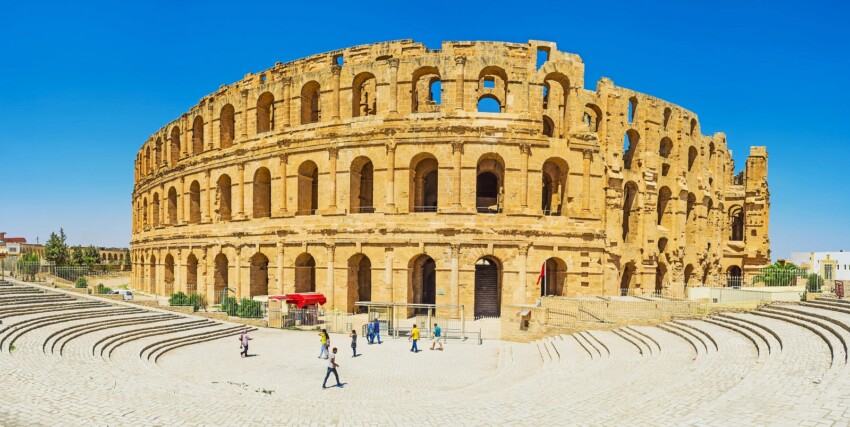
The Amphitheatre of El Djem, constructed in the 3rd century AD and designated a UNESCO World Heritage Site in 1979, is Africa’s most imposing Roman monument and the third-largest amphitheatre in the entire Empire after the Colosseum and that of Capua. What makes El Djem particularly extraordinary is its location: it rises in the middle of a flat plain, in a small town of 20,000 inhabitants, with no monumental urban context around it, which amplifies its scenic presence in an almost surreal way.
The structure survives to three-quarters of its original height, and the underground chambers—the galleries where gladiators and animals were kept before spectacles—are accessible and in excellent condition. Adjacent to the amphitheatre lie the remains of a second, older amphitheatre and the Archaeological Museum of El Djem, which displays mosaics from Roman villas in the area, among the most refined in Tunisia.
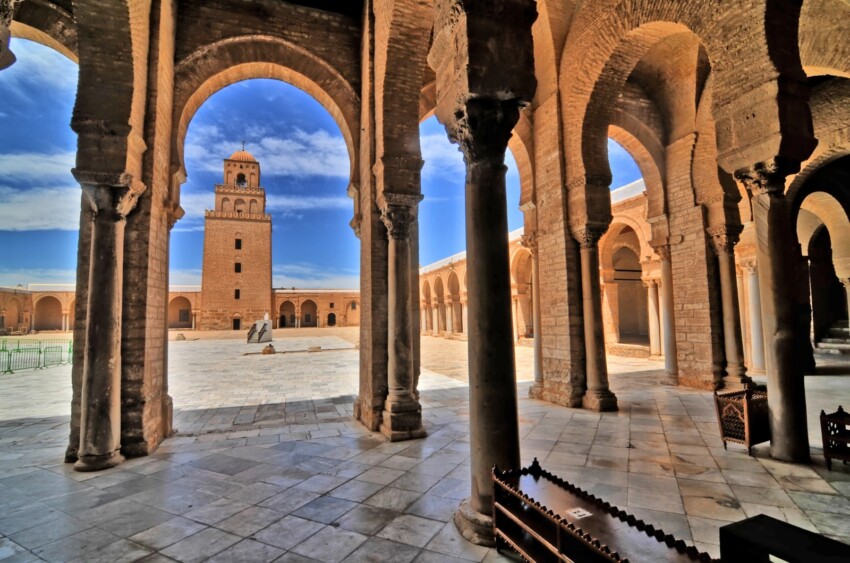
Kairouan is the fourth holiest city in Islam after Mecca, Medina and Jerusalem, and the most important in North Africa. Founded by the Arabs in 670 AD as a military base for the conquest of the Maghreb, it became, in the 9th century under the Aghlabid dynasty, one of the cultural and religious capitals of the Islamic world. Its historic centre, entirely inscribed on the UNESCO list, is dominated by the Great Mosque of Kairouan, the oldest mosque in sub-Saharan Africa still in use, with its celebrated three-storey minaret dating to 836 AD.
Kairouan is also a premier centre of craftsmanship: its Berber carpets, woven by hand according to techniques passed down through generations, are considered among the world’s finest and are sold in workshops around the medina. The city is also renowned for makroudh, traditional sweet pastries made from semolina, dates and fried honey, found fresh in the bakeries of the old town.
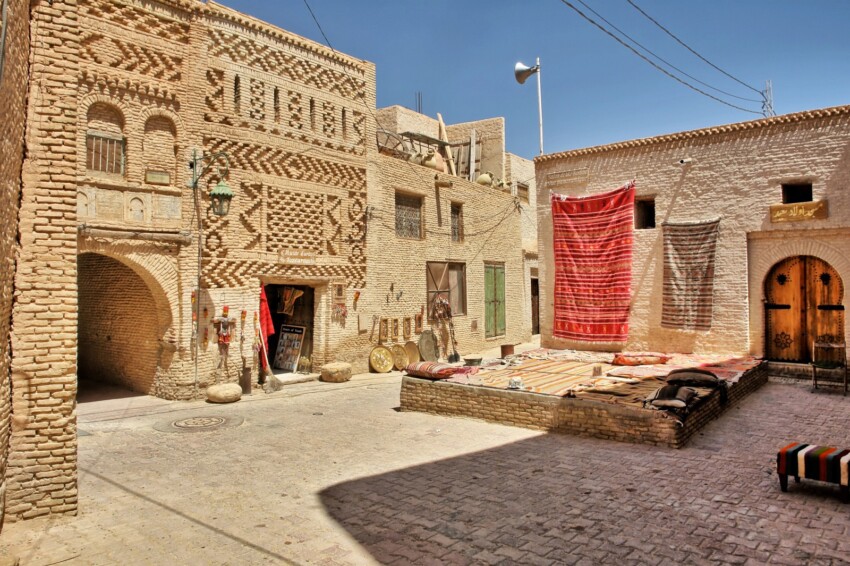
Tozeur, in the heart of southern Tunisia, is the main gateway to the Sahara Desert and the country’s major oases. The town sits at the edge of Chott el-Djerid, North Africa’s largest salt lake, an immense glittering white expanse that changes colour with the light and produces spectacular mirages in the heat of the day. Driving across it, you find yourself in an alien landscape, completely devoid of vegetation, which leaves a mark hard to forget.
From the Tozeur oasis—400,000 date palms cultivated in a lattice of irrigation channels dating back to the Middle Ages—four-wheel drive excursions are organised to the dunes of Ong Jemal, the rock formations of Tamerza and the waterfalls of Mides, or to the Star Wars film sets shot in the area in the Seventies and still preserved today. About 90 kilometres from Tozeur, Douz is the traditional starting point for camel-back desert expeditions.
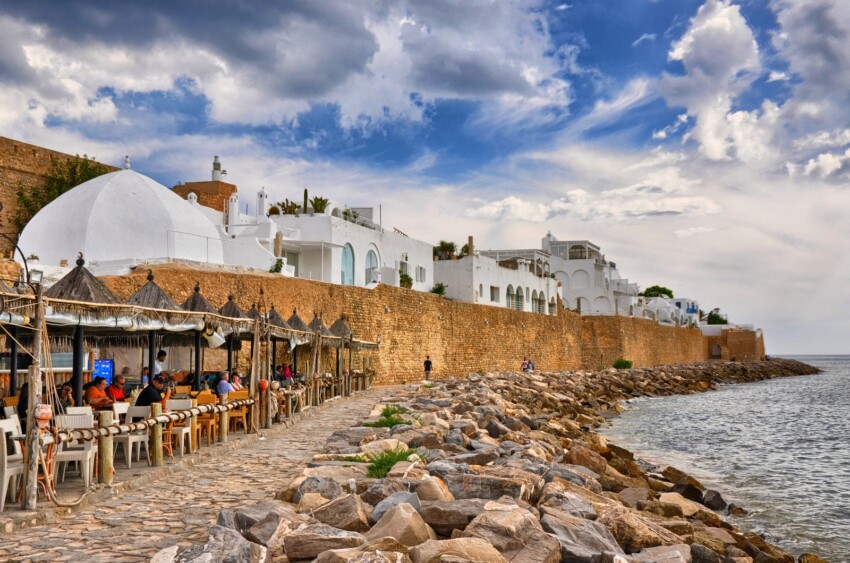
Hammamet, 60 kilometres south of Tunis, is Tunisia’s premier seaside resort and one of the first mass-tourism destinations in the Maghreb, developed from the Sixties onwards thanks to its fine sandy beaches and the calm waters of Hammamet Gulf. The old town—the medina with its 14th-century casbah—still retains an authentic atmosphere, with craftspeople and small cafés within the walls, in stark contrast to the Yasmine Hammamet tourist zone, a purpose-built resort complex with water parks and hospitality facilities erected in the Nineties.
Hammamet’s seafront is flanked by one of Tunisia’s most well-maintained beaches, with clear sand and shallow waters for several metres. The town is also historically linked to André Gide and other European intellectuals who stayed here in the early 20th century, drawn by North African light and the tranquillity of the citrus gardens.
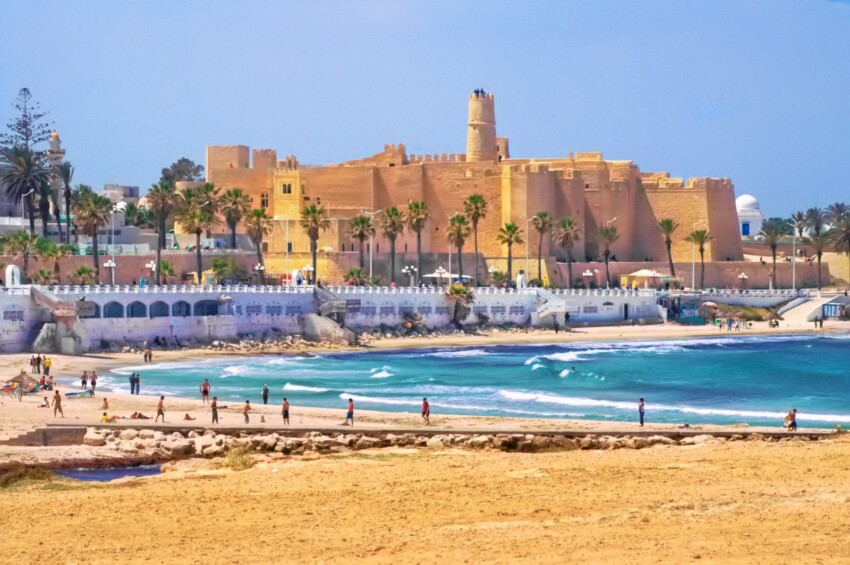
With over 1,300 kilometres of coastline stretching from the Gulf of Tunis to the Libyan border, Tunisia offers some of the most varied and beautiful beaches in the southern Mediterranean: long equipped sandy shores, isolated coves accessible only by sea and nearly deserted islands where the sand is so fine it was historically used for glassmaking.
The island of Djerba, connected to the mainland by a causeway of Roman origin, is the country’s most celebrated beach destination. Its north-eastern coast—the so-called Tourist Zone—hosts a long succession of white sandy beaches with shallow warm waters, ideal for families. But Djerba is also an island of religious coexistence: Jews, Muslims and Christians have lived here for centuries, and the Ghriba Synagogue, traditionally dating back to the 6th century BC, is Africa’s oldest Jewish place of worship.
On the country’s eastern coast, the beaches stretching from Hammamet to Mahdia via Monastir and Sousse form a continuous sandy beach strip with clear sand and relatively calm seas, protected from northern winds by the Cape Bon Peninsula. Mahdia in particular retains a compact medina on a promontory and less-frequented beaches than the major tourist centres, with a more authentic atmosphere. To the north, Cape Bon Peninsula offers lesser-known alternatives: Kelibia, with its imposing Aragonese castle on the headland and the beach below, and the transparent waters of El Haouaria at the peninsula’s far tip, much frequented by divers for exceptional visibility.
Tunisia’s accommodation options are remarkably diverse and primarily geared towards mass beach tourism, with large all-inclusive resorts concentrated in tourist hotspots such as Hammamet, Sousse, Monastir and Djerba. These establishments offer excellent value for money compared with their European counterparts, complete with pools, private beaches and entertainment programmes, but they tend to insulate visitors from local life.
For those seeking a more authentic experience, Tunis boasts a growing number of boutique hotels housed in restored medina palaces — the so-called riads — featuring internal courtyards, tilework and intricately carved wooden furnishings that offer a completely different experience from beach resorts. Their central location means you can walk to the medina, the Bardo Museum and transport links to Carthage and Sidi Bou Said.
In Djerba, alongside the large complexes in the Midoun tourist zone, you’ll also find traditional farmhouses — menzels — and small family-run hotels in Houmt Souk, the island’s main town, which allow for a slower pace and the chance to explore inland villages. For those venturing into the desert, Tozeur offers lodges and eco-resorts nestled within palm groves and fixed campsites among the dunes, complete with equipped Berber tents that guarantee essential comfort within an extraordinary landscape.
Tunisia is accessible from Sicily via two main routes — ferry and plane — both convenient and frequent, particularly during the summer season. The geographical proximity means your options are competitive in terms of both time and cost compared with many European destinations.
The most direct sea crossing is the Palermo–Tunis route, operated by Grimaldi Lines and CTN (Compagnie Tunisienne de Navigation) with regular departures year-round. The crossing takes approximately 10–11 hours and typically runs overnight, departing in the evening and arriving the following morning at La Goulette port, Tunis’s harbour, just a few kilometres from the city centre. The Genoa or Civitavecchia–Tunis route is also available for those not departing from Sicily.
Getting from Palermo airport to Palermo port takes approximately 35 minutes by taxi or via the Prestia e Comandé bus service. From Palermo, the ferry is the most scenic and practical choice for those wishing to take a car to Tunisia — essential for exploring the country beyond the main tourist circuits.
The quickest alternative is a direct flight to Tunis-Carthage International Airport (IATA code: TUN) or to the airports at Monastir (MIR) and Djerba (DJE), which serve the main beach resorts directly. Airlines including Ryanair, Vueling and Tunisair operate seasonal routes from Catania airport and Palermo to these destinations, with flight times between 60 and 90 minutes. Direct flights to Djerba from Sicily are particularly frequent in summer and represent the ideal solution for a beach holiday.
Once in Tunisia, the intercity bus network (SNTRI) and louages — shared taxis running fixed routes, an extremely popular transport method among Tunisians — cover the entire country at very reasonable prices. For exploring inland Roman sites, southern oases and medinas off the beaten track, car hire remains the most flexible option. Main roads are in good condition, signage is bilingual in Arabic and French, and many signs also include Latin transliteration. The A1 motorway connects Tunis to Sfax via Sousse in approximately two and a half hours.
Tunisia sits on the Mediterranean in central Maghreb, bordered by Algeria to the west and Libya to the south-east. It lies approximately 140 km from Sicily's coastline: Palermo is the natural departure port, whilst Trapani and Agrigento are located 170 and 220 km respectively from the Tunisian coast.
 Hotel
Hotel 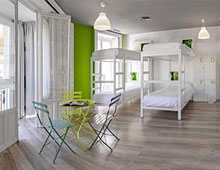 Budget accommodations
 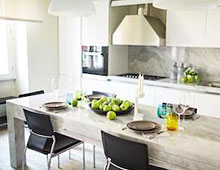 Apartments
  Family Hotel
 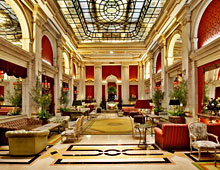 Luxury Hotel
 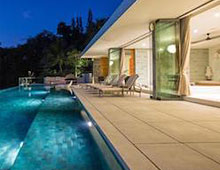 Resorts